
Question 41 markMCQEasy
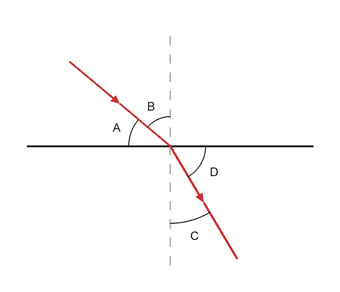
The diagram given below shows light travelling from air into glass. Four angles A, B, C and D are shown. Which of the following formulae is used to calculate the refractive index of the glass ?
Confirming your payment
Sign up now and get 250 free tokens.
Refraction of Light at Plane Surfaces · Question 4 of 139
The diagram given below shows light travelling from air into glass. Four angles A, B, C and D are shown. Which of the following formulae is used to calculate the refractive index of the glass ?
(A)
(B)
(C)
(D)
Answer: (C)
Concept: Snell's law: for light going from medium 1 into medium 2, sin i ÷ sin r = ₁μ₂, a constant called the refractive index of medium 2 with respect to medium 1. Here i is the angle of incidence and r the angle of refraction, both measured from the normal. Angles of incidence and refraction are measured from the normal, never from the surface.
Step 1 — Pick the angle of incidence.
B lies between the incident ray and the normal, so B is the angle of incidence i. (A lies between the incident ray and the surface.)
Step 2 — Pick the angle of refraction.
C lies between the refracted ray and the normal, so C is the angle of refraction r. (D lies between the refracted ray and the surface.)
Step 3 — Write Snell's law with these angles.
We replace i by B and r by C in Snell's law.
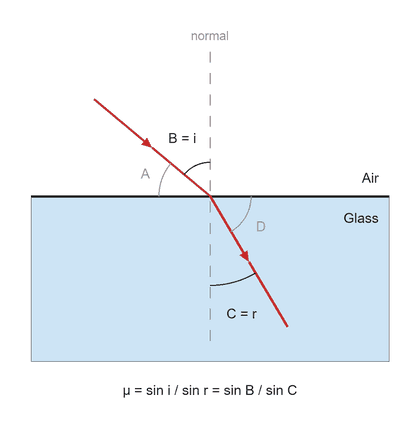
Watch out: Angles of incidence and refraction are measured from the normal, never from the surface.
Why the other options are wrong:
Therefore, μ = sin B ÷ sin C, option (C).