
Question 1394 marksMedium
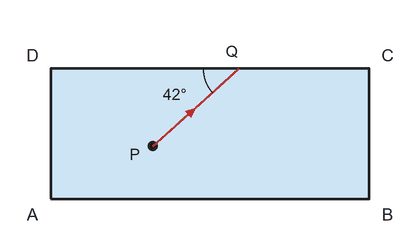
The diagram given below shows a light source P embedded in a rectangular glass block ABCD of critical angle . Complete the path of ray PQ till it emerges out of the block. [Write necessary angles]
Confirming your payment
Sign up now and get 250 free tokens.
Refraction of Light at Plane Surfaces · Question 139 of 139
The diagram given below shows a light source P embedded in a rectangular glass block ABCD of critical angle . Complete the path of ray PQ till it emerges out of the block. [Write necessary angles]
Solution:
Concept: Total internal reflection happens when light goes from a denser to a rarer medium and meets the surface at an angle of incidence greater than the critical angle. Then no light is refracted out: all of it is reflected back into the denser medium, obeying the laws of reflection. Angles of incidence and refraction are measured from the normal, never from the surface.
Step 1 — At Q on face DC.
PQ makes 42° with the surface, so its angle of incidence is
This is more than 42°, so the ray is totally internally reflected, leaving Q at 48° on the other side of the normal.
Step 2 — At face BC.
The normal to BC is parallel to DC, so the reflected ray meets BC at
This equals the critical angle, so it refracts at 90° and emerges grazing along the face BC.
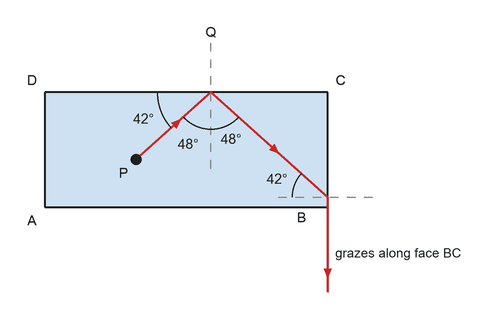
Watch out: The 42° marked at Q is the angle with the surface; the angle of incidence is 48°.
Therefore, the ray is totally reflected at Q (i = 48°) and then emerges grazing along BC (i = 42°, r = 90°).