Solution:
Concept: Here i is the angle in glass and r the angle in air, because gμa = sin i ÷ sin r describes light going from glass into air. Reversing the light reverses the ratio.
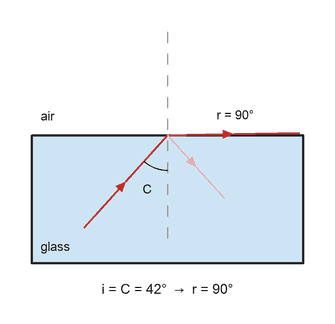
The critical angle C is the angle of incidence in the denser medium for which the angle of refraction in the rarer medium is 90° (the refracted ray grazes the surface). It is given by sin C = 1/μ; it is about 42° for glass (μ of 1.5) and about 48° to 49° for water (μ of 4/3).
(a)
Step 1 — Use the principle of reversibility.
aμg is the reciprocal of gμa.
aμg=gμa1=sinisinr
(b)
Step 2 — Name the angle.
The angle i in glass for which r is 90° is the critical angle C for the glass–air surface.
(c)
Step 3 — Its significance.
It marks the limit for light to leave the glass: if the angle of incidence in glass becomes greater than C, the light cannot refract into air at all and is totally internally reflected. With r = 90°, part (a) gives
aμg=sinC1
Therefore, (a) aμg = sin r ÷ sin i, (b) i is the critical angle, and (c) for angles of incidence above it, light is totally internally reflected.
