Solution:
Concept: All three rays go from water (denser) to air (rarer), so what happens depends only on how each angle of incidence compares with the critical angle, 48°.
(a) Paths of the rays
Step 1 — Ray A.
Its angle of incidence is about 10° (read from the figure), less than 48°. It refracts into air, bending away from the normal (to about 13°).
Step 2 — Ray B.
Its angle of incidence is 48°, equal to the critical angle. It refracts at 90° and grazes along the surface.
Step 3 — Ray C.
Its angle of incidence is about 60°, more than 48°. It is totally reflected back into the water at an equal angle (60°).
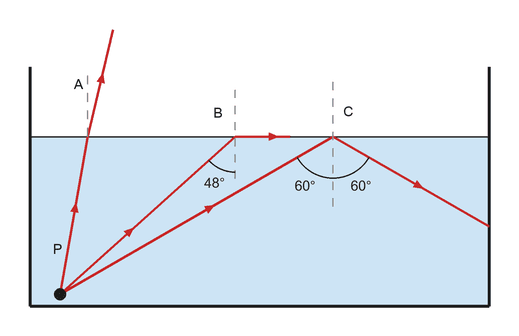
(b) Phenomena
Step 4 — Name them.
A shows refraction (denser to rarer); B shows refraction at the critical angle (grazing emergence); C shows total internal reflection.
Therefore, A refracts out, B grazes the surface, and C is totally internally reflected.

