Solution:
Concept: The critical angle C is the angle of incidence in the denser medium for which the angle of refraction in the rarer medium is 90° (the refracted ray grazes the surface). It is given by sin C = 1/μ; it is about 42° for glass (μ of 1.5) and about 48° to 49° for water (μ of 4/3). An object inside a denser medium, seen from the rarer medium (air) along the normal, appears raised: light from it bends away from the normal on leaving, and the eye traces the rays straight back.
(a)
Step 1 — Name the angle.
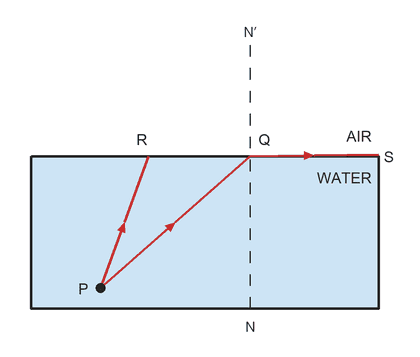
The refracted ray QS lies along the water surface, so its angle of refraction is 90°. ∠PQN is therefore the critical angle for the water–air surface.
(b)
Step 2 — Angle of refraction.
QS grazes the surface, so the angle of refraction is 90°.
(c)
Step 3 — Increase ∠PQN.
If ∠PQN is increased beyond the critical angle, PQ is reflected back entirely into the water: total internal reflection.
(d)
Step 4 — Why PR is partly reflected.
PR meets the surface at an angle of incidence less than the critical angle. For i < C most of the light is refracted into air, while a small part is reflected back into the water.
(e)
Step 5 — Find P′.
The ray PR refracts into air, bending away from the normal. Produced backward, it meets the vertical line through P at P′, above P. This is the image of P seen from above: the object appears raised.
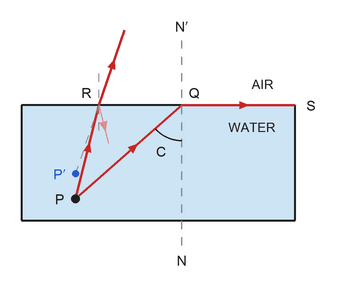
Therefore, ∠PQN is the critical angle, QS is refracted at 90°, a larger angle gives total internal reflection, PR is partly reflected because i < C, and P′ lies above P.