Refraction of Light at Plane Surfaces · Question 44 of 139
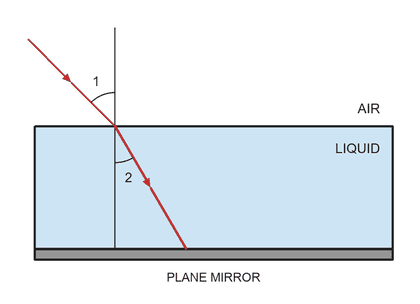
A ray of green light enters a liquid from air, as shown in Fig. 4.21. Angle 1 is 45^° and angle 2 is 30^° .
Question 445 marksMedium
A ray of green light enters a liquid from air, as shown in Fig. 4.21. Angle 1 is 45∘ and angle 2 is 30∘.
(a) Find the refractive index of the liquid.
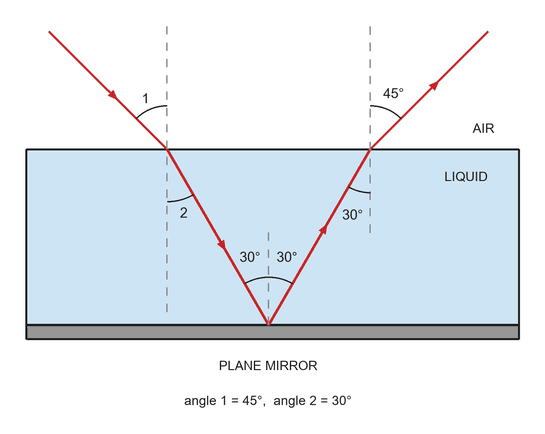
(b) Show in the diagram the path of the ray after it strikes the mirror and re-enters in air. Mark in the diagram the angles wherever necessary.
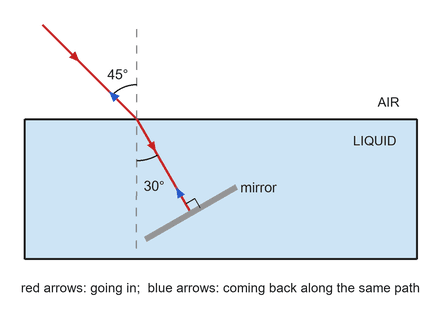
(c) Redraw the diagram if plane mirror becomes normal to the refracted ray inside the liquid. State the principle used.
Solution:
Concept: Angle 1 is the angle of incidence and angle 2 the angle of refraction at the liquid surface. Snell's law: for light going from medium 1 into medium 2, sin i ÷ sin r = ₁μ₂, a constant called the refractive index of medium 2 with respect to medium 1. Here i is the angle of incidence and r the angle of refraction, both measured from the normal. At the mirror the law of reflection holds, and the principle of reversibility says that a ray sent back along its path retraces it exactly.
(a) Refractive index of the liquid
Step 1 — Apply Snell's law.
Here i = 45° and r = 30°.
μ=sin30∘sin45∘=1/21/2=2≈1.41
(b) Path after the mirror
Step 2 — Reflection at the mirror.
The normals at the liquid surface and at the horizontal mirror are both vertical, so the refracted ray meets the mirror at 30° to its normal and is reflected at 30°.
Step 3 — Refraction back into air.
The reflected ray reaches the surface at an angle of incidence of 30° and goes from the liquid into air, bending away from the normal.
sinee=2×sin30∘=21=45∘
The ray emerges into air at 45° to the normal.
(c) Mirror normal to the refracted ray
Step 4 — Reflection along the normal.
The refracted ray now falls on the mirror along its normal, so it is reflected straight back along its own path. It reaches the surface at 30°, refracts into air at 45°, and leaves along the original incident ray in the reverse direction.
Step 5 — Principle used.
This is the principle of reversibility of the path of light: if a ray is reversed, it retraces its path exactly.
Watch out: The angle of incidence at the mirror is measured from the mirror's normal (vertical here), not from the mirror.
Note: the stem's misprint "digaram" is corrected to "diagram".
Therefore, (a) μ = √2 ≈ 1.41; (b) the ray reflects at 30° and leaves the liquid at 45°; (c) it retraces its path, by the principle of reversibility.