
Question 811 markMCQEasy
An object in a denser medium when viewed from a rarer medium appears to be raised. The shift is maximum for :
Confirming your payment
Sign up now and get 250 free tokens.
Refraction of Light at Plane Surfaces · Question 81 of 139
An object in a denser medium when viewed from a rarer medium appears to be raised. The shift is maximum for :
(A) red light
(B) violet light
(C) yellow light
(D) green light.
Answer: (B) violet light
Concept: An object inside a denser medium, seen from the rarer medium (air) along the normal, appears raised: light from it bends away from the normal on leaving, and the eye traces the rays straight back. For viewing from vertically above, μ = real depth ÷ apparent depth. The object appears raised by the shift (real depth − apparent depth), which works out as t(1 − 1/μ) for real depth t. The refractive index of a medium depends on the colour (wavelength) of light: it is greatest for violet (shortest wavelength) and least for red (longest wavelength). So violet light travels slowest in glass and bends the most.
Step 1 — See what controls the shift.
The shift is t(1 − 1/μ), so a larger μ gives a larger shift.
Step 2 — Pick the colour.
μ is greatest for violet light, so 1/μ is smallest and the shift is the greatest. Violet light bends the most on leaving, so its image is the highest.
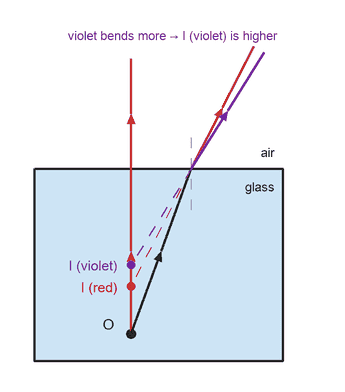
Why the other options are wrong:
Therefore, the shift is maximum for violet light, option (B).