
Opening your dashboard
Class 10 Chemistry Chapter 5: Mole Concept and Stoichiometry Solutions
159 textbook questions with step-by-step answers, free to read, for ICSE 2026-27.
Get talked through Ch 5, not just shown the answer
Reading a finished solution is not the same as being able to do it. The AI tutor takes one question at a time and works it with you, in your own words, until you can.
- Ask it out loud, in your own words
- It gives you the next step, not the answer
- Stuck on part (ii)? Start there
159 questions with solutions
1–5 marks · Mixed difficulty
The first 56 solutions are on this page. This chapter is a long one, so the rest open on their own page to keep this one quick to load.
- 14 marks
Question 1
(a) Calculate the volume of oxygen at STP required for the complete combustion of 100 litres of carbon monoxide at the same temperature and pressure.
(b) 200 cm³ of hydrogen and 150 cm³ of oxygen are mixed and ignited, as per the following reaction,
What volume of oxygen remains unreacted ?
Solve with AIWritten solution
Solution:
Concept: Gay-Lussac's law of combining volumes: when gases react, they do so in volumes that bear a simple whole-number ratio to one another and to the volumes of any gaseous products, all measured at the same temperature and pressure. The ratio is read from the coefficients of the balanced equation.
Step 1 — (a) Read the volume ratio.
The balanced equation shows that 2 volumes of carbon monoxide react with 1 volume of oxygen to give 2 volumes of carbon dioxide.
So the oxygen needed is half the volume of carbon monoxide.
Step 2 — (a) Find the oxygen needed.
We take half of 100 litres, because the ratio CO : O₂ is 2 : 1.
Step 3 — (b) Find which gas is in excess.
From the equation, 2 volumes of hydrogen react with 1 volume of oxygen.
So 200 cm³ of hydrogen needs only half its volume of oxygen:
Since 150 cm³ of oxygen is present, all the hydrogen reacts and oxygen is left over.
Step 4 — (b) Find the oxygen left.
We subtract the oxygen used from the oxygen taken.

Watch out: In (b) first find which gas runs out (the limiting gas). Here hydrogen is used up, so the leftover gas is oxygen.
Therefore, (a) 50 litres of oxygen are required, and (b) 50 cm³ of oxygen remains unreacted.
- 22 marks
Question 2
24 cc Marsh gas () was mixed with 106 cc oxygen and then exploded. On cooling, the volume of the mixture became 82 cc, of which, 58 cc was unchanged oxygen. Which law does this experiment support? Explain with calculations.
Solve with AIWritten solution
Solution:
Concept: Gay-Lussac's law of combining volumes: when gases react, they do so in volumes that bear a simple whole-number ratio to one another and to the volumes of any gaseous products, all measured at the same temperature and pressure. The ratio is read from the coefficients of the balanced equation.
Step 1 — Write the balanced equation.
Methane burns in oxygen to give carbon dioxide and water:
So 1 volume of methane reacts with 2 volumes of oxygen and gives 1 volume of carbon dioxide (1 : 2 : 1). On cooling, the water becomes a liquid and takes up no gas volume.
Step 2 — Find the oxygen used.
Each volume of methane uses two volumes of oxygen.
Step 3 — Find the oxygen left.
We subtract the oxygen used from the 106 cc taken.
Step 4 — Find the carbon dioxide formed.
Each volume of methane gives one volume of carbon dioxide, so 24 cc of methane gives 24 cc of carbon dioxide.
Step 5 — Compare with the experiment.
The calculated volume after cooling is the oxygen left plus the carbon dioxide formed.
This matches the experiment exactly: 82 cc in all, of which 58 cc is unchanged oxygen.
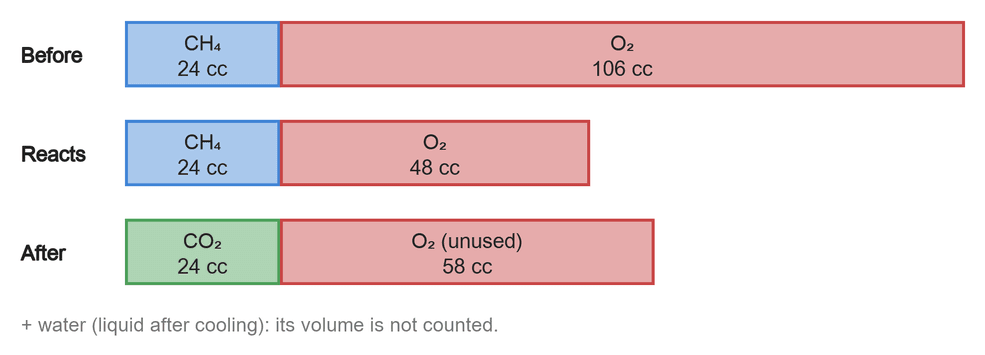
Watch out: Water formed in these reactions condenses to a liquid on cooling, so it has no gas volume; never add its coefficient to the gas volumes.
Therefore, the experiment supports Gay-Lussac's law of combining volumes: methane, oxygen and carbon dioxide react in the simple volume ratio 1 : 2 : 1.
- 32 marks
Question 3
What volume of oxygen would be required to burn completely 400 mL of acetylene [] ? Also, calculate the volume of carbon dioxide formed.
Solve with AIWritten solution
Solution:
Concept: Gay-Lussac's law of combining volumes: when gases react, they do so in volumes that bear a simple whole-number ratio to one another and to the volumes of any gaseous products, all measured at the same temperature and pressure. The ratio is read from the coefficients of the balanced equation.
Step 1 — Read the volume ratio.
The balanced equation gives the ratio of the gas volumes.
So acetylene : oxygen : carbon dioxide = 2 : 5 : 4 by volume. Water is a liquid, so it is not counted.
Step 2 — Find the oxygen required.
Every 2 volumes of acetylene need 5 volumes of oxygen, so we multiply by 5/2.
Step 3 — Find the carbon dioxide formed.
Every 2 volumes of acetylene give 4 volumes of carbon dioxide, so we multiply by 4/2.

Watch out: Multiply by the ratio (needed ÷ given) from the equation, not by the coefficient alone; here 5/2, not 5.
Therefore, 1000 mL of oxygen is required, and 800 mL of carbon dioxide is formed.
- 44 marks
Question 4
112 cm³ of is mixed with 120 cm³ of at STP to produce and sulphur(s). Write a balanced equation for this reaction and calculate (i) the volume of gaseous product formed (ii) composition of the resulting mixture.
Solve with AIWritten solution
Solution:
Concept: Gay-Lussac's law of combining volumes: when gases react, they do so in volumes that bear a simple whole-number ratio to one another and to the volumes of any gaseous products, all measured at the same temperature and pressure. The ratio is read from the coefficients of the balanced equation. Solids such as sulphur have almost no volume compared with gases, so they are not counted.
Step 1 — Write the balanced equation.
Hydrogen sulphide reacts with chlorine to give hydrogen chloride gas and solid sulphur:
So 1 volume of H₂S reacts with 1 volume of Cl₂ to give 2 volumes of HCl.
Step 2 — Find the limiting gas.
Since the ratio H₂S : Cl₂ is 1 : 1, the 112 cm³ of H₂S needs only 112 cm³ of chlorine. As 120 cm³ of chlorine is present, all the H₂S reacts and chlorine is in excess.
Step 3 — (i) Find the volume of HCl formed.
Each volume of H₂S gives two volumes of HCl.
Step 4 — (ii) Find the chlorine left.
We subtract the chlorine used from the chlorine taken.
So the gas mixture left is 224 cm³ of HCl and 8 cm³ of Cl₂ (232 cm³ in all), and solid sulphur is deposited.
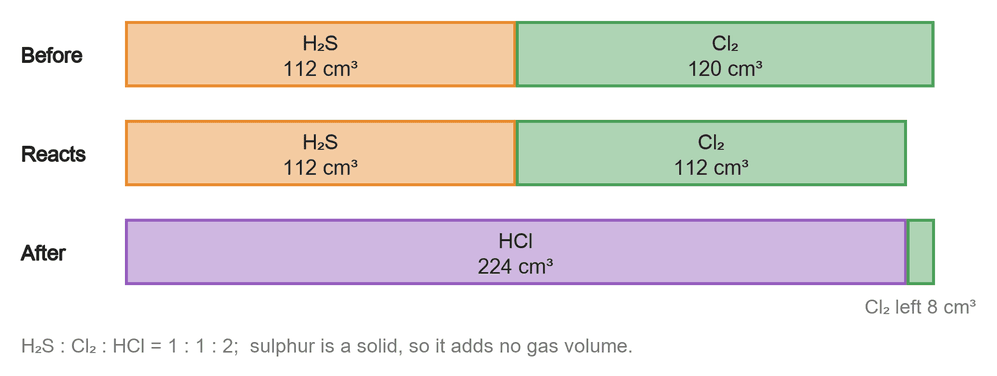
Watch out: The 2 in '2HCl' doubles the volume of HCl, so 112 cm³ of H₂S gives 224 cm³ of HCl, not 112 cm³.
Therefore, the balanced equation is H₂S + Cl₂ → 2HCl + S; (i) 224 cm³ of HCl gas is formed; (ii) the resulting mixture is 224 cm³ of HCl and 8 cm³ of unreacted chlorine (with solid sulphur).
- 52 marks
Question 5
1250 cc of oxygen was burnt with 300 cc of ethane []. Calculate the volume of unused oxygen and the volume of carbon dioxide formed :
Solve with AIWritten solution
Solution:
Concept: Gay-Lussac's law of combining volumes: when gases react, they do so in volumes that bear a simple whole-number ratio to one another and to the volumes of any gaseous products, all measured at the same temperature and pressure. The ratio is read from the coefficients of the balanced equation.
Step 1 — Read the volume ratio.
The balanced equation gives the ratio of the gas volumes.
So ethane : oxygen : carbon dioxide = 2 : 7 : 4 by volume.
Step 2 — Find the oxygen used.
Every 2 volumes of ethane need 7 volumes of oxygen, so we multiply by 7/2.
Since 1250 cc of oxygen is supplied, all the ethane burns and some oxygen is left.
Step 3 — Find the unused oxygen.
We subtract the oxygen used from the oxygen supplied.
Step 4 — Find the carbon dioxide formed.
Every 2 volumes of ethane give 4 volumes of carbon dioxide.
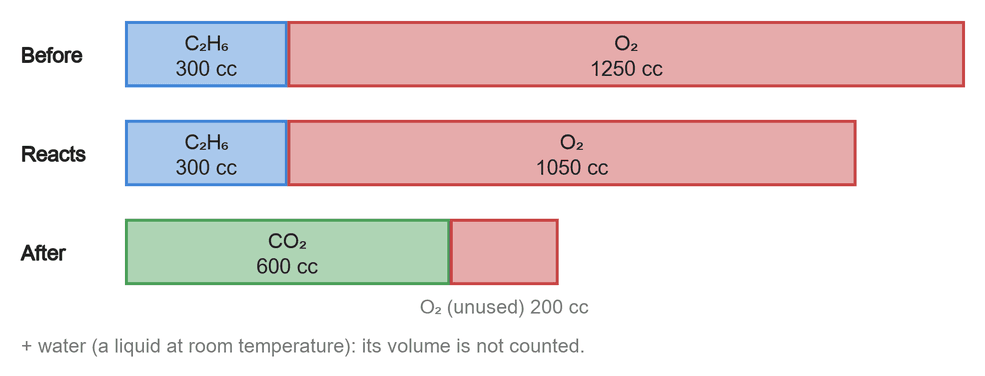
Watch out: The carbon dioxide comes from the ethane (the gas that is used up), not from the oxygen that was supplied.
Therefore, 200 cc of oxygen is unused, and 600 cc of carbon dioxide is formed.
- 62 marks
Question 6
What volume of oxygen at STP is required to affect the combustion of 11 litres of ethylene [] at 273°C and 380 mm of Hg pressure?
Solve with AIWritten solution
Solution:
Concept: Gay-Lussac's law compares gas volumes only at the same temperature and pressure. So we first change the ethylene's volume to S.T.P. (273 K, 760 mm of Hg) with the gas equation , and then use the volume ratio from the equation.
Step 1 — Write down the data.
The ethylene is at 273 °C, which is 273 + 273 = 546 K, and at 380 mm of Hg. S.T.P. means 273 K and 760 mm of Hg.
Step 2 — Rearrange the gas equation.
We need the volume at S.T.P., so we make the subject.
Step 3 — Find the volume of ethylene at S.T.P.
We substitute the values.
Step 4 — Find the oxygen needed.
The equation shows that 1 volume of ethylene needs 3 volumes of oxygen.

Watch out: Do not multiply 11 L by 3 directly; the ethylene is not at S.T.P., so its volume must be converted first. Also change °C to kelvin by adding 273.
Therefore, 8.25 litres of oxygen at S.T.P. are required.
- 72 marks
Question 7
Calculate the volume of HCl gas formed and chlorine gas required when 40 mL of methane reacts completely with chlorine at STP.
Solve with AIWritten solution
Solution:
Concept: Gay-Lussac's law of combining volumes: when gases react, they do so in volumes that bear a simple whole-number ratio to one another and to the volumes of any gaseous products, all measured at the same temperature and pressure. The ratio is read from the coefficients of the balanced equation.
Step 1 — Read the volume ratio.
The balanced equation gives the ratio of the gas volumes.
So methane : chlorine : hydrogen chloride = 1 : 2 : 2 by volume.
Step 2 — Find the HCl formed.
Each volume of methane gives two volumes of HCl.
Step 3 — Find the chlorine required.
Each volume of methane also needs two volumes of chlorine.
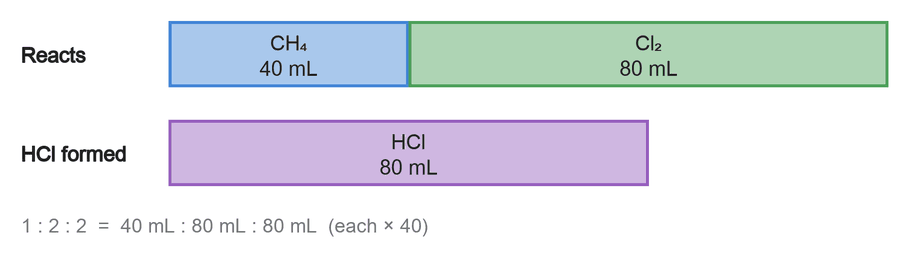
Therefore, 80 mL of HCl gas is formed, and 80 mL of chlorine is required.
- 82 marks
Question 8
What volume of propane is burnt for every 500 cm³ of air used in the reaction under the same conditions ? (Assuming oxygen is 1/5th of air)
Solve with AIWritten solution
Solution:
Concept: Gay-Lussac's law of combining volumes: when gases react, they do so in volumes that bear a simple whole-number ratio to one another and to the volumes of any gaseous products, all measured at the same temperature and pressure. The ratio is read from the coefficients of the balanced equation. Only the oxygen in the air takes part; the rest of the air (mostly nitrogen) does not react.
Step 1 — Find the oxygen in the air.
Oxygen is one-fifth of the air by volume.
Step 2 — Read the volume ratio.
The balanced equation shows that 1 volume of propane burns in 5 volumes of oxygen.
Step 3 — Find the propane burnt.
Since propane needs five times its volume of oxygen, the propane burnt is one-fifth of the oxygen.

Watch out: Use the oxygen (100 cm³), not the whole 500 cm³ of air, in the volume ratio.
Therefore, 20 cm³ of propane is burnt for every 500 cm³ of air.
- 92 marks
Question 9
450 cm³ of nitrogen monoxide and 200 cm³ of oxygen are mixed together and ignited. Calculate the composition of resulting mixture.
Solve with AIWritten solution
Solution:
Concept: Gay-Lussac's law of combining volumes: when gases react, they do so in volumes that bear a simple whole-number ratio to one another and to the volumes of any gaseous products, all measured at the same temperature and pressure. The ratio is read from the coefficients of the balanced equation.
Step 1 — Read the volume ratio.
The balanced equation gives the ratio of the gas volumes.
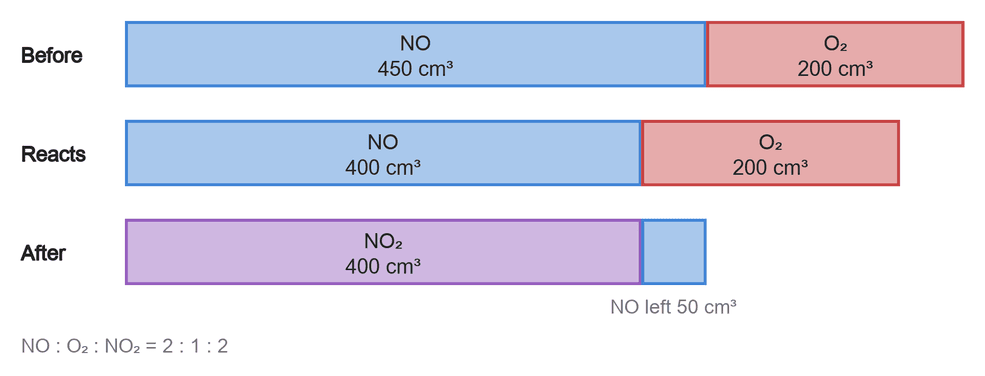
So NO : O₂ : NO₂ = 2 : 1 : 2 by volume.
Step 2 — Find the limiting gas.
The 200 cm³ of oxygen needs twice its volume of NO.
Since 450 cm³ of NO is present, all the oxygen is used up and NO is in excess.
Step 3 — Find the NO left.
We subtract the NO used from the NO taken.
Step 4 — Find the NO₂ formed.
Each volume of oxygen gives two volumes of NO₂.
Watch out: Work from the gas that is used up (oxygen here). Starting from 450 cm³ of NO would need 225 cm³ of oxygen, which is more than is present.
Therefore, the resulting mixture is 400 cm³ of NO₂ and 50 cm³ of unreacted NO (no oxygen is left), 450 cm³ in all.
- 102 marks
Question 10
If 6 litres of hydrogen and 4 litres of chlorine are mixed and exploded and if water is added to the gases formed, find the volume of the residual gas.
Solve with AIWritten solution
Solution:
Concept: Gay-Lussac's law of combining volumes: when gases react, they do so in volumes that bear a simple whole-number ratio to one another and to the volumes of any gaseous products, all measured at the same temperature and pressure. The ratio is read from the coefficients of the balanced equation. Hydrogen chloride is very soluble in water, while hydrogen is almost insoluble.
Step 1 — Write the balanced equation.
Hydrogen and chlorine combine to give hydrogen chloride:
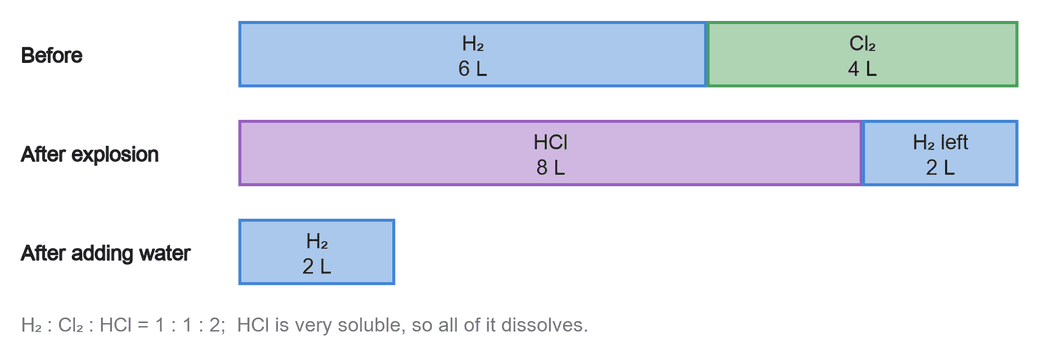
So H₂ : Cl₂ : HCl = 1 : 1 : 2 by volume.
Step 2 — Find the limiting gas.
Since H₂ and Cl₂ react 1 : 1, the 4 L of chlorine reacts with only 4 L of hydrogen. So chlorine is used up and hydrogen is in excess.
Step 3 — Find the gases after the explosion.
Each volume of chlorine gives two volumes of HCl, and the unreacted hydrogen is left over.
Step 4 — Add water.
All 8 L of HCl dissolves in the water, but hydrogen does not dissolve, so it remains as the residual gas.
Watch out: The HCl does not remain as a gas after water is added, because it is highly soluble.
Therefore, the residual gas is 2 litres of hydrogen.
- 112 marks
Question 11
Ammonia may be oxidised to nitrogen monoxide in the presence of a catalyst according to the following equation.
If 27 litres of reactants are consumed, what volume of nitrogen monoxide is produced at the same temperature and pressure ?
Solve with AIWritten solution
Solution:
Concept: Gay-Lussac's law of combining volumes: when gases react, they do so in volumes that bear a simple whole-number ratio to one another and to the volumes of any gaseous products, all measured at the same temperature and pressure. The ratio is read from the coefficients of the balanced equation.
Step 1 — Read the volume ratio.
The balanced equation gives the ratio of the gas volumes.
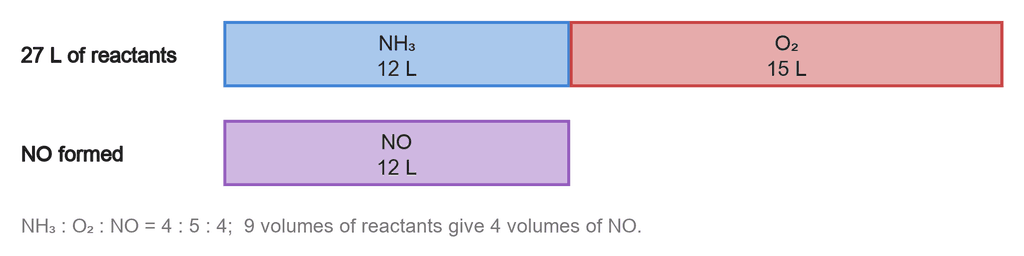
So 4 volumes of ammonia and 5 volumes of oxygen, that is 4 + 5 = 9 volumes of reactants, give 4 volumes of nitrogen monoxide.
Step 2 — Find the volume of NO.
Since every 9 volumes of reactants give 4 volumes of NO, we multiply the 27 L by 4/9.
(The 27 L was 12 L of ammonia and 15 L of oxygen.)
Watch out: The 27 L is the total of both reactants, so divide by 4 + 5 = 9, not by 4 or 5 alone.
Therefore, 12 litres of nitrogen monoxide are produced.
- 122 marks
Question 12
A mixture of hydrogen and chlorine occupying 36 cm³ was exploded. On shaking it with water, 4 cm³ of hydrogen was left behind. Find the composition of the initial mixture.
Solve with AIWritten solution
Solution:
Concept: Gay-Lussac's law of combining volumes: when gases react, they do so in volumes that bear a simple whole-number ratio to one another and to the volumes of any gaseous products, all measured at the same temperature and pressure. The ratio is read from the coefficients of the balanced equation. Hydrogen chloride dissolves when shaken with water; hydrogen does not.
Step 1 — Write the balanced equation.
Hydrogen and chlorine react in equal volumes:
Step 2 — Find the volume that reacted.
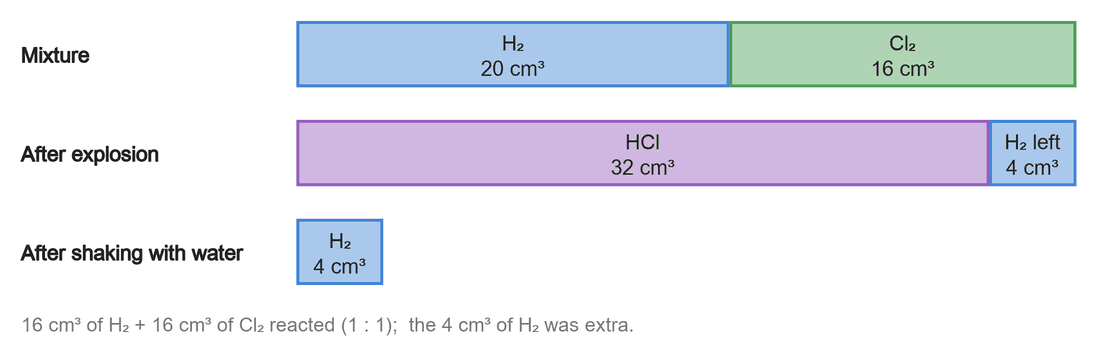
The 4 cm³ of hydrogen left over did not react, so the rest of the mixture reacted.
Step 3 — Split it in the ratio 1 : 1.
Since H₂ and Cl₂ react in equal volumes, the 32 cm³ was half hydrogen and half chlorine.
Step 4 — Add back the excess hydrogen.
The hydrogen in the original mixture is the hydrogen that reacted plus the 4 cm³ left over.
Watch out: The 4 cm³ left over is hydrogen, so it is added to the hydrogen only, not shared between both gases.
Therefore, the initial mixture contained 20 cm³ of hydrogen and 16 cm³ of chlorine.
- 132 marks
Question 13
What volume of air (containing 20% by volume) will be required to burn completely 10 cm³ each of methane and acetylene.
Solve with AIWritten solution
Solution:
Concept: Gay-Lussac's law of combining volumes: when gases react, they do so in volumes that bear a simple whole-number ratio to one another and to the volumes of any gaseous products, all measured at the same temperature and pressure. The ratio is read from the coefficients of the balanced equation. Air is 20% oxygen, so the volume of air is 100/20 = 5 times the volume of oxygen.
Step 1 — Find the oxygen for methane.
One volume of methane needs two volumes of oxygen.
Step 2 — Find the oxygen for acetylene.
Two volumes of acetylene need five volumes of oxygen.
Step 3 — Find the total oxygen.
We add the oxygen needed by the two gases.
Step 4 — Find the volume of air.
Since only 20% of the air is oxygen, we scale up by 100/20.

Watch out: The answer is air, not oxygen; do not stop at 45 cm³.
Therefore, 225 cm³ of air is required.
- 142 marks
Question 14
LPG has 60% propane and 40% butane : 10 litres of this mixture is burnt. Calculate the volume of carbon dioxide added to atmosphere.
Solve with AIWritten solution
Solution:
Concept: Gay-Lussac's law of combining volumes: when gases react, they do so in volumes that bear a simple whole-number ratio to one another and to the volumes of any gaseous products, all measured at the same temperature and pressure. The ratio is read from the coefficients of the balanced equation. Each gas in a mixture burns according to its own equation.
Step 1 — Find the volume of each gas.
LPG is 60% propane and 40% butane by volume.
Step 2 — Find the CO₂ from propane.
One volume of propane gives three volumes of carbon dioxide.
Step 3 — Find the CO₂ from butane.
Two volumes of butane give eight volumes of carbon dioxide.
Step 4 — Add the two volumes.
The total carbon dioxide is the sum from both gases.
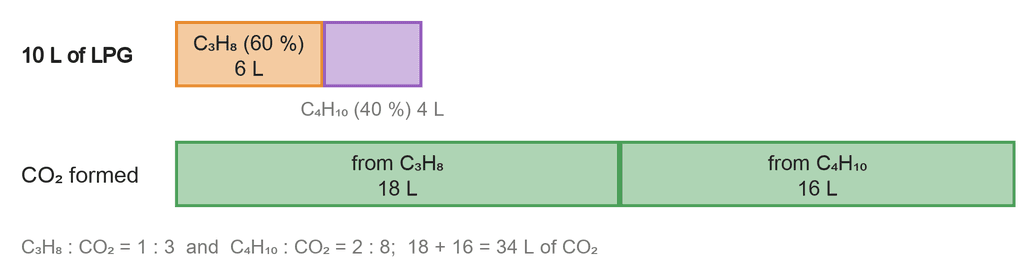
Watch out: For butane the ratio is 2 : 8 (that is 1 : 4), so 4 L of butane gives 16 L of CO₂, not 32 L.
Therefore, 34 litres of carbon dioxide are added to the atmosphere.
- 155 marks
Question 15
Water decomposes to and under suitable conditions as represented by the equation below :
(a) If 2500 cm³ of is produced, what volume of is liberated at the same time and under the same conditions of temperature and pressure ?
(b) The 2500 cm³ of is subjected to times increase in pressure (temp. remaining constant). What volume will now occupy ?
(c) Taking the volume of calculated in 5(b), what changes must be made in kelvin (absolute) temperature to return the volume to 2500 cm³ pressure remaining constant.
Solve with AIWritten solution
Solution:
Concept: Three gas laws are used: Gay-Lussac's law (gases react in simple volume ratios at the same temperature and pressure), Boyle's law (at constant temperature, , so volume falls as pressure rises) and Charles's law (at constant pressure, , with T in kelvin).
Step 1 — (a) Read the volume ratio.
The equation shows that 2 volumes of hydrogen are formed with 1 volume of oxygen.
So the oxygen is half the volume of the hydrogen.
Step 2 — (b) Write down the data.
The pressure is made times its first value, so if the first pressure is P, the new pressure is 2.5P. The temperature does not change, so Boyle's law applies.
Step 3 — (b) Find the new volume.
We substitute the values.
Step 4 — (c) Use Charles's law.
To bring 1000 cm³ back to 2500 cm³ at the same pressure, the kelvin temperature must rise in the same ratio as the volume.
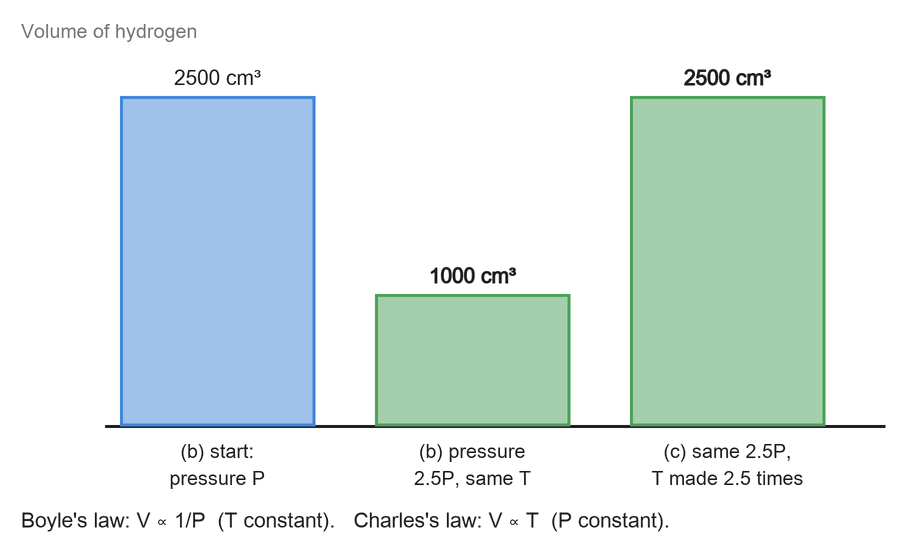
Watch out: Boyle's and Charles's laws work only with kelvin (absolute) temperature, never °C.
Note: this follows the book's reading, that the pressure becomes 2.5 times its first value. If "increase" is read as the pressure rising by 2.5P (to 3.5P), the volume in (b) is 2500 ÷ 3.5 ≈ 714.3 cm³, and in (c) the kelvin temperature must be made 3.5 times.
Therefore, (a) 1250 cm³ of oxygen is liberated; (b) the hydrogen now occupies 1000 cm³; (c) the kelvin temperature must be increased to 2.5 times its original value.
- 162 marks
Question 16
The gases chlorine, nitrogen, ammonia and sulphur dioxide are collected under the same conditions of temperature and pressure. The following table gives the volumes of gases collected and the number of molecules () in 20 litres of nitrogen. You are to complete the table giving the number of molecules in the other gases in terms of .
Gas Volume (in litres) Number of molecules Chlorine 10 Nitrogen 20 Ammonia 20 Sulphur dioxide 5 Solve with AIWritten solution
Solution:
Concept: Avogadro's law: equal volumes of all gases, under the same conditions of temperature and pressure, contain an equal number of molecules. So, at fixed temperature and pressure, the number of molecules is proportional to the volume.
Step 1 — Find the molecules in one litre.
Since 20 litres of nitrogen contain molecules, one litre of any of these gases (same temperature and pressure) contains one-twentieth of that.
Step 2 — Chlorine (10 litres).
We multiply the molecules per litre by 10.
Step 3 — Ammonia (20 litres).
Ammonia has the same volume as the nitrogen, so by Avogadro's law it has the same number of molecules, .
Step 4 — Sulphur dioxide (5 litres).
We multiply the molecules per litre by 5.
Step 5 — Complete the table.
The completed table is:
Gas Volume (in litres) Number of molecules Chlorine 10 Nitrogen 20 Ammonia 20 Sulphur dioxide 5 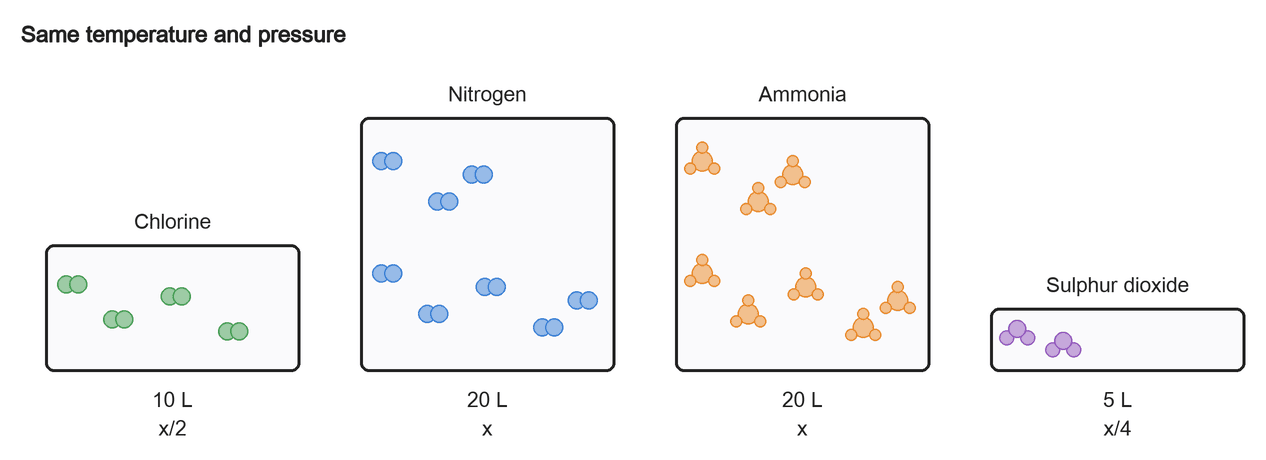
Watch out: The kind of gas (and its molecular mass) does not matter here; only the volume does.
Therefore, chlorine has x/2 molecules, ammonia has x molecules and sulphur dioxide has x/4 molecules.
- 174 marks
Question 17
(i) If 150 cc of gas A contains molecules, how many molecules of gas B will be present in 75 CC of gas B ? The gases A and B are under the same conditions of temperature and pressure?
(ii) Name the law on which the above problem is based.
Solve with AIWritten solution
Solution:
Concept: Avogadro's law: equal volumes of all gases, under the same conditions of temperature and pressure, contain an equal number of molecules. So, at fixed temperature and pressure, the number of molecules is proportional to the volume.
Step 1 — (i) Compare with the same volume of gas B.
By Avogadro's law, 150 cc of gas B at the same temperature and pressure would also contain molecules.
Step 2 — (i) Scale to 75 cc.
Since 75 cc is half of 150 cc, it holds half as many molecules.
Step 3 — (ii) Name the law.
The problem is based on Avogadro's law: equal volumes of all gases under the same conditions of temperature and pressure contain equal numbers of molecules.
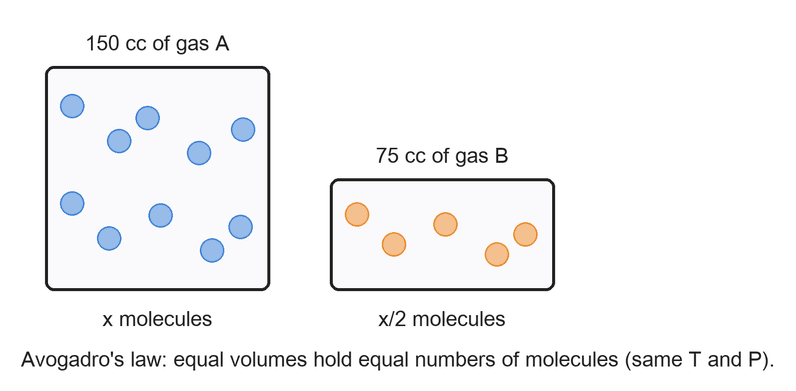
Watch out: The gases are different, but that does not matter; equal volumes at the same temperature and pressure hold equal numbers of molecules.
Therefore, (i) 75 cc of gas B contains x/2 molecules; (ii) the problem is based on Avogadro's law.
- 185 marks
Question 18
Calculate the relative molecular masses of :
(a) Ammonium chloroplatinate ,
(b) Potassium chlorate,
(c) ,
(d)
(e) ,
(f) ,
(g) .
Solve with AIWritten solution
Solution:
Concept: The relative molecular mass of a compound is the sum of the relative atomic masses of all the atoms in one molecule (or formula unit). A bracket multiplies every atom inside it, and water of crystallisation (·5H₂O) is added on. Atomic masses used: H = 1, C = 12, N = 14, O = 16, Na = 23, S = 32, Cl = 35.5, K = 39, Cr = 52, Cu = 63.5, Pt = 195.
Step 1 — (a) Ammonium chloroplatinate.
The formula (NH₄)₂PtCl₆ has 2 N, 8 H, 1 Pt and 6 Cl.
Step 2 — (b) Potassium chlorate.
Potassium chlorate is KClO₃, with 1 K, 1 Cl and 3 O.
Step 3 — (c) Copper sulphate crystals.
We add the mass of CuSO₄ and of five water molecules.
Step 4 — (d) Ammonium sulphate.
The formula (NH₄)₂SO₄ has 2 N, 8 H, 1 S and 4 O.
Step 5 — (e) Sodium acetate.
CH₃COONa has 2 C, 3 H, 2 O and 1 Na.
Step 6 — (f) Chloroform.
CHCl₃ has 1 C, 1 H and 3 Cl.
Step 7 — (g) Ammonium dichromate.
The formula (NH₄)₂Cr₂O₇ has 2 N, 8 H, 2 Cr and 7 O.
Watch out: Multiply everything inside a bracket by the number outside it: (NH₄)₂ means 2 N and 8 H. Relative molecular mass has no unit.
Therefore, the relative molecular masses are (a) 444, (b) 122.5, (c) 249.5, (d) 132, (e) 82, (f) 119.5 and (g) 252.
- 195 marks
Question 19
Find the :
(a) number of molecules in 73 g of HCl,
(b) weight of 0.5 mole of ,
(c) number of molecules in 1.8 g of ,
(d) number of moles in 10 g of ,
(e) weight of 0.2 mole of gas,
(f) number of molecules in 3.2 g of .
Solve with AIWritten solution
Solution:
Concept: The mole concept: one mole of any substance contains the Avogadro number, , of particles (atoms, molecules or formula units), and its mass in grams equals its atomic or molecular mass (the gram atomic / gram molecular mass). So and .
Step 1 — (a) Molecules in 73 g of HCl.
The molar mass of HCl is 1 + 35.5 = 36.5 g. We find the moles, then multiply by the Avogadro number.
Step 2 — (b) Mass of 0.5 mole of O₂.
The molar mass of O₂ is 32 g, so we multiply the moles by 32.
Step 3 — (c) Molecules in 1.8 g of water.
The molar mass of H₂O is 2 + 16 = 18 g.
Step 4 — (d) Moles in 10 g of CaCO₃.
The molar mass of CaCO₃ is 40 + 12 + 48 = 100 g.
Step 5 — (e) Mass of 0.2 mole of H₂.
The molar mass of H₂ is 2 g.
Step 6 — (f) Molecules in 3.2 g of SO₂.
The molar mass of SO₂ is 32 + 32 = 64 g.

Watch out: To go from grams to molecules, always pass through moles: divide by the molar mass first, then multiply by 6.022 × 10²³.
Therefore, (a) 1.2044 × 10²⁴ molecules; (b) 16 g; (c) 6.022 × 10²² molecules; (d) 0.1 mole; (e) 0.4 g; (f) 3.011 × 10²² molecules.
- 201 mark
Question 20
Which of the following would weigh most ?
Solve with AIAnswer
(A) 1 mole of ,
- Correct
(B) 1 mole of ,
(C) 1 mole of ,
(D) 1 mole of CO ?
Answer: (B) 1 mole of ,
Concept: The mass of one mole of a substance is its gram molecular mass. So, for equal numbers of moles, the substance with the largest molecular mass weighs the most.
Step 1 — Find each molecular mass.
We add the atomic masses (H = 1, C = 12, N = 14, O = 16).
Step 2 — Compare the masses of one mole.
One mole of each weighs 18 g, 44 g, 17 g and 28 g. The largest is 44 g, for carbon dioxide.

Why the other options are wrong:
- (A) 1 mole of ,: one mole of water weighs only 18 g.
- (C) 1 mole of ,: one mole of ammonia weighs only 17 g, the lightest of the four.
- (D) 1 mole of CO ?: one mole of carbon monoxide weighs 28 g, which is less than 44 g.
Therefore, 1 mole of CO₂ (44 g) weighs the most, option (B).
- 211 mark
Question 21
Which of the following contains maximum number of molecules :
Solve with AIAnswer
(A) 4 g of ,
- Correct
(B) 4 g of ,
(C) 4 g of ,
(D) 4 g of ?
Answer: (B) 4 g of ,
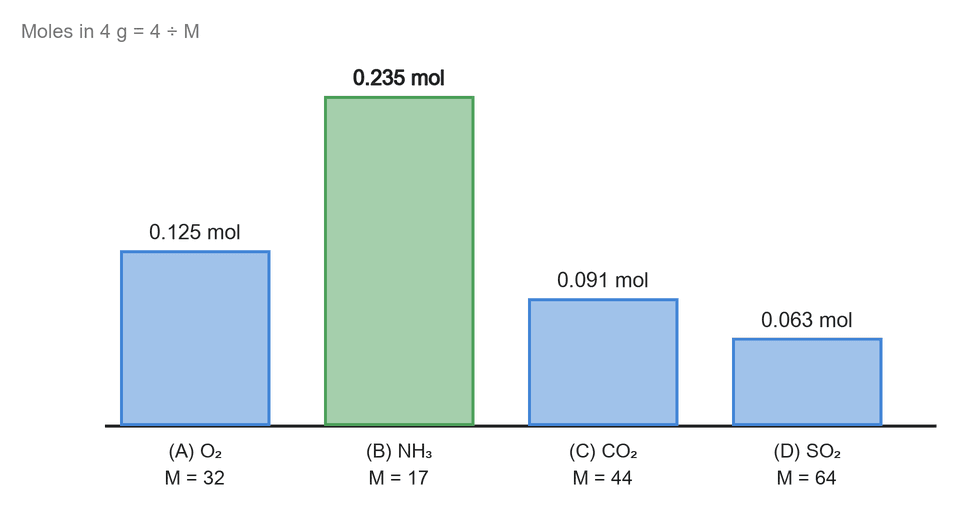
Concept: The number of molecules is proportional to the number of moles, and for a fixed mass . So the gas with the smallest molar mass has the most molecules in 4 g.
Step 1 — Find each molar mass.
The molar masses are O₂ = 32, NH₃ = 17, CO₂ = 44 and SO₂ = 64.
Step 2 — Find the moles in 4 g of ammonia.
We divide the mass by the molar mass.
This is the largest number of moles, because 17 is the smallest molar mass.
Watch out: More mass per molecule means fewer molecules in the same mass; do not pick the heaviest gas.
Why the other options are wrong:
- (A) 4 g of ,: 4 g of O₂ is only 4 ÷ 32 = 0.125 mole.
- (C) 4 g of ,: 4 g of CO₂ is only 4 ÷ 44 = 0.091 mole.
- (D) 4 g of ?: 4 g of SO₂ is only 4 ÷ 64 = 0.0625 mole, the fewest molecules.
Therefore, 4 g of NH₃ contains the maximum number of molecules, option (B).
- 225 marks
Question 22
Calculate the number of :
(a) particles in 0.1 mole of any substance,
(b) hydrogen atoms in 0.1 mole of ,
(c) molecules in one kg of calcium chloride.
Solve with AIWritten solution
Solution:
Concept: The mole concept: one mole of any substance contains the Avogadro number, , of particles (atoms, molecules or formula units), and its mass in grams equals its atomic or molecular mass (the gram atomic / gram molecular mass). So and .
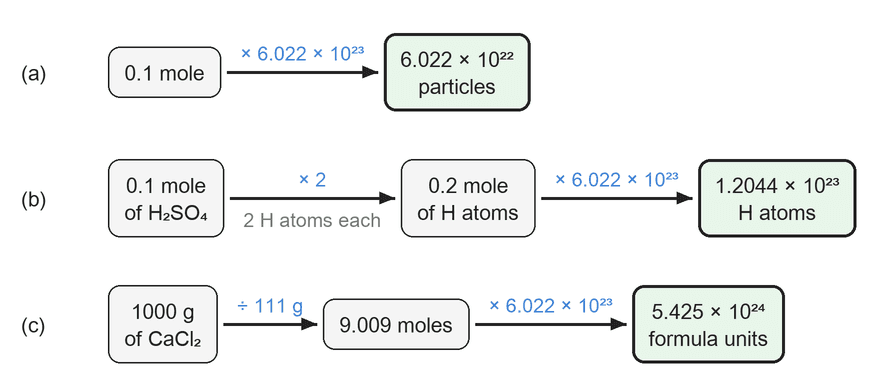
Step 1 — (a) Particles in 0.1 mole.
One mole of any substance has 6.022 × 10²³ particles, so we multiply by 0.1.
Step 2 — (b) Hydrogen atoms in 0.1 mole of H₂SO₄.
Each H₂SO₄ molecule contains 2 hydrogen atoms, so 0.1 mole of molecules contains 0.2 mole of hydrogen atoms.
Step 3 — (c) Moles in 1 kg of calcium chloride.
The molar mass of CaCl₂ is 40 + 2 × 35.5 = 111 g, and 1 kg = 1000 g.
Step 4 — (c) Number of molecules.
We multiply the moles by the Avogadro number.
Calcium chloride is ionic, so these 'molecules' are really formula units.
Watch out: In (b) count the atoms per molecule: 0.1 mole of H₂SO₄ has 0.2 mole of hydrogen atoms, not 0.1.
Therefore, (a) 6.022 × 10²² particles; (b) 1.2044 × 10²³ hydrogen atoms; (c) 5.425 × 10²⁴ molecules (formula units).
- 235 marks
Question 23
How many grams of :
(a) Al are present in 0.2 mole of it ?
(b) HCl are present in 0.1 mole of it ?
(c) are present in 0.2 mole of it ?
(d) is present in 0.1 mole of it ?
Solve with AIWritten solution
Solution:
Concept: The mole concept: one mole of any substance contains the Avogadro number, , of particles (atoms, molecules or formula units), and its mass in grams equals its atomic or molecular mass (the gram atomic / gram molecular mass). So and . Here the mass is found by multiplying the number of moles by the molar mass.
Step 1 — (a) Aluminium.
The atomic mass of Al is 27, so one mole weighs 27 g.
Step 2 — (b) Hydrogen chloride.
The molar mass of HCl is 1 + 35.5 = 36.5 g.
Step 3 — (c) Water.
The molar mass of H₂O is 2 + 16 = 18 g.
Step 4 — (d) Carbon dioxide.
The molar mass of CO₂ is 12 + 32 = 44 g.
Therefore, (a) 5.4 g of Al, (b) 3.65 g of HCl, (c) 3.6 g of H₂O and (d) 4.4 g of CO₂.
- 244 marks
Question 24
(a) The mass of 5.6 litres of a certain gas at STP is 12 g. What is the relative molecular mass or molar mass of the gas ?
(b) Calculate the volume occupied at S.T.P. by 2 moles of .
Solve with AIWritten solution
Solution:
Concept: Molar volume: one mole of any gas occupies 22.4 litres (22400 cm³) at S.T.P. (273 K and 760 mm of Hg, or 1 atm). So the mass of 22.4 L of a gas at S.T.P. is its gram molecular mass.
Step 1 — (a) Find the moles in 5.6 L.
At S.T.P. one mole occupies 22.4 L.
Step 2 — (a) Find the mass of one mole.
Since 0.25 mole weighs 12 g, one mole weighs 12 ÷ 0.25.
Step 3 — (b) Find the volume of 2 moles of SO₂.
Each mole of any gas occupies 22.4 L at S.T.P.

Watch out: The volume at S.T.P. depends only on the number of moles, not on which gas it is.
Therefore, (a) the relative molecular mass of the gas is 48 (molar mass 48 g); (b) 2 moles of SO₂ occupy 44.8 litres at S.T.P.
- 254 marks
Question 25
Calculate the number of moles of :
(a) which contain 8.00 g of ,
(b) methane in 0.80 g of methane.
Solve with AIWritten solution
Solution:
Concept: The mole concept: one mole of any substance contains the Avogadro number, , of particles (atoms, molecules or formula units), and its mass in grams equals its atomic or molecular mass (the gram atomic / gram molecular mass). So and .
Step 1 — (a) Oxygen in one mole of CO₂.
One mole of CO₂ weighs 12 + 2 × 16 = 44 g. Of this, the two oxygen atoms make up 2 × 16 = 32 g.
Step 2 — (a) Moles of CO₂ holding 8.00 g of oxygen.
Since each mole of CO₂ holds 32 g of oxygen, we divide 8.00 g by 32 g.
(This is 0.25 × 44 = 11 g of carbon dioxide.)
Step 3 — (b) Moles of methane.
The molar mass of CH₄ is 12 + 4 = 16 g.

Watch out: In (a) divide by the oxygen in one mole of CO₂ (32 g), not by the molar mass of CO₂ (44 g).
Therefore, (a) 0.25 mole of CO₂ contains 8.00 g of oxygen; (b) 0.80 g of methane is 0.05 mole.
- 265 marks
Question 26
Calculate the weight/mass of :
(a) an atom of oxygen,
(b) an atom of hydrogen,
(c) a molecule of ,
(d) atoms of carbon,
(e) the molecule of oxygen,
(f) 0.25 gram atom of calcium.
Solve with AIWritten solution
Solution:
Concept: The mole concept: one mole of any substance contains the Avogadro number, , of particles (atoms, molecules or formula units), and its mass in grams equals its atomic or molecular mass (the gram atomic / gram molecular mass). So and . So the mass of one particle is the molar mass divided by 6.022 × 10²³.
Step 1 — (a) One atom of oxygen.
One mole of oxygen atoms weighs 16 g.
Step 2 — (b) One atom of hydrogen.
One mole of hydrogen atoms weighs 1 g.
Step 3 — (c) One molecule of NH₃.
One mole of ammonia weighs 14 + 3 = 17 g.
Step 4 — (d) 10²² atoms of carbon.
We first change the number of atoms to moles, then multiply by 12 g.
Step 5 — (e) One molecule of oxygen.
One mole of O₂ weighs 32 g.
Step 6 — (f) 0.25 gram atom of calcium.
One gram atom of calcium weighs 40 g.

Watch out: A single atom or molecule has a tiny mass (about 10⁻²³ g); if the answer for one particle is bigger than a gram, the division by 6.022 × 10²³ has been missed.
Therefore, (a) 2.657 × 10⁻²³ g; (b) 1.661 × 10⁻²⁴ g; (c) 2.823 × 10⁻²³ g; (d) 0.1993 g (about 0.2 g); (e) 5.314 × 10⁻²³ g; (f) 10 g.
- 275 marks
Question 27
Calculate the mass of 0.1 mole of each of the following:
(a) ,
(b) ,
(c) ,
(d) Mg.
(Ca = 40, Na = 23, Mg = 24, S = 32, C = 12, Cl = 35.5, O = 16, H = 1)
Solve with AIWritten solution
Solution:
Concept: The mole concept: one mole of any substance contains the Avogadro number, , of particles (atoms, molecules or formula units), and its mass in grams equals its atomic or molecular mass (the gram atomic / gram molecular mass). So and . Here the mass is found by multiplying the number of moles by the molar mass.
Step 1 — (a) Calcium carbonate.
We find the molar mass, then take 0.1 of it.
Step 2 — (b) Glauber's salt.
The ten water molecules are included in the molar mass.
Step 3 — (c) Calcium chloride.
We find the molar mass, then take 0.1 of it.
Step 4 — (d) Magnesium.
The atomic mass of magnesium is 24.
Watch out: In (b) do not forget the 10H₂O; it adds 180 to the molar mass.
Therefore, the masses are (a) 10 g, (b) 32.2 g, (c) 11.1 g and (d) 2.4 g.
- 285 marks
Question 28
Calculate the number of
(a) oxygen atoms in 0.10 mole of
(b) gram atoms in 4.6 gram of sodium.
(c) moles in 12 g of oxygen gas.
Solve with AIWritten solution
Solution:
Concept: The mole concept: one mole of any substance contains the Avogadro number, , of particles (atoms, molecules or formula units), and its mass in grams equals its atomic or molecular mass (the gram atomic / gram molecular mass). So and . A gram atom is one mole of atoms of an element.
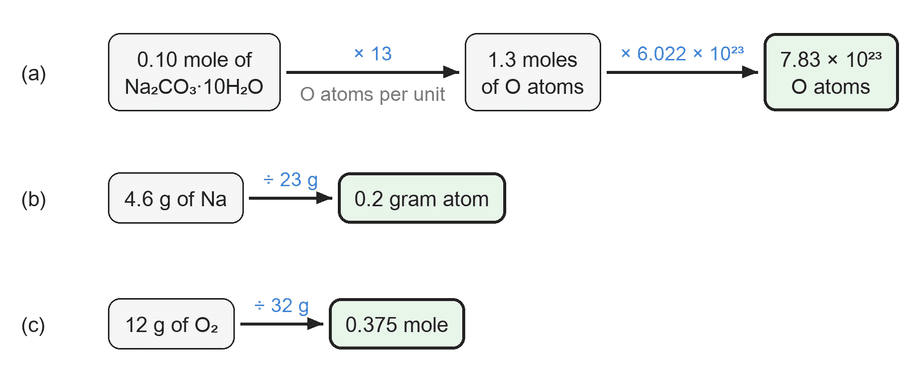
Step 1 — (a) Count the oxygen atoms in one formula unit.
Na₂CO₃·10H₂O has 3 oxygen atoms in the carbonate part and 1 in each of the 10 water molecules, so 3 + 10 = 13 oxygen atoms.
Step 2 — (a) Find the number of oxygen atoms.
Since 0.10 mole of the salt holds 13 × 0.10 = 1.3 mole of oxygen atoms, we multiply by the Avogadro number.
Step 3 — (b) Gram atoms in 4.6 g of sodium.
One gram atom of sodium weighs 23 g.
Step 4 — (c) Moles in 12 g of oxygen gas.
Oxygen gas is O₂, with molar mass 32 g.
Watch out: In (a) count the oxygen in the water of crystallisation too; in (c) oxygen gas is O₂ (32 g), not O (16 g).
Therefore, (a) 7.83 × 10²³ oxygen atoms; (b) 0.2 gram atom of sodium; (c) 0.375 mole of oxygen gas.
- 292 marks
Question 29
What mass of Ca will contain the same number of atoms as are present in 3.2 g of S ?
Solve with AIWritten solution
Solution:
Concept: Equal numbers of gram atoms contain equal numbers of atoms (6.022 × 10²³ atoms per gram atom). So we change sulphur to gram atoms, then take the same number of gram atoms of calcium (S = 32, Ca = 40).
Step 1 — Find the gram atoms of sulphur.
One gram atom of sulphur weighs 32 g.
Step 2 — Take the same number of calcium atoms.
So we need 0.1 gram atom of calcium.
Step 3 — Find the mass of calcium.
One gram atom of calcium weighs 40 g.

Watch out: Equal masses do not contain equal numbers of atoms; compare gram atoms, not grams.
Therefore, 4 g of calcium contains the same number of atoms as 3.2 g of sulphur.
- 305 marks
Question 30
Calculate the number of atoms in each of the following :
(a) 52 moles of He,
(b) 52 amu of He,
(c) 52 g of He.
Solve with AIWritten solution
Solution:
Concept: The mole concept: one mole of any substance contains the Avogadro number, , of particles (atoms, molecules or formula units), and its mass in grams equals its atomic or molecular mass (the gram atomic / gram molecular mass). So and . The atomic mass of helium is 4: one atom weighs 4 amu, and one mole of atoms weighs 4 g.
Step 1 — (a) 52 moles of He.
Each mole contains 6.022 × 10²³ atoms.
Step 2 — (b) 52 amu of He.
Since one helium atom weighs 4 amu, we divide 52 amu by 4 amu.
Step 3 — (c) 52 g of He.
Since one mole of helium weighs 4 g, we first find the moles.

Watch out: '52 amu' is the mass of just 13 atoms, while '52 g' is 13 moles of atoms; the unit makes all the difference.
Therefore, (a) 3.131 × 10²⁵ atoms; (b) 13 atoms; (c) 7.829 × 10²⁴ atoms.
- 312 marks
Question 31
Calculate the number of atoms of each kind in 5.3 grams of sodium carbonate.
Solve with AIWritten solution
Solution:
Concept: The mole concept: one mole of any substance contains the Avogadro number, , of particles (atoms, molecules or formula units), and its mass in grams equals its atomic or molecular mass (the gram atomic / gram molecular mass). So and . One formula unit of Na₂CO₃ contains 2 Na, 1 C and 3 O atoms.
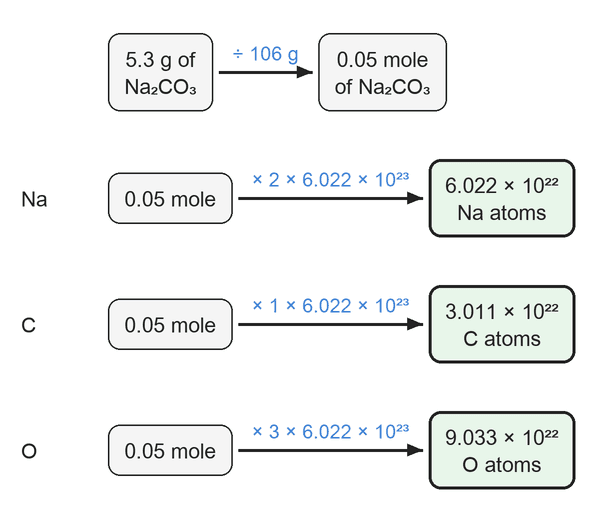
Step 1 — Find the formula mass.
We add the atomic masses (Na = 23, C = 12, O = 16).
Step 2 — Find the moles.
We divide the mass by the formula mass.
Step 3 — Sodium atoms.
Each unit has 2 sodium atoms.
Step 4 — Carbon atoms.
Each unit has 1 carbon atom.
Step 5 — Oxygen atoms.
Each unit has 3 oxygen atoms.
Watch out: The atoms are in the same 2 : 1 : 3 ratio as in the formula; use it to check your three answers.
Therefore, 5.3 g of sodium carbonate contains 6.022 × 10²² sodium atoms, 3.011 × 10²² carbon atoms and 9.033 × 10²² oxygen atoms.
- 324 marks
Question 32
(a) Calculate the mass of nitrogen supplied to soil by 5 kg of urea [].
[O = 16; N = 14; C = 12; H = 1]
(b) Calculate the volume occupied by 320 g of sulphur dioxide at STP [S = 32; O = 16]
Solve with AIWritten solution
Solution:
Concept: The mass of an element in a compound is in the same proportion as in one mole of the compound. Molar volume: one mole of any gas occupies 22.4 litres (22400 cm³) at S.T.P. (273 K and 760 mm of Hg, or 1 atm).
Step 1 — (a) Find the molar mass of urea.
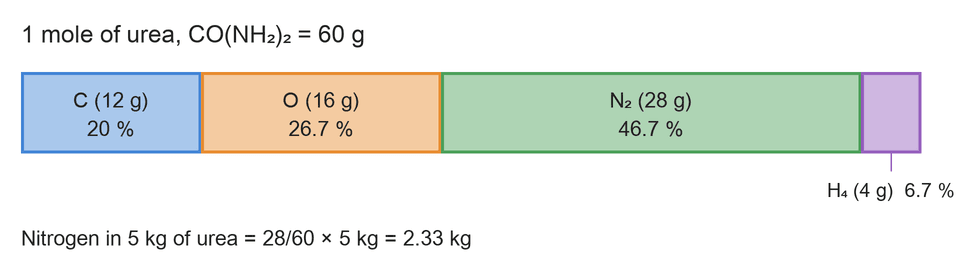
Urea, CO(NH₂)₂, has 1 C, 1 O, 2 N and 4 H.
Of this, nitrogen contributes 2 × 14 = 28.
Step 2 — (a) Find the nitrogen in 5 kg.
Nitrogen is 28/60 of the mass of urea.
Step 3 — (b) Find the moles of SO₂.
The molar mass of SO₂ is 32 + 2 × 16 = 64 g.
Step 4 — (b) Find the volume at S.T.P.
Each mole occupies 22.4 L at S.T.P.
Watch out: Urea has two nitrogen atoms, so use 28, not 14.
Therefore, (a) 5 kg of urea supplies 2.33 kg of nitrogen; (b) 320 g of SO₂ occupies 112 litres at S.T.P.
- 334 marks
Question 33
(a) What do you understand by the statement that 'vapour density of carbon dioxide is 22' ?
(b) Atomic mass of chlorine is 35.5. What is its vapour density ?
Solve with AIWritten solution
Solution:
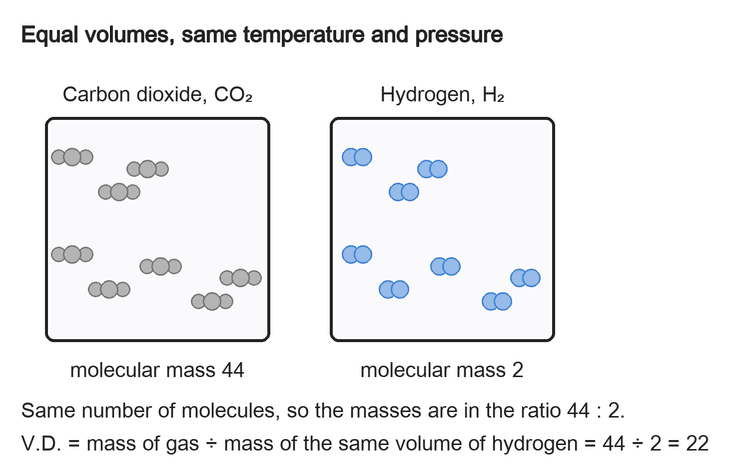
Concept: Vapour density (V.D.) is the ratio of the mass of a certain volume of a gas to the mass of the same volume of hydrogen at the same temperature and pressure. Since one molecule of hydrogen has mass 2,
Step 1 — (a) Explain the statement.
'Vapour density of carbon dioxide is 22' means that any volume of carbon dioxide is 22 times as heavy as the same volume of hydrogen, both measured at the same temperature and pressure.
Step 2 — (a) Link it to molecular mass.
Since relative molecular mass = 2 × V.D., the statement also tells us the molecular mass of CO₂.
This matches the formula mass of CO₂, which is 12 + 2 × 16 = 44.
Step 3 — (b) Find the molecular mass of chlorine.
Chlorine gas is diatomic, Cl₂.
Step 4 — (b) Find the vapour density.
Vapour density is half the molecular mass.
Watch out: Use the molecular mass of Cl₂ (71), not the atomic mass, to find V.D.; the answer equals the atomic mass only because Cl₂ has two atoms.
Therefore, (a) carbon dioxide is 22 times as heavy as an equal volume of hydrogen at the same temperature and pressure (so its molecular mass is 44); (b) the vapour density of chlorine is 35.5.
- 342 marks
Question 34
What is the mass of 56 cm³ of carbon monoxide at STP? [C = 12; O = 16]
Solve with AIWritten solution
Solution:
Concept: Molar volume: one mole of any gas occupies 22.4 litres (22400 cm³) at S.T.P. (273 K and 760 mm of Hg, or 1 atm).
Step 1 — Find the molar mass.
Carbon monoxide, CO, has molar mass 12 + 16 = 28 g, so 22400 cm³ of it at S.T.P. weighs 28 g.
Step 2 — Find the moles in 56 cm³.
We divide the volume by the molar volume.
Step 3 — Find the mass.
We multiply the moles by the molar mass.

Watch out: The volume is in cm³, so use 22400 cm³ (not 22.4) for one mole.
Therefore, 56 cm³ of carbon monoxide at S.T.P. has a mass of 0.07 g.
- 352 marks
Question 35
Determine the no. of molecules in a drop of water which weighs .09 g.
Solve with AIWritten solution
Solution:
Concept: The mole concept: one mole of any substance contains the Avogadro number, , of particles (atoms, molecules or formula units), and its mass in grams equals its atomic or molecular mass (the gram atomic / gram molecular mass). So and .
Step 1 — Find the moles of water.
The molar mass of H₂O is 2 + 16 = 18 g.
Step 2 — Find the number of molecules.
We multiply the moles by the Avogadro number.

Therefore, the drop of water contains 3.011 × 10²¹ molecules.
- 364 marks
Question 36
The molecular formula for elemental sulphur is . In a sample of 5.12 g of sulphur :
(a) How many moles of sulphur are present ?
(b) How many molecules and atoms are present ?
Solve with AIWritten solution
Solution:
Concept: The mole concept: one mole of any substance contains the Avogadro number, , of particles (atoms, molecules or formula units), and its mass in grams equals its atomic or molecular mass (the gram atomic / gram molecular mass). So and . Sulphur exists as S₈ molecules, so one mole of S₈ weighs 8 × 32 = 256 g and each molecule has 8 atoms.
Step 1 — (a) Find the moles of S₈.
We divide the mass by the molar mass of S₈.
Step 2 — (b) Find the number of molecules.
We multiply the moles by the Avogadro number.
Step 3 — (b) Find the number of atoms.
Each S₈ molecule contains 8 atoms.

Watch out: The molar mass of S₈ is 256 g, not 32 g; using 32 g would count atoms, not molecules.
Therefore, (a) 0.02 mole of sulphur (S₈) is present; (b) it contains 1.204 × 10²² molecules and 9.635 × 10²² atoms.
- 372 marks
Question 37
If phosphorus is considered to contain molecules, then calculate the number of moles in 100 g of phosphorus.
Solve with AIWritten solution
Solution:
Concept: The mole concept: one mole of any substance contains the Avogadro number, , of particles (atoms, molecules or formula units), and its mass in grams equals its atomic or molecular mass (the gram atomic / gram molecular mass). So and . Phosphorus exists as P₄ molecules, and the atomic mass of phosphorus is 31.
Step 1 — Find the molar mass of P₄.
Each molecule has 4 phosphorus atoms.
Step 2 — Find the number of moles.
We divide the mass by the molar mass.
Watch out: Use 124 g for one mole of P₄; dividing by 31 would give moles of P atoms (3.226), which is not asked.
Therefore, 100 g of phosphorus contains 0.806 mole of P₄ molecules.
- 385 marks
Question 38
Calculate :
(a) the gram molecular mass of chlorine if 308 cm³ of it at STP weighs 0.979 g,
(b) the volume of 4 g of at 4 atmosphere,
(c) the mass of oxygen in 2.2 litres of at STP.
Solve with AIWritten solution
Solution:
Concept: Molar volume: one mole of any gas occupies 22.4 litres (22400 cm³) at S.T.P. (273 K and 760 mm of Hg, or 1 atm). Boyle's law ( at constant temperature) changes a gas volume to a new pressure.
Step 1 — (a) Find the mass of 22400 cm³ of chlorine.
The gram molecular mass is the mass of 22400 cm³ at S.T.P. Since 308 cm³ weighs 0.979 g, we scale up.
This is close to 71 g for Cl₂.
Step 2 — (b) Find the volume of 4 g of hydrogen at 1 atm.
The molar mass of H₂ is 2 g, so 4 g is 2 moles. Taking the temperature as 0 °C (none is given), 2 moles occupy 2 × 22.4 L at 1 atm.
Step 3 — (b) Apply Boyle's law at 4 atm.
The pressure becomes 4 times, so the volume becomes a quarter.
Step 4 — (c) Find the mass of oxygen in 2.2 L of CO₂.
One mole of CO₂ (22.4 L at S.T.P.) contains 2 × 16 = 32 g of oxygen, so we take the fraction 2.2/22.4 of 32 g.

Watch out: In (c) the answer is the oxygen in the CO₂ (32 g per mole), not the mass of the CO₂ itself (44 g per mole).
Therefore, (a) the gram molecular mass of chlorine is 71.2 g; (b) 4 g of hydrogen occupies 11.2 dm³ at 4 atmospheres; (c) 2.2 litres of CO₂ contain 3.14 g of oxygen.
- 392 marks
Question 39
A student puts his signature with graphite pencil. If the mass of carbon in the signature is g, calculate the number of carbon atoms in the signature.
Solve with AIWritten solution
Solution:
Concept: The mole concept: one mole of any substance contains the Avogadro number, , of particles (atoms, molecules or formula units), and its mass in grams equals its atomic or molecular mass (the gram atomic / gram molecular mass). So and . One gram atom of carbon weighs 12 g.
Step 1 — Find the gram atoms of carbon.
We divide the mass by 12 g.
Step 2 — Find the number of atoms.
We multiply by the Avogadro number.

Watch out: Keep track of the powers of ten: 10⁻¹⁴ × 10²³ = 10⁹, and 8.33 × 6.022 ≈ 50.2 adds one more power.
Therefore, the signature contains about 5.018 × 10¹⁰ carbon atoms.
- 402 marks
Question 40
An unknown gas shows a density of 3 g per litre at 273°C and 1140 mm Hg pressure. What is the gram molecular mass of this gas ?
Solve with AIWritten solution
Solution:
Concept: The gram molecular mass is the mass of 22.4 L of the gas at S.T.P. So we first use the gas equation to find what volume the 1 litre (3 g) occupies at S.T.P.
Step 1 — Write down the data.
One litre weighs 3 g at 1140 mm of Hg and 273 °C, which is 273 + 273 = 546 K. S.T.P. is 273 K and 760 mm of Hg.
Step 2 — Find the volume at S.T.P.
We make the subject of the gas equation and substitute.
So 0.75 L of the gas at S.T.P. weighs 3 g.
Step 3 — Find the mass of 22.4 L at S.T.P.
We scale the mass up from 0.75 L to 22.4 L.

Watch out: The density is not at S.T.P., so 3 × 22.4 = 67.2 g would be wrong; convert the volume first.
Therefore, the gram molecular mass of the gas is 89.6 g.
- 412 marks
Question 41
Cost of Sugar () is ₹ 40 per kg; calculate its cost per mole.
Solve with AIWritten solution
Solution:
Concept: One mole of a substance is its gram molecular mass, so the cost of one mole is the cost of that many grams.
Step 1 — Find the molecular mass of sugar.
Sucrose, C₁₂H₂₂O₁₁, has 12 C, 22 H and 11 O atoms.
So one mole weighs 342 g, which is 0.342 kg.
Step 2 — Find the cost of one mole.
Sugar costs 40 rupees per kg, so we multiply the mass in kg by 40.
This is ₹ 13.68.
Watch out: Change grams to kilograms (342 g = 0.342 kg) before using a price per kg.
Therefore, the cost of one mole of sugar is ₹ 13.68.
- 422 marks
Question 42
Calculate the number of molecules in one kg of NaOH.
Solve with AIWritten solution
Solution:
Concept: The mole concept: one mole of any substance contains the Avogadro number, , of particles (atoms, molecules or formula units), and its mass in grams equals its atomic or molecular mass (the gram atomic / gram molecular mass). So and .
Step 1 — Find the moles of NaOH.
The molar mass of NaOH is 23 + 16 + 1 = 40 g, and 1 kg = 1000 g.
Step 2 — Find the number of molecules.
We multiply the moles by the Avogadro number.
Sodium hydroxide is ionic, so these 'molecules' are really formula units.
Watch out: Change 1 kg to 1000 g before dividing by the molar mass in grams.
Therefore, one kg of NaOH contains 1.5055 × 10²⁵ molecules (formula units).
- 434 marks
Question 43
Calculate the number of atoms present in :
(a) 10 g of Chlorine
(b) 10 g of Nitrogen
Solve with AIWritten solution
Solution:
Concept: The mole concept: one mole of any substance contains the Avogadro number, , of particles (atoms, molecules or formula units), and its mass in grams equals its atomic or molecular mass (the gram atomic / gram molecular mass). So and . The number of atoms comes from the gram atoms: mass ÷ atomic mass, with atomic masses 35.5 for chlorine and 14 for nitrogen.
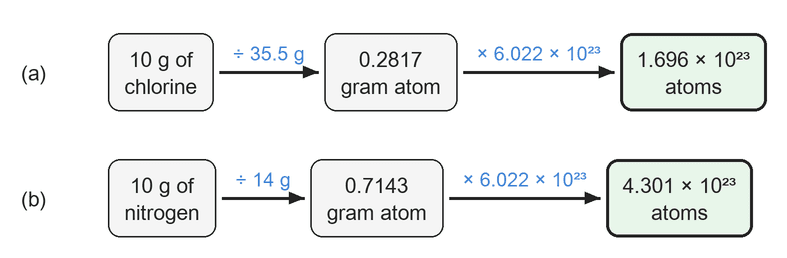
Step 1 — (a) Gram atoms of chlorine.
We divide 10 g by the atomic mass of chlorine.
Step 2 — (a) Atoms of chlorine.
We multiply by the Avogadro number.
Step 3 — (b) Gram atoms of nitrogen.
We divide 10 g by the atomic mass of nitrogen.
Step 4 — (b) Atoms of nitrogen.
We multiply by the Avogadro number.
Watch out: Atoms are asked, so divide by the atomic mass (35.5, 14), not the molecular mass of Cl₂ or N₂.
Therefore, (a) 10 g of chlorine contains 1.696 × 10²³ atoms; (b) 10 g of nitrogen contains 4.301 × 10²³ atoms.
- 445 marks
Question 44
Correct the following :
(a) Equal volumes of any gas, under similar conditions, contain an equal number of atoms.
(b) 22 g of occupies 22.4 litres at STP.
(c) The unit of atomic weight is grams.
Solve with AIWritten solution
Solution:
Concept: Avogadro's law is about molecules, one mole of any gas occupies 22.4 L at S.T.P., and relative atomic mass is a ratio, so it has no unit.
Step 1 — (a) Correct statement.
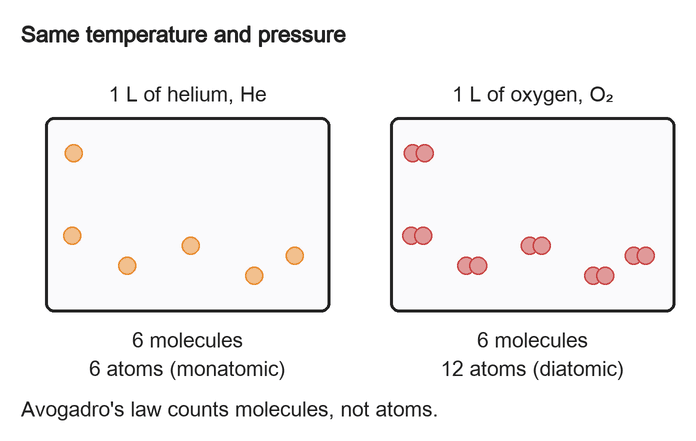
Equal volumes of all gases, under similar conditions of temperature and pressure, contain an equal number of molecules.
This is because gases such as helium (1 atom per molecule) and oxygen (2 atoms per molecule) have equal numbers of molecules in equal volumes, but not equal numbers of atoms.
Step 2 — (b) Correct statement.
44 g of CO₂ occupies 22.4 litres at S.T.P.
This is because 22.4 L at S.T.P. is one mole, and one mole of CO₂ is 12 + 2 × 16 = 44 g. (22 g is half a mole, which occupies 11.2 litres.)
Step 3 — (c) Correct statement.
Relative atomic weight has no unit.
This is because it tells how many times one atom is heavier than 1/12 of a carbon-12 atom, which is a ratio. Only the gram atomic mass (the atomic weight expressed in grams) has the unit gram.
Watch out: In (b) another correct version is '22 g of CO₂ occupies 11.2 litres at S.T.P.'
Therefore, (a) equal volumes contain equal numbers of molecules; (b) 44 g of CO₂ occupies 22.4 litres at S.T.P.; (c) relative atomic weight has no unit (the gram atomic mass is in grams).
- 455 marks
Question 45
Give the empirical formula of :
(a) ,
(b) ,
(c) ,
(d) .
Solve with AIWritten solution
Solution:
Concept: The empirical formula shows the simplest whole-number ratio of the atoms in a compound. We write the number of each kind of atom and divide all of them by their highest common factor (HCF).
Step 1 — (a) C₆H₆.
The ratio C : H is 6 : 6. The HCF is 6, so dividing by 6 gives 1 : 1. The empirical formula is CH.
Step 2 — (b) C₆H₁₈O₃.
The ratio C : H : O is 6 : 18 : 3. The HCF is 3, so dividing by 3 gives 2 : 6 : 1. The empirical formula is C₂H₆O.
Step 3 — (c) C₂H₂.
The ratio C : H is 2 : 2. The HCF is 2, so dividing by 2 gives 1 : 1. The empirical formula is CH.
Step 4 — (d) CH₃COOH.
First we count all the atoms: 2 C, 4 H and 2 O, so the formula is C₂H₄O₂. The ratio 2 : 4 : 2 has HCF 2, and dividing gives 1 : 2 : 1. The empirical formula is CH₂O.
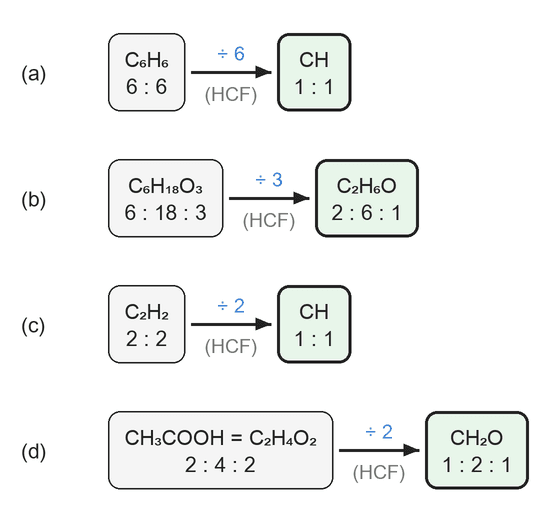
Watch out: In acetic acid count every atom, including the H in –COOH; it has 4 H, not 3.
Therefore, the empirical formulae are (a) CH, (b) C₂H₆O, (c) CH and (d) CH₂O.
- 462 marks
Question 46
Find the percentage of water of crystallisation in . (At. mass Cu = 64, H = 1, O = 16, S = 32)
Solve with AIWritten solution
Solution:
Concept: Percentage composition: the percentage of an element in a compound is . The water of crystallisation is the water held in one formula unit of the crystal.
Step 1 — Find the formula mass.
We add the masses of CuSO₄ and five water molecules (Cu = 64, S = 32, O = 16, H = 1).
Step 2 — Find the mass of water.
There are five water molecules, each of mass 18.
Step 3 — Find the percentage.
We divide the water by the formula mass and multiply by 100.

Watch out: Include the water in the formula mass (250), not just CuSO₄ (160).
Therefore, copper sulphate crystals contain 36% water of crystallisation.
- 474 marks
Question 47
Calculate the percentage of phosphorus in :
(a) Calcium hydrogen phosphate ,
(b) Calcium phosphate .
Solve with AIWritten solution
Solution:
Concept: Percentage composition: the percentage of an element in a compound is . Atomic masses: Ca = 40, H = 1, P = 31, O = 16.
Step 1 — (a) Formula mass of Ca(H₂PO₄)₂.
The bracket is taken twice.
It contains 2 phosphorus atoms, that is 2 × 31 = 62.
Step 2 — (a) Percentage of phosphorus.
We divide the phosphorus by the formula mass.
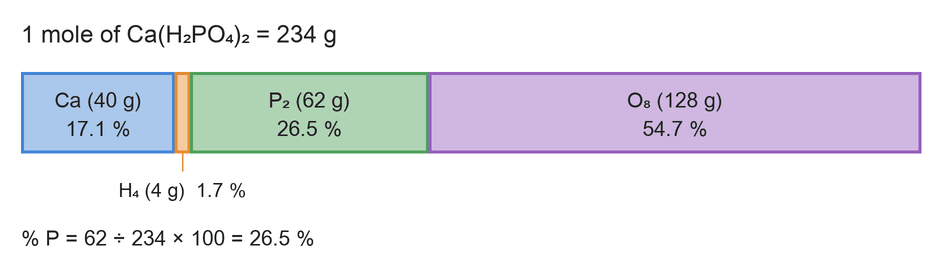
Step 3 — (b) Formula mass of Ca₃(PO₄)₂.
There are 3 Ca and two PO₄ groups.
It also contains 2 × 31 = 62 of phosphorus.
Step 4 — (b) Percentage of phosphorus.
We divide the phosphorus by the formula mass.
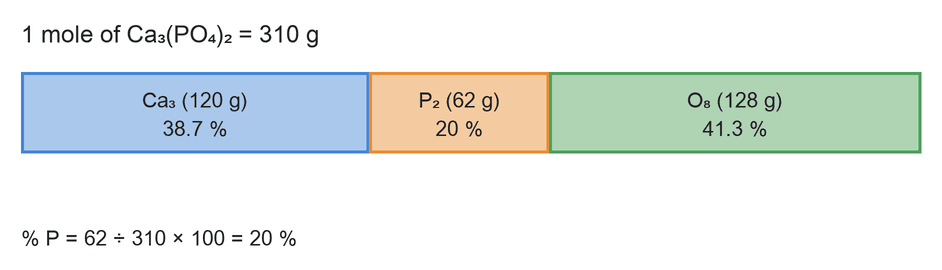
Watch out: Both salts hold 62 of phosphorus, but (b) is the heavier formula unit, so its percentage is smaller.
Therefore, the percentage of phosphorus is (a) 26.5% in calcium hydrogen phosphate and (b) 20% in calcium phosphate.
- 482 marks
Question 48
Calculate the percentage composition of :
Potassium chlorate, .
Solve with AIWritten solution
Solution:
Concept: Percentage composition: the percentage of an element in a compound is .
Step 1 — Find the formula mass.
KClO₃ has 1 K, 1 Cl and 3 O (K = 39, Cl = 35.5, O = 16).
Step 2 — Percentage of potassium.
We divide the mass of K by the formula mass.
Step 3 — Percentage of chlorine.
We divide the mass of Cl by the formula mass.
Step 4 — Percentage of oxygen.
The three oxygen atoms weigh 3 × 16 = 48.
Step 5 — Check the total.
The three percentages should add up to 100.

Therefore, potassium chlorate contains K = 31.84%, Cl = 28.98% and O = 39.18%.
- 492 marks
Question 49
Find the empirical formula of the compounds with the following percentage composition. :
Pb = 62.5%; N = 8.5%; O = 29.0%.
Solve with AIWritten solution
Solution:
Concept: To find an empirical formula (the simplest whole-number ratio of atoms): divide each element's percentage (or mass) by its atomic mass to get the relative number of gram atoms, divide every value by the smallest one, and, if needed, multiply by a small whole number to clear fractions. The molecular formula is n × (empirical formula), where n = molecular mass ÷ empirical formula mass, and molecular mass = 2 × vapour density.
Step 1 — Find the simplest ratio.
We divide each percentage by the atomic mass (Pb = 207, N = 14, O = 16), then by the smallest value, 0.302.
Element % Atomic mass Gram atoms (÷ atomic mass) ÷ smallest Pb 62.5 207 62.5 ÷ 207 = 0.302 1 N 8.5 14 8.5 ÷ 14 = 0.607 2.01 O 29.0 16 29.0 ÷ 16 = 1.813 6 Step 2 — Write the empirical formula.
The ratio Pb : N : O is 1 : 2 : 6, which gives PbN₂O₆. Grouped as nitrate ions (NO₃), this is Pb(NO₃)₂, lead nitrate.
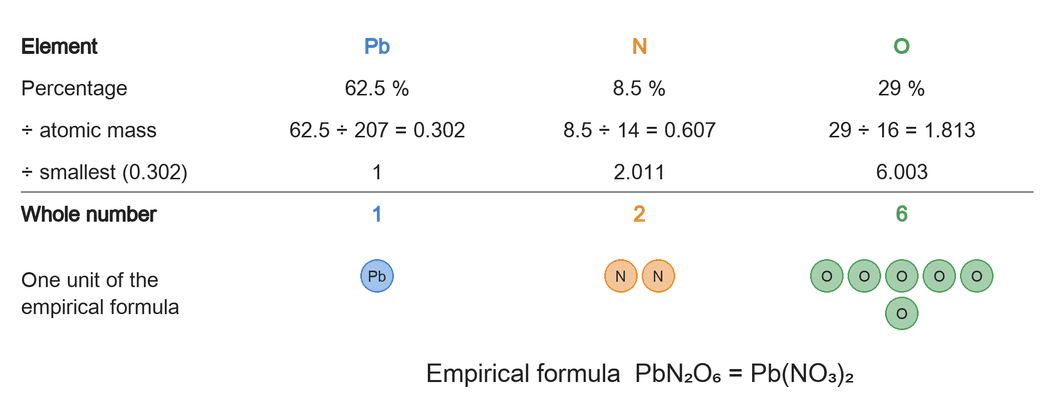
Watch out: Do not round 2.01 to anything other than 2; small differences come only from rounding the data.
Therefore, the empirical formula is PbN₂O₆, that is Pb(NO₃)₂.
- 502 marks
Question 50
Calculate the mass of iron in 10 kg of iron ore which contains 80% of pure ferric oxide.
Solve with AIWritten solution
Solution:
Concept: The mass of an element in a sample is found from its fraction in the compound: for iron in Fe₂O₃, the fraction is (2 × 56) ÷ 160.
Step 1 — Find the mass of ferric oxide.
The ore is 80% pure Fe₂O₃.
Step 2 — Find the fraction of iron.
We find the formula mass of Fe₂O₃ (Fe = 56, O = 16).
Of this, iron makes up 2 × 56 = 112.
Step 3 — Find the mass of iron.
We take 112/160 of the 8 kg of oxide.
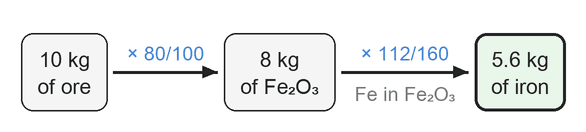
Watch out: Only the 80% that is Fe₂O₃ contains iron; the rest of the ore (impurities) contains none.
Therefore, 10 kg of the ore contains 5.6 kg of iron.
- 512 marks
Question 51
If the empirical formula of two compounds is CH and their vapour densities are 13 and 39 respectively, find their molecular formula.
Solve with AIWritten solution
Solution:
Concept: Molecular mass = 2 × vapour density, and the molecular formula is n × (empirical formula), where n = molecular mass ÷ empirical formula mass.
Step 1 — Find the empirical formula mass.
For CH, the mass is 12 + 1 = 13.
Step 2 — First compound.
We find its molecular mass and then n.
So the molecular formula is (CH)₂ = C₂H₂ (acetylene).
Step 3 — Second compound.
We find its molecular mass and then n.
So the molecular formula is (CH)₆ = C₆H₆ (benzene).
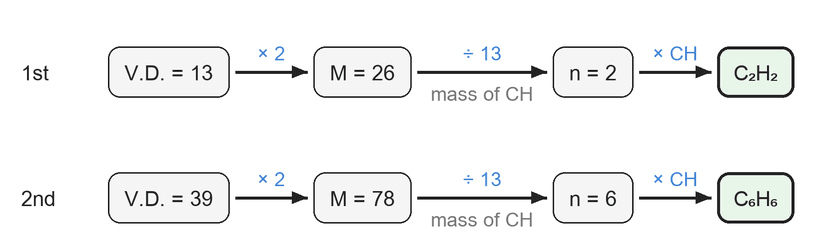
Watch out: Do not divide the vapour density itself by 13; double it first to get the molecular mass.
Therefore, the molecular formulae are C₂H₂ and C₆H₆.
- 522 marks
Question 52
Find the empirical formula of a compound containing 17.64% hydrogen and 82.35% nitrogen.
Solve with AIWritten solution
Solution:
Concept: To find an empirical formula (the simplest whole-number ratio of atoms): divide each element's percentage (or mass) by its atomic mass to get the relative number of gram atoms, divide every value by the smallest one, and, if needed, multiply by a small whole number to clear fractions. The molecular formula is n × (empirical formula), where n = molecular mass ÷ empirical formula mass, and molecular mass = 2 × vapour density.
Step 1 — Find the simplest ratio.
We divide each percentage by the atomic mass (N = 14, H = 1), then by the smallest value, 5.882.
Element % Atomic mass Gram atoms (÷ atomic mass) ÷ smallest N 82.35 14 82.35 ÷ 14 = 5.882 1 H 17.64 1 17.64 3 Step 2 — Write the empirical formula.
The ratio N : H is 1 : 3, so the formula is NH₃ (ammonia).
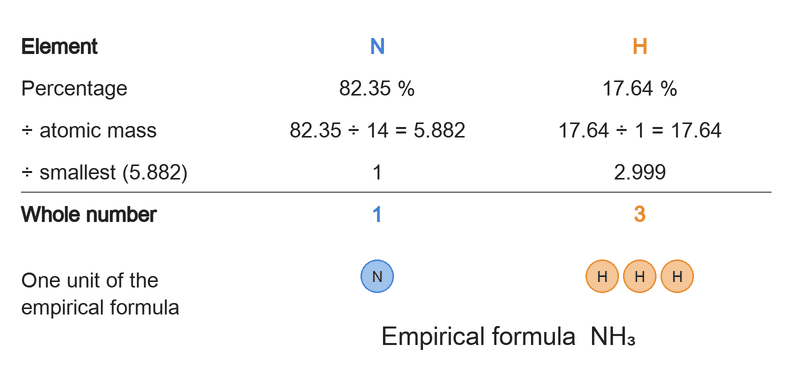
Therefore, the empirical formula is NH₃.
- 534 marks
Question 53
On analysis, a substance was found to contain :
C = 54.54%, H = 9.09%, O = 36.36%.
The vapour density of the substance is 44, calculate :
(a) its empirical formula,
(b) its molecular formula.
Solve with AIWritten solution
Solution:
Concept: To find an empirical formula (the simplest whole-number ratio of atoms): divide each element's percentage (or mass) by its atomic mass to get the relative number of gram atoms, divide every value by the smallest one, and, if needed, multiply by a small whole number to clear fractions. The molecular formula is n × (empirical formula), where n = molecular mass ÷ empirical formula mass, and molecular mass = 2 × vapour density.
Step 1 — (a) Find the simplest ratio.
We divide each percentage by the atomic mass (C = 12, H = 1, O = 16), then by the smallest value, 2.273.
Element % Atomic mass Gram atoms (÷ atomic mass) ÷ smallest C 54.54 12 54.54 ÷ 12 = 4.545 2 H 9.09 1 9.09 4 O 36.36 16 36.36 ÷ 16 = 2.273 1 So C : H : O = 2 : 4 : 1, and the empirical formula is C₂H₄O.
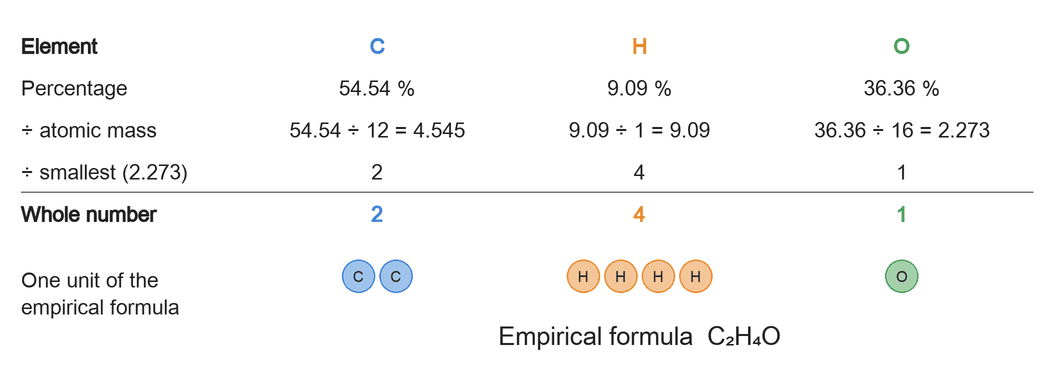
Step 2 — (b) Find the empirical formula mass.
We add the atomic masses in C₂H₄O.
Step 3 — (b) Find the molecular mass and n.
The molecular mass is twice the vapour density.
Step 4 — (b) Write the molecular formula.
We multiply every subscript of C₂H₄O by 2, giving C₄H₈O₂.
Watch out: The vapour density (44) happens to equal the empirical formula mass here; still double it to get the molecular mass (88).
Therefore, (a) the empirical formula is C₂H₄O; (b) the molecular formula is C₄H₈O₂.
- 544 marks
Question 54
An organic compound, whose vapour density is 45, has the following percentage composition,
H = 2.22%; O = 71.19%; and remaining carbon.
Calculate :
(a) its empirical formula,
(b) its molecular formula.
Solve with AIWritten solution
Solution:
Concept: To find an empirical formula (the simplest whole-number ratio of atoms): divide each element's percentage (or mass) by its atomic mass to get the relative number of gram atoms, divide every value by the smallest one, and, if needed, multiply by a small whole number to clear fractions. The molecular formula is n × (empirical formula), where n = molecular mass ÷ empirical formula mass, and molecular mass = 2 × vapour density.
Step 1 — Find the percentage of carbon.
Carbon is the remainder after hydrogen and oxygen.
Step 2 — (a) Find the simplest ratio.
We divide each percentage by the atomic mass, then by the smallest value, 2.216.
Element % Atomic mass Gram atoms (÷ atomic mass) ÷ smallest C 26.59 12 26.59 ÷ 12 = 2.216 1 H 2.22 1 2.22 1 O 71.19 16 71.19 ÷ 16 = 4.449 2.01 So C : H : O = 1 : 1 : 2, and the empirical formula is CHO₂.
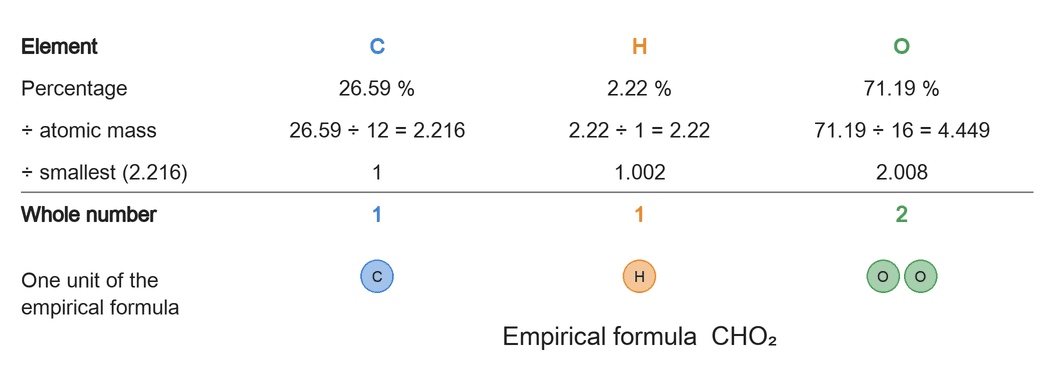
Step 3 — (b) Find n.
The empirical formula mass is 12 + 1 + 32 = 45, and the molecular mass is twice the vapour density.
Step 4 — (b) Write the molecular formula.
We double every subscript of CHO₂, giving C₂H₂O₄ (oxalic acid).
Therefore, (a) the empirical formula is CHO₂; (b) the molecular formula is C₂H₂O₄.
- 554 marks
Question 55
An organic compound contains 4.07% hydrogen, 71.65% chlorine and remaining carbon. Its molar mass is 98.96. Find its,
(a) Empirical formula
(b) Molecular formula
Solve with AIWritten solution
Solution:
Concept: To find an empirical formula (the simplest whole-number ratio of atoms): divide each element's percentage (or mass) by its atomic mass to get the relative number of gram atoms, divide every value by the smallest one, and, if needed, multiply by a small whole number to clear fractions. The molecular formula is n × (empirical formula), where n = molecular mass ÷ empirical formula mass, and molecular mass = 2 × vapour density.
Step 1 — Find the percentage of carbon.
Carbon is the remainder after hydrogen and chlorine.
Step 2 — (a) Find the simplest ratio.
We divide each percentage by the atomic mass (C = 12, H = 1, Cl = 35.5), then by the smallest value, 2.018.
Element % Atomic mass Gram atoms (÷ atomic mass) ÷ smallest C 24.28 12 24.28 ÷ 12 = 2.023 1 H 4.07 1 4.07 2.02 Cl 71.65 35.5 71.65 ÷ 35.5 = 2.018 1 So C : H : Cl = 1 : 2 : 1, and the empirical formula is CH₂Cl.
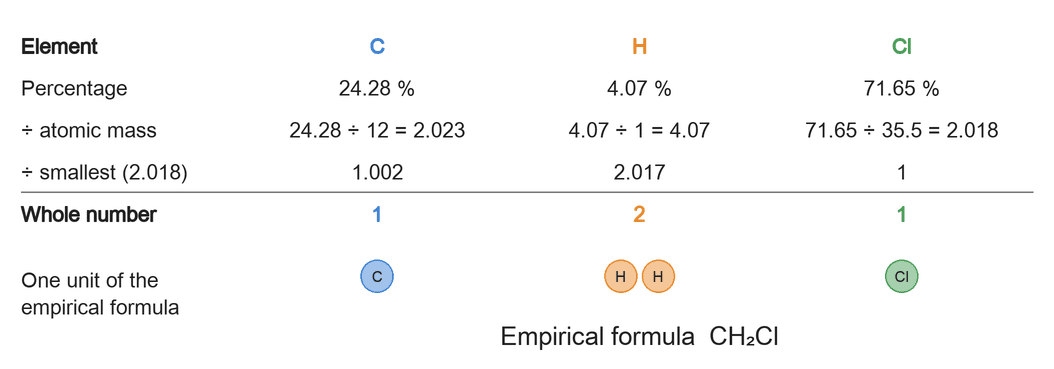
Step 3 — (b) Find n.
The empirical formula mass is 12 + 2 + 35.5 = 49.5, and the molar mass is given as 98.96.
Step 4 — (b) Write the molecular formula.
We double every subscript of CH₂Cl, giving C₂H₄Cl₂ (molar mass 99, which matches 98.96).
Watch out: N must be a whole number; 1.999 rounds to 2 because the data are rounded.
Therefore, (a) the empirical formula is CH₂Cl; (b) the molecular formula is C₂H₄Cl₂.
- 565 marks
Question 56
A hydrocarbon contains 4.8 g of carbon per gram of hydrogen. Calculate :
(a) the gram atom of each,
(b) find the empirical formula,
(c) find molecular formula, if its vapour density is 29.
Solve with AIWritten solution
Solution:
Concept: To find an empirical formula (the simplest whole-number ratio of atoms): divide each element's percentage (or mass) by its atomic mass to get the relative number of gram atoms, divide every value by the smallest one, and, if needed, multiply by a small whole number to clear fractions. The molecular formula is n × (empirical formula), where n = molecular mass ÷ empirical formula mass, and molecular mass = 2 × vapour density. A gram atom is one mole of atoms, so gram atoms = mass ÷ atomic mass.
Step 1 — (a) Gram atoms of carbon.
We divide 4.8 g by the atomic mass of carbon, 12.
Step 2 — (a) Gram atoms of hydrogen.
We divide 1 g by the atomic mass of hydrogen, 1.
Step 3 — (b) Find the simplest whole-number ratio.
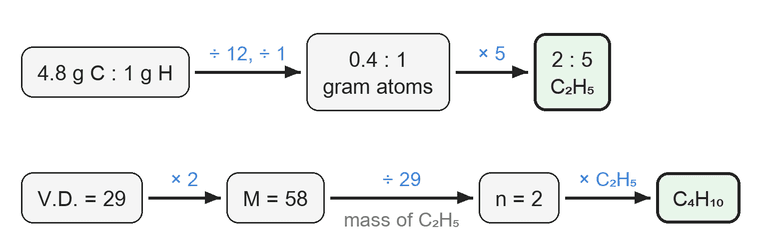
C : H = 0.4 : 1. Dividing by 0.4 gives 1 : 2.5, and multiplying by 2 gives 2 : 5. So the empirical formula is C₂H₅ (mass 24 + 5 = 29).
Step 4 — (c) Find n.
The molecular mass is twice the vapour density.
Step 5 — (c) Write the molecular formula.
We double every subscript of C₂H₅, giving C₄H₁₀ (butane).
Watch out: A ratio of 1 : 2.5 is not finished; multiply by 2 to make it whole.
Therefore, (a) there are 0.4 gram atom of carbon and 1 gram atom of hydrogen; (b) the empirical formula is C₂H₅; (c) the molecular formula is C₄H₁₀.
- 572 marks
Question 57
0.2 g atom of silicon combine with 21.3 g of chlorine. Find the empirical formula of the compound formed.
- 582 marks
Question 58
A gaseous hydrocarbon contains 82.76% of carbon. Given that its vapour density is 29, find its molecular formula.
- 595 marks
Question 59
In a compound of magnesium (Mg = 24) and nitrogen (N = 14), 18 g of magnesium combines with 7g of nitrogen.
Deduce the simplest formula by answering the following questions :
(a) How many gram-atoms of magnesium are equal to 18g ?
(b) How many gram-atoms of nitrogen are equal to 7g of nitrogen ?
(c) Calculate simple ratio of gram-atoms of magnesium to gram-atoms of nitrogen and hence the simplest formula of the compound formed.
- 602 marks
Question 60
Barium chloride crystals contain 14.8% water of crystallisation. Find the number of molecules of water of crystallisation per molecule.
- 612 marks
Question 61
Urea is a very important nitrogenous fertilizer. Its formula is . Calculate the percentage of nitrogen in urea (C = 12, O = 16, N = 14 and H = 1).
- 622 marks
Question 62
Determine the formula of the organic compound if its molecule contains 12 atoms of carbon. The percentage compositions of hydrogen and oxygen are 6.48 and 51.42 respectively.
- 635 marks
Question 63
(a) A compound with empirical formula , has the vapour density equal to its empirical formula weight. Find its molecular formula.
(b) A compound with empirical formula AB has vapour density three times its empirical formula weight. Find the molecular formula.
(c) 10.47 g of a compound contained 6.25 g of metal A and rest non metal B. Calculate the empirical formula of the compound [At. wt of A = 207, B = 35.5].
- 642 marks
Question 64
A hydride of nitrogen contains 87.5 per cent by mass of nitrogen. Determine the empirical formula of this compound.
- 652 marks
Question 65
A compound has O = 61.32%, S = 11.15%, H = 4.88% and Zn = 22.65%. The relative molecular mass of the compound is 287 a.m.u. Find the molecular formula of the compound, assuming that all the hydrogen is present as water of crystallisation.
- 664 marks
Question 66
Note : Atomic mass wherever required should be taken from the table given on the preliminary pages, rounded off to the nearest whole number.
The reaction between 15 g of marble and nitric acid is given by the following equation :
Calculate :
(a) the mass of anhydrous calcium nitrate formed,
(b) the volume of carbon dioxide evolved at STP.
- 675 marks
Question 67
Note : Atomic mass wherever required should be taken from the table given on the preliminary pages, rounded off to the nearest whole number.
66 g ammonium sulphate is produced by the action of ammonia on sulphuric acid.
Write a balanced equation and calculate :
(a) mass of ammonia required,
(b) the volume of the gas used at STP,
(c) the mass of acid required.
- 685 marks
Question 68
Note : Atomic mass wherever required should be taken from the table given on the preliminary pages, rounded off to the nearest whole number.
The reaction between red lead and hydrochloric acid is given below :
Calculate : (a) the mass of lead chloride formed by the action of 6.85 g of red lead, (b) the mass of chlorine and (c) the volume of chlorine evolved at STP.
- 692 marks
Question 69
Note : Atomic mass wherever required should be taken from the table given on the preliminary pages, rounded off to the nearest whole number.
Find the mass of required to produce 126 kg of nitric acid. Find whether a larger or smaller mass of is required for the same purpose.
- 704 marks
Question 70
Note : Atomic mass wherever required should be taken from the table given on the preliminary pages, rounded off to the nearest whole number.
Pure calcium carbonate and dilute hydrochloric acid are reacted and 2 litres of carbon dioxide was collected at 27°C and normal pressure.
Calculate : (a) the mass of salt required,
(b) the mass of the acid required.
- 712 marks
Question 71
Note : Atomic mass wherever required should be taken from the table given on the preliminary pages, rounded off to the nearest whole number.
Calculate the mass and volume of oxygen at STP, which will be evolved on electrolysis of 1 mole (18 g) of water.
- 725 marks
Question 72
Note : Atomic mass wherever required should be taken from the table given on the preliminary pages, rounded off to the nearest whole number.
1.56 g of sodium peroxide reacts with water according to the following equation :
Calculate : (a) mass of sodium hydroxide formed,
(b) volume of oxygen liberated at STP,
(c) mass of oxygen liberated.
- 734 marks
Question 73
Note : Atomic mass wherever required should be taken from the table given on the preliminary pages, rounded off to the nearest whole number.
(a) Calculate the mass of ammonia that can be obtained from 21.4 g of by the reaction :
(b) What will be the volume of ammonia when measured at STP ?
- 744 marks
Question 74
Note : Atomic mass wherever required should be taken from the table given on the preliminary pages, rounded off to the nearest whole number.
Aluminium carbide reacts with water according to the following equation :
(a) What mass of aluminium hydroxide is formed from 12g of aluminium carbide ?
(b) What volume of methane is obtained from 12 g of aluminium carbide ?
- 755 marks
Question 75
Note : Atomic mass wherever required should be taken from the table given on the preliminary pages, rounded off to the nearest whole number.
0.02 moles of pure is heated strongly with conc. HCl. Calculate :
(a) mass of used,
(b) moles of salt formed,
(c) mass of salt formed,
(d) moles of chlorine gas formed,
(e) mass of chlorine gas formed,
(f) volume of chlorine gas formed at STP,
(g) moles of acid required,
(h) mass of acid required.
- 764 marks
Question 76
Note : Atomic mass wherever required should be taken from the table given on the preliminary pages, rounded off to the nearest whole number.
Nitrogen and hydrogen react to form ammonia.
If 1000 g of react with 2000 g of .
(a) Will any of the two reactants remain unreacted ? If yes, which one and what will be its mass ?
(b) Calculate the mass of ammonia () that will be formed.
- 771 mark
Question 77
Which of the following weighs the least ?
- 781 mark
Question 78
Four grams of caustic soda contains :
- 791 mark
Question 79
The number of molecules in 4.25 g of ammonia is :
- 801 mark
Question 80
A gas cylinder of capacity of 20 dm³ is filled with gas X the mass of which is 10 g. When the same cylinder is filled with hydrogen gas at the same temperature and pressure and the mass of the hydrogen is 2 g, the relative molecular mass of the gas will be :
- 811 mark
Question 81
Twice the vapour density gives :
- 821 mark
Question 82
The empirical formula of the compound is , the possible molecular formula can be :
- 831 mark
Question 83
If relative molecular mass of butane () is 58, then its vapour density will be :
- 841 mark
Question 84
If the empirical mass of the formula is 10 and the relative molecular mass is 30, then the molecular formula will be :
- 851 mark
Question 85
The ratio between the number of molecules in 2 g of hydrogen and 32 g of oxygen is :
[Atomic mass : H = 1, O = 16]
- 861 mark
Question 86
One mole of sulphur dioxide represents which of the following ?
P 22.4 litres at STP Q atoms
R molecules
- 871 mark
Question 87
The following questions are Assertion-Reason based questions. Choose the answer based on the codes given below.
(1) Both A and R are true and R is the correct explanation of A.
(2) Both A and R are true but R is not the correct explanation of A.
(3) A is true but R is false.
(4) A is false but R is true.
Assertion (A) : According to gas equation, .
Reason (R) : On combining Boyle's law and Charle's law, 'volume of a given mass of a dry gas varies inversely as the pressure and directly as the absolute temperature.'
- 881 mark
Question 88
The following questions are Assertion-Reason based questions. Choose the answer based on the codes given below.
(1) Both A and R are true and R is the correct explanation of A.
(2) Both A and R are true but R is not the correct explanation of A.
(3) A is true but R is false.
(4) A is false but R is true.
Assertion (A) : The absolute scale of temperature is the Kelvin scale.
Reason (R) : Kelvin scale starts from 0°C.
- 891 mark
Question 89
The following questions are Assertion-Reason based questions. Choose the answer based on the codes given below.
(1) Both A and R are true and R is the correct explanation of A.
(2) Both A and R are true but R is not the correct explanation of A.
(3) A is true but R is false.
(4) A is false but R is true.
Assertion (A) : Triatomic molecules consist of four atoms.
Reason (R) : Monoatomic molecules contain only one atom.
- 901 mark
Question 90
The following questions are Assertion-Reason based questions. Choose the answer based on the codes given below.
(1) Both A and R are true and R is the correct explanation of A.
(2) Both A and R are true but R is not the correct explanation of A.
(3) A is true but R is false.
(4) A is false but R is true.
Assertion (A) : One litre of hydrogen weighs the same as one litre of oxygen.
Reason (R) : One litre of hydrogen contains the same number of molecules as one litre of oxygen.
- 911 mark
Question 91
The following questions are Assertion-Reason based questions. Choose the answer based on the codes given below.
(1) Both A and R are true and R is the correct explanation of A.
(2) Both A and R are true but R is not the correct explanation of A.
(3) A is true but R is false.
(4) A is false but R is true.
Assertion (A) : Atomic mass is expressed in atomic mass unit.
Reason (R) : Atomic mass is defined as times the mass of carbon-12.
- 921 mark
Question 92
The following questions are Assertion-Reason based questions. Choose the answer based on the codes given below.
(1) Both A and R are true and R is the correct explanation of A.
(2) Both A and R are true but R is not the correct explanation of A.
(3) A is true but R is false.
(4) A is false but R is true.
Assertion (A) : Sulphur is an octatomic molecule.
Reason (R) : The number of atoms in a molecule of an element is known as atomicity.
- 931 mark
Question 93
The following questions are Assertion-Reason based questions. Choose the answer based on the codes given below.
(1) Both A and R are true and R is the correct explanation of A.
(2) Both A and R are true but R is not the correct explanation of A.
(3) A is true but R is false.
(4) A is false but R is true.
Assertion (A) : One mole of a gas occupies 24.4 litres at S.T.P.
Reason (R) : The mass of one mole of a gas is equal to its molecular mass.
- 943 marks
Question 94
Complete the following blanks in the equation as indicated.
(a) Moles : 1 mole + ............ → ............ + ............
(b) Grams : 42 g + ............ → ............ + ............
(c) Molecules : + ........ → ........ + ........
- 954 marks
Question 95
Correct the statements, if required.
(a) One mole of chlorine contains atoms of chlorine,
(b) Under similar conditions of temperature and pressure, two volumes of hydrogen combined with two volumes of oxygen will give two volumes of water vapour,
(c) Relative atomic mass of an element is the number of times one molecule of an element is heavier than 1/12 the mass of an atom of carbon [C¹²],
(d) Under the same conditions of the temperature and pressure, equal volumes of all gases contain the same number of atoms.
- 961 mark
Question 96
The gases hydrogen, oxygen, carbon dioxide, sulphur dioxide and chlorine are arranged in order of their increasing relative molecular masses. Given 8 g of each gas at STP, which gas will contain the least number of molecules and which gas the most ?
- 975 marks
Question 97
Define or explain the terms :
(a) vapour density,
(b) molar volume,
(c) relative atomic mass,
(d) relative molecular mass,
(e) Avogadro's number,
(f) Gram atom,
(g) Mole.
- 984 marks
Question 98
State :
(a) Gay-Lussac's Law of combining volumes,
(b) Avogadro's law.
- 995 marks
Question 99
Explain why ?
(a) The number of atoms in a certain volume of hydrogen is twice the number of atoms in the same volume of helium at the same temperature and pressure.
(b) When stating the volume of a gas, the pressure and temperature should also be given.
(c) Inflating a balloon seems to violate Boyle's law.
- 1002 marks
Question 100
Explain the terms, empirical formula and molecular formula.
- 1013 marks
Question 101
Give three kinds of information conveyed by the formula .
- 1025 marks
Question 102
(a) What do you mean by stoichiometry ?
(b) Define atomicity of a gas. State the atomicity of Hydrogen, Phosphorus and Sulphur.
(b) Differentiate between and 2N.
- 1035 marks
Question 103
(a) What are the main applications of Avogadro's Law ?
(b) How does Avogadro's Law explain Gay-Lussac's Law of combining volumes?
- 1045 marks
Question 104
(a) The relative atomic mass of Cl atom is 35.5 a.m.u. Explain this statement.
(b) What is the value of Avogadro's number ?
(c) What is the value of molar volume of a gas at S.T.P.?
- 1052 marks
Question 105
From the equation for burning of hydrogen and oxygen
write down the number of mole (or moles) of steam obtained from 0.5 moles of oxygen.
- 1064 marks
Question 106
From the equation,
(At. mass Cu = 64, H = 1, N = 14, O = 16)
calculate :
(a) mass of copper needed to react with 63 g of ,
(b) volume of nitric oxide at STP that can be collected.
- 1075 marks
Question 107
(a) Calculate the number of moles in 7 g of nitrogen.
(b) What is the volume at STP of 7.1 g of chlorine?
(c) What is the mass of 56 cm³ of carbon monoxide at STP?
- 1082 marks
Question 108
Some of the fertilizers are sodium nitrate , ammonium sulphate and urea . Which of these contains the highest percentage of nitrogen ?
- 1092 marks
Question 109
200 cm³ of is collected at STP when a mixture of acetylene and oxygen is ignited. Calculate the volume of acetylene and oxygen at STP in original mixture
- 1102 marks
Question 110
Urea [] is an important nitrogeneous fertilizer, and is sold in 50 kg sacks. What mass of nitrogen is in one sack of urea ?
- 1112 marks
Question 111
Find the molecular formula of a hydrocarbon having vapour density 15, which contains 20% of Hydrogen.
- 1125 marks
Question 112
The following experiment was performed in order to determine the formula of a hydrocarbon. The hydrocarbon X is purified by fractional distillation.
0.145 g of X was heated with dry copper (II) oxide and 224 cm³ of carbon dioxide was collected at STP.
(a) Which elements does X contain ?
(b) What was the purpose of Copper (II) oxide ?
(c) Calculate the empirical formula of X by the following steps :
(i) Calculate the number of moles of carbon dioxide gas.
(ii) Calculate the mass of carbon contained in this quantity of carbon dioxide and thus the mass of carbon in sample X.
(iii) Calculate the mass of hydrogen in sample X.
(iv) Deduce the ratio of atoms of each element in X (empirical formula).
- 1132 marks
Question 113
A compound is formed by 24 g of X and 64 g of oxygen. If atomic mass of X = 12 and O = 16, calculate the simplest formula of the compound.
- 1144 marks
Question 114
A gas cylinder filled with hydrogen holds 5 g of the gas. The same cylinder holds 85 g of gas X under same temperature and pressure. Calculate :
(a) vapour density of gas X,
(b) molecular weight of gas X.
- 1155 marks
Question 115
(a) When carbon dioxide is passed over red hot carbon, carbon monoxide is produced according to the equation :
What volume of carbon monoxide at STP can be obtained from 3 g of carbon ?
(b) 60 cm³ of oxygen was added to 24 cm³ of carbon monoxide and mixture ignited. Calculate :
(i) volume of oxygen used up and
(ii) volume of carbon dioxide formed.
- 1162 marks
Question 116
How much calcium oxide is obtained by heating 82 g of calcium nitrate ? Also find the volume of evolved :
- 1175 marks
Question 117
The equation for the burning of octane is :
(i) How many moles of carbon dioxide are produced when one mole of octane burns?
(ii) What volume, at STP, is occupied by the number of moles determined in (i) ?
(iii) If the relative molecular mass of carbon dioxide is 44, what is the mass of carbon dioxide produced by burning two moles of octane ?
(iv) What is the empirical formula of octane ?
- 1182 marks
Question 118
Ordinary chlorine gas has two isotopes Cl and Cl in the ratio of 3 : 1. Calculate the relative atomic mass of chlorine.
- 1192 marks
Question 119
Silicon (Si = 28) forms a compound with chlorine (Cl = 35.5) in which 5.6 g of silicon combines with 21.3 g of chlorine. Calculate the empirical formula of the compound.
- 1204 marks
Question 120
An acid of phosphorus has the following percentage composition; Phosphorus = 38.27%; hydrogen = 2.47%; oxygen = 59.26%. Find the empirical formula of the acid and its molecular formula, given that its relative molecular mass is 162.
- 1214 marks
Question 121
(a) Calculate the mass of substance 'A' which in gaseous form occupies 10 litres at 27°C and 700 mm pressure. The molecular mass of 'A' is 60.
(b) A gas occupied 360 cm³ at 87°C and 380 mm Hg pressure. If the mass of gas is 0.546 g, find its relative molecular mass.
- 1224 marks
Question 122
A gas cylinder can hold 1 kg of hydrogen at room temperature and pressure. (a) What mass of carbon dioxide can it hold under similar conditions of temperature and pressure? (b) If the number of molecules of hydrogen in the cylinder is X, calculate the number of carbon dioxide molecules in the cylinder. State the law that helped you to arrive at the above result.
- 1235 marks
Question 123
Following questions refer to one mole of chlorine gas.
(a) What is the volume occupied by this gas at STP?
(b) What will happen to volume of gas, if pressure is doubled ?
(c) What volume will it occupy at 273°C ?
(d) If the relative atomic mass of chlorine is 35.5, what will be the mass of 1 mole of chlorine gas?
- 1245 marks
Question 124
(a) A hydrate of calcium sulphate contains 21% water of crystallisation. Find the value of .
(b) What volume of hydrogen and oxygen measured at STP will be required to prepare 1.8 g of water.
(c) How much volume will be occupied by 2 g of dry oxygen at 27°C and 740 mm pressure ?
(d) What would be the mass of occupying a volume of 44 litres at 25°C and 750 mm pressure.
(e) 1 g of a mixture of sodium chloride and sodium nitrate is dissolved in water. On adding silver nitrate solution, 1.435 g of AgCl is precipitated.
Calculate the precentage of NaCl in the mixture.
- 1255 marks
Question 125
(a) From the equation :
Calculate :
(i) the mass of carbon oxidized by 49 g of sulphuric acid.
(ii) The volume of sulphur dioxide measured at STP, liberated at the same time.
(b) (i) A compound has the following percentage composition by mass : carbon 14.4%, hydrogen 1.2% and chlorine 84.5%. Determine the empirical formula of this compound. Work correct to 1 decimal place. (H = 1; C = 12; Cl = 35.5)
(ii) The relative molecular mass of this compound is 168, so what is its molecular formula ?
- 1265 marks
Question 126
Find the percentage of
(a) oxygen in magnesium nitrate crystals [].
(b) boron in . [H = 1, B = 11, O = 16, Na = 23].
(c) phosphorus in the fertilizer superphosphate .
- 1272 marks
Question 127
What mass of copper hydroxide is precipitated by using 200 gm of sodium hydroxide ?
[Cu = 64, Na = 23, S = 32, H = 1]
- 1285 marks
Question 128
Solid ammonium dichromate decomposes as under :
If 63 g of ammonium dichromate decomposes, calculate:
(a) the quantity in moles of
(b) the quantity in moles of nitrogen formed
(c) the volume of evolved at STP.
(d) the loss of mass
(e) the mass of chromium (III) oxide formed at the same time.
- 1292 marks
Question 129
Hydrogen sulphide gas burns in oxygen to yield 12.8 g of sulphur dioxide gas as under :
Calculate the volume of hydrogen sulphide at STP. Also, calculate the volume of oxygen required at STP which will complete the combustion of hydrogen sulphide determined in litres.
- 1302 marks
Question 130
Ammonia burns in oxygen and the combustion, in the presence of a catalyst, may be represented by;
[H = 1; N = 14; O = 16]. What mass of steam is produced when 1.5 g of nitrogen monoxide is formed ?
- 1312 marks
Question 131
If a crop of wheat removes 20 kg of nitrogen per hectare of soil, what mass of the fertilizer, calcium nitrate would be required to replace the nitrogen in a 10 hectare field ?
- 1325 marks
Question 132
Concentrated nitric acid oxidises phosphorus to phosphoric acid according to the following equation:
If 6.2 g of phosphorus was used in the reaction, calculate :
(a) Number of moles of phosphorus taken and mass of phosphoric acid formed.
(b) Mass of nitric acid consumed at the same time.
(c) The volume of steam produced at the same time if measured at 760 mm Hg pressure and 273°C.
- 1334 marks
Question 133
112 cm³ of a gaseous fluoride of phosphorus has a mass of 0.63 g. Calculate the relative molecular mass of the fluoride. If the molecule of the fluoride contains only one atom of phosphorus, then determine the formula of the phosphorus fluoride. [F = 19; P = 31].
- 1342 marks
Question 134
Washing soda has the formula . What mass of anhydrous sodium carbonate is left when all the water of crystallization is expelled by heating 57.2 g of washing soda ?
- 1352 marks
Question 135
A metal M forms a volatile chloride containing 65.5% chlorine. If the density of the chloride relative to hydrogen is 162.5, find the molecular formula of the chloride (M=56).
- 1364 marks
Question 136
A compound X consists of 4.8% carbon and 95.2% bromine by mass :
(i) Determine the empirical formula of this compound working correct to one decimal place (C = 12; Br = 80).
(ii) If the vapour density of the compound is 252, what is the molecular formula of the compound ?
- 1372 marks
Question 137
The reaction : takes place in the gaseous state. If all volumes are measured at the same temperature and pressure, calculate the volume of dinitrogen oxide () required to give 150 cm³ of steam.
- 1385 marks
Question 138
Samples of the gases , , and CO under the same conditions of temperature and pressure contain the same number of molecules . The molecules of oxygen occupy V litres and have a mass of 8 g under the same conditions of temperature and pressure.
What is the volume occupied by :
(a) molecules of ,
(b) molecules of CO,
(c) What is the mass of in grams ?
(d) In answering the above questions, which law have you used ?
- 1392 marks
Question 139
The percentage composition of sodium phosphate as determined by analysis is 42.1% sodium, 18.9% phosphorus and 39% oxygen. Find the empirical formula of the compound.
- 1402 marks
Question 140
What volume of oxygen is required to burn completely a mixture of 22.4 dm³ of methane and 11.2 dm³ of hydrogen into carbon dioxide and steam ?
- 1412 marks
Question 141
An experiment showed that in a lead chloride solution, 6.21 g of lead is combined with 4.26 g of chlorine. What is the empirical formula of this chloride ?
(Pb = 207; Cl = 35.5).
- 1422 marks
Question 142
10 g of a mixture of sodium chloride and anhydrous sodium sulphate is dissolved in water. An excess of barium chloride solution is added and 6.99 g of barium sulphate is precipitated according to the equation given below :
Calculate the percentage of sodium sulphate in the original mixture.
- 1434 marks
Question 143
When heated, potassium permanganate decomposes according to the following equation :
( + form the solid residue.)
(a) Some potassium permanganate was heated in the test tube. After collecting one litre of oxygen at room temperature, it was found that the test tube had undergone a loss in mass of 1.32 g. If one litre of hydrogen under the same conditions of temperature and pressure has a mass of 0.0825 g, calculate the relative molecular mass of oxygen.
(b) Given that the molecular mass of potassium permanganate is 158, what volume of oxygen (measured at room temperature) would be obtained by the complete decomposition of 15.8 g of potassium permanganate ? (Molar volume at room temperature is 24 litres).
- 1445 marks
Question 144
A flask contains 3.2 g of sulphur dioxide. Calculate the following :
(a) The moles of sulphur dioxide present in the flask.
(b) The number of molecules of sulphur dioxide present in the flask.
(c) The volume occupied by 3.2 g of sulphur dioxide at STP.
(S = 32, O = 16)
- 1455 marks
Question 145
The volumes of gases A, B, C and D are in the ratio, 1 : 2 : 2 : 4 under the same conditions of temperature and pressure.
(i) Which sample of gas contains the maximum number of molecules ?
(ii) If the temperature and the pressure of gas A are kept constant, then what will happen to the volume of A when the number of molecules is doubled ?
(iii) If this ratio of gas volume refers to the reactants and products of a reaction, which gas law is being observed ?
(iv) If the volume of A is actually 5.6 dm³ at STP, calculate the number of molecules in the actual volume of D at STP (Avogadro's Number is 6 x 10²³).
(v) Using your answer from (iv), state the mass of D if the gas is dinitrogen oxide ().
- 1464 marks
Question 146
The equations given below relate to the manufacture of sodium carbonate (molecular weight of = 106).
Equation (1):
Equation (2):
Equations (1) and (2) are based on the production of 21.2 g of sodium carbonate.
(a) What mass of sodium hydrogen carbonate must be heated to give 21.2 g of sodium carbonate?
(b) To produce the mass of sodium hydrogen carbonate calculated in (a), what volume of carbon dioxide, measured at STP, would be required ?
- 1475 marks
Question 147
A sample of ammonium nitrate when heated yields 8.96 litres of steam (measure at STP).
(i) What volume of dinitrogen oxide is produced at the same time as 8.96 litres of steam ?
(ii) What mass of ammonium nitrate should be heated to produce 8.96 litres of steam ? (Relative molecular mass of ammonium nitrate is 80).
(iii) Determine the percentage of oxygen in ammonium nitrate (O = 16).
- 1482 marks
Question 148
Given that the relative molecular mass of copper oxide is 80, what volume of ammonia (measured at STP) is required to completely reduce 120g of copper oxide?
The equation for the reaction is :
- 1494 marks
Question 149
(a) Calculate the number of moles and the number of molecules present in 1.4 g of ethylene gas. What is the volume occupied by the same amount of ethylene?
(b) What is the vapour density of ethylene ?
- 1504 marks
Question 150
(a) Calculate the percentage of sodium in sodium aluminium fluoride () correct to the nearest whole number. (F = 19; Na = 23; Al = 27)
(b) 560 ml of carbon monoxide is mixed with 500 ml of oxygen and ignited. The chemical equation for the reaction is as follows :
Calculate the volume of oxygen used and carbon dioxide formed in the above reaction.
- 1515 marks
Question 151
(a) Calcium carbide is used for the artificial ripening of fruits. Actually the fruit ripens because of the heat evolved while calcium carbide reacts with moisture. During this reaction calcium hydroxide and acetylene gas are formed. If 200 cm³ of acetylene is formed from a certain mass of calcium carbide, find the volume of oxygen required and carbon dioxide formed during the complete combustion. The combustion reaction can be represented as below.
(b) A gaseous compound of nitrogen and hydrogen contains 12.5% hydrogen by mass. Find the molecular formula of the compound if its relative molecular mass is 37. [N = 14, H = 1].
(c) A gas cylinder contains 24 × 10²⁴ molecules of nitrogen gas. If Avogadro's number is 6 × 10²³ and the relative atomic mass of nitrogen is 14, calculate :
(i) Mass of nitrogen gas in the cylinder
(ii) Volume of nitrogen at STP in dm³.
(d) Commercial sodium hydroxide weighing 30 g has some sodium chloride in it. The mixture on dissolving in water and subsequent treatment with excess silver nitrate solution formed a precipitate weighing 14.3 g. What is the percentage of sodium chloride in the commercial sample of sodium hydroxide ? The equation for the reaction is
[Relative molecular mass of NaCl = 58; = AgCl = 143]
(e) A certain gas 'X' occupies a volume of 100 cm³ at S.T.P. and weighs 0.5 g. Find its relative molecular mass.
- 1525 marks
Question 152
(a) (i) LPG stands for liquefied petroleum gas. Varieties of LPG are marketed including a mixture of propane (60%) and butane (40%). If 10 litres of this mixture is burnt, find the total volume of carbon dioxide gas added to the atmosphere. Combustion reactions can be represented as :
(ii) Calculate the percentage of nitrogen and oxygen in ammonium nitrate. [Relative molecular mass of ammonium nitrate is 80, H = 1, N = 14, O = 16].
(b) 4.5 moles of calcium carbonate are reacted with dilute hydrochloric acid.
(i) Write the equation for the reaction.
(ii) What is the mass of 4.5 moles of calcium carbonate ? (Relative molecular mass of calcium carbonate is 100).
(iii) What is the volume of carbon dioxide liberated at STP ?
(iv) What mass of calcium chloride is formed ? (Relative molecular mass of calcium chloride is 111).
(v) How many moles of HCl are used in this reaction ?
- 1535 marks
Question 153
(a) (i) Calculate the volume of 320 g of at STP. (Atomic mass : S = 32 and O = 16).
(ii) State Gay-Lussac's Law of combining volumes.
(iii) Calculate the volume of oxygen required for the complete combustion of 8.8 g of propane (). (Atomic mass : C = 12, O = 16, H = 1, Molar Volume = 22.4 dm³ at STP.)
(b) (i) An organic compound with vapour density = 94 contains C = 12.67%, H = 2.13%, and Br = 85.11%. Find the molecular formula.
[Atomic mass : C = 12, H = 1, Br = 80]
(ii) Calculate the mass of :
(1) 10²² atoms of sulphur.
(2) 0.1 mole of carbon dioxide.
[Atomic mass : S = 32, C = 12 and O = 16 and Avogadro's Number = 6 × 10²³]
- 1545 marks
Question 154
(a) Concentrated nitric acid oxidises phosphorus to phosphoric acid according to the following equation:
If 9.3 g of phosphorus was used in the reaction, calculate :
(i) Number of moles of phosphorus taken.
(ii) The mass of phosphoric acid formed.
(iii) The volume of nitrogen dioxide produced at STP.
(b) (i) 67.2 litres of hydrogen combines with 44.8 litres of nitrogen to form ammonia under specific conditions as :
Calculate the volume of ammonia produced. What is the other substance, if any, that remains in the resultant mixture ?
(ii) The mass of 5.6 dm³ of a certain gas at STP is 12.0 g. Calculate the relative molecular mass of the gas.
(iii) Find the total percentage of Magnesium in magnesium nitrate crystals, .
[Mg = 24, N = 14, O = 16 and H = 1]
- 1555 marks
Question 155
(a) (i) What volume of oxygen is required to burn completely 90 dm³ of butane under similar conditions of temperature and pressure ?
(ii) The vapour density of a gas is 8. What would be the volume occupied by 24.0 g of the gas at STP ?
(iii) A vessel contains X number of molecules of hydrogen gas at a certain temperature and pressure. How many molecules of nitrogen gas would be present in the same vessel under the same conditions of temperature and pressure?
(b) is evolved by heating using as a catalyst.
(i) Calculate the mass of required to produce 6.72 litre of at STP.
[atomic masses of K = 39, Cl = 35.5, O = 16].
(ii) Calculate the number of moles of oxygen present in the above volume and also the number of molecules.
(iii) Calculate the volume occupied by 0.01 mole of at STP.
- 1565 marks
Question 156
(a) (i) Oxygen oxidises ethyne to carbon dioxide and water as shown by the equation:
What volume of ethyne gas at s.t.p. is required to produce 8.4 dm³ of carbon dioxide at STP ? [H = 1, C = 12, O = 16]
(ii) A compound made up of two elements X and Y has an empirical formula . If the atomic weight of X is 10 and that of Y is 5 and the compound has a vapour density (V.D.) 25, find its molecular formula.
(b) A cylinder contains 68 g of Ammonia gas at STP
(i) What is the volume occupied by this gas ?
(ii) How many moles of ammonia are present in the cylinder ?
(iii) How many molecules of ammonia are present in the cylinder ?
- 1572 marks
Question 157
In an experiment, 6.21 g of lead is combined with 4.26 g of chlorine. What is the empirical formula of the resulting compound ?
- 1582 marks
Question 158
An organic compound with vapour density 94 contains H = 2.13% and Br = 85.11%. Find its molecular formula.
- 1594 marks
Question 159
A compound A consists of 4.8% carbon and 95.2% bromine by mass. Its vapour density is 252. Find its :
(i) empirical formula
(ii) molecular formula
What Class 10 Chemistry Ch 5 covers
The sections of the chapter, in the order the book takes them. Every question above comes from one of these.
- 01Gay-Lussac's Law of Combining Volumes
- 02Avogadro's Law
- 03Relative Atomic Mass and Relative Molecular Mass
- 04Mole Concept
- 05Vapour Density and Its Relation to Relative Molecular Mass
- 06Percentage Composition
More ways to study this chapter
The same chapter asked three other ways. Practise it, revise it, and see what the board has set on Ch 5 before.
- Competency-Based Questions (CBQ)Case study questions: a situation, and the part of the chapter that answers it.40questionsOpen
- Previous Year QuestionsQuestions that have actually appeared in board papers, each tagged with its year.55questionsOpen
- Practice QuestionsExtra questions per chapter, for when one attempt at a method is not enough.52questionsOpen
Ch 5 in past ICSE papers
The same chapter as the board has actually asked it. These are worded differently from the textbook exercise, which is the point of reading them.
- 11 mark
Board paper question 1
The ratio between the number of molecules in 2g of hydrogen and 32g of oxygen is:
[Given that H=1, O=16]
Solve with AIAnswer
(A) 1:2
(B) 1:0.01
- Correct
(C) 1:1
(D) 0.01:1
Answer: (C) 1:1
Concept: The mole concept: one mole of any substance contains the Avogadro number, , of particles (atoms, molecules or formula units), and its mass in grams equals its atomic or molecular mass (the gram atomic / gram molecular mass). So and . So equal numbers of moles always contain equal numbers of molecules, whatever the gas.
Step 1 — Find the moles of hydrogen.
The molar mass of hydrogen gas, H₂, is 2 × 1 = 2 g, so we divide the mass by 2 g.
Step 2 — Find the moles of oxygen.
The molar mass of oxygen gas, O₂, is 2 × 16 = 32 g, so we divide the mass by 32 g.
Step 3 — Compare the numbers of molecules.
Both samples are exactly 1 mole, so each contains 6.022 × 10²³ molecules. Equal numbers of molecules give the ratio 1 : 1.
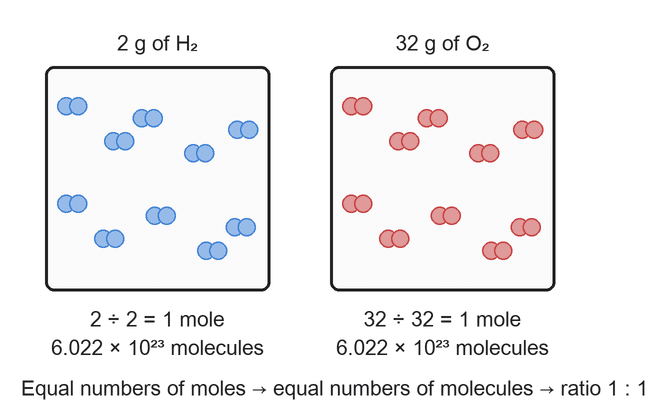
Watch out: Do not compare the masses (2 g and 32 g). It is equal numbers of moles, not equal masses, that give equal numbers of molecules.
Why the other options are wrong:
- (A) 1:2: a ratio of 1 : 2 would need 2 moles of oxygen, that is 64 g; 32 g of oxygen is only 1 mole, the same as the hydrogen.
- (B) 1:0.01: this would mean the oxygen has only one-hundredth as many molecules, which would be 0.01 mole or 0.32 g of oxygen, not 32 g.
- (D) 0.01:1: this would mean the hydrogen has only one-hundredth as many molecules, which would be 0.01 mole or 0.02 g of hydrogen, not 2 g.
Therefore, 2 g of hydrogen and 32 g of oxygen contain molecules in the ratio 1 : 1, option (C).
- 25 marks
Board paper question 2
(i) A gas of mass 32 gms has a volume of 20 litres at S.T.P. Calculate the gram molecular weight of the gas.
(ii) How much Calcium oxide is formed when 82 g of calcium nitrate is heated? Also find the volume of nitrogen dioxide evolved:
[Ca = 40, N = 14, O = 16]
Solve with AIWritten solution
Solution:
Concept: The mole concept: one mole of any substance contains the Avogadro number, , of particles (atoms, molecules or formula units), and its mass in grams equals its atomic or molecular mass (the gram atomic / gram molecular mass). So and . Molar volume: one mole of any gas occupies 22.4 litres (22400 cm³) at S.T.P. (273 K and 760 mm of Hg, that is 1 atm). Stoichiometry: the coefficients of a balanced equation give the ratio of moles in which substances react and form. So we change the given quantity to moles (mass ÷ molar mass, or volume at S.T.P. ÷ 22.4 L), use the mole ratio, and change back to mass (moles × molar mass) or volume (moles × 22.4 L at S.T.P.).
(i) Gram molecular weight of the gas
Step 1 — Write what is given.
We know that 20 L of the gas at S.T.P. weighs 32 g. The gram molecular weight is the mass of one mole, that is, of 22.4 L at S.T.P.
Step 2 — Scale the mass up to 22.4 L.
The mass is proportional to the volume, so we multiply the mass of 1 L (32 ÷ 20 g) by 22.4.
So one mole of the gas weighs 35.84 g, and its relative molecular mass is 35.84.
(ii) Calcium oxide formed and nitrogen dioxide evolved
Step 3 — Write the balanced equation and the molar masses.
The equation shows the mole ratio in which the substances react and form.
Using Ca = 40, N = 14 and O = 16, we work out the two molar masses we need.
Step 4 — Change 82 g of calcium nitrate to moles.
We divide the mass by the molar mass.
Step 5 — Find the mass of calcium oxide.
The equation shows that 2 moles of Ca(NO₃)₂ give 2 moles of CaO, a 1 : 1 ratio, so 0.5 mol of calcium nitrate gives 0.5 mol of calcium oxide. We then multiply by its molar mass.
Step 6 — Find the volume of nitrogen dioxide.
The equation shows that 2 moles of Ca(NO₃)₂ give 4 moles of NO₂, a 1 : 2 ratio, so 0.5 mol gives 1 mol of NO₂. One mole of a gas occupies 22.4 L at S.T.P.
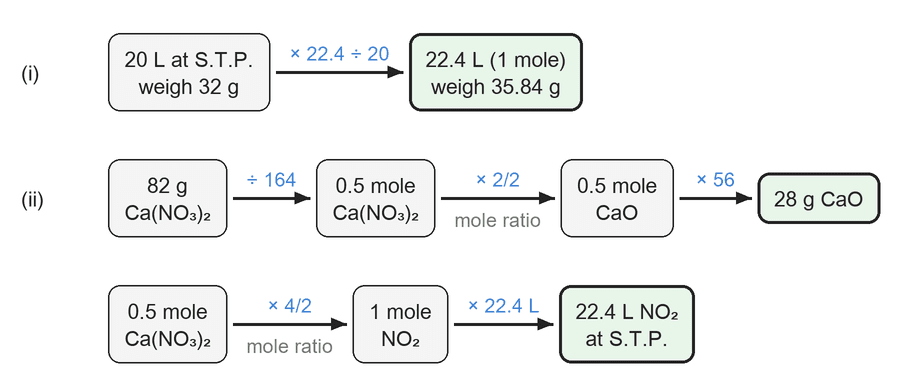
Watch out: The coefficients give MOLES, not grams: change 82 g to moles first, use the mole ratio, and only then change back to grams or litres.
Note: As the question expects, nitrogen dioxide is treated as a gas at S.T.P. (Real NO₂ condenses, mostly as N₂O₄, below about 21 °C, so this is the ideal-gas volume the mole method gives.)
Therefore, (i) the gram molecular weight of the gas is 35.84 g; (ii) 28 g of calcium oxide is formed and 22.4 litres of nitrogen dioxide (at S.T.P.) is evolved.
- 32 marks
Board paper question 3
A gas cylinder contains molecules of oxygen gas. If Avogadro's number is ; Calculate:
(i) the mass of oxygen present in the cylinder.
(ii) the volume of oxygen at S.T.P. present in the cylinder. [O=16]
Solve with AIWritten solution
Solution:
Concept: The mole concept: one mole of any substance contains the Avogadro number, , of particles (atoms, molecules or formula units), and its mass in grams equals its atomic or molecular mass (the gram atomic / gram molecular mass). So and . Molar volume: one mole of any gas occupies 22.4 litres (22400 cm³) at S.T.P. (273 K and 760 mm of Hg, that is 1 atm).
Step 1 — Change the number of molecules to moles.
One mole contains Avogadro's number of molecules, which the question gives as 6 × 10²³, so we divide by it.
(i) Mass of oxygen
Step 2 — Multiply the moles by the molar mass.
The molar mass of oxygen gas, O₂, is 2 × 16 = 32 g, so each mole weighs 32 g.
(ii) Volume of oxygen at S.T.P.
Step 3 — Multiply the moles by the molar volume.
Each mole of a gas occupies 22.4 L at S.T.P.
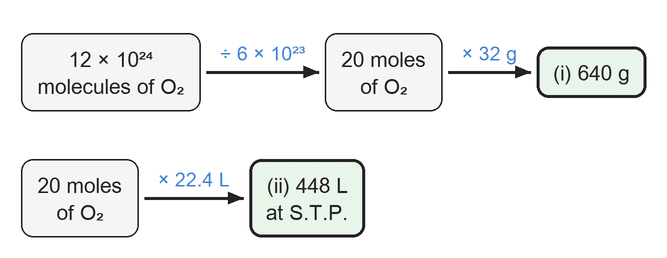
Watch out: The gas is O₂ (molar mass 32 g), not O atoms (16 g); the molecules in the cylinder are O₂ molecules.
Therefore, (i) the cylinder holds 640 g of oxygen and (ii) this oxygen occupies 448 litres at S.T.P.
- 43 marks
Board paper question 4
A gaseous hydrocarbon contains 82.76% of carbon. Given that its vapour density is 29, find its molecular formula.
[C=12, H=1]
Solve with AIWritten solution
Solution:
Concept: To find an empirical formula (the simplest whole-number ratio of atoms): divide each element's percentage (or mass) by its atomic mass to get the relative number of gram atoms, divide every value by the smallest one, and, if needed, multiply by a small whole number to clear fractions. The molecular formula is n × (empirical formula), where n = molecular mass ÷ empirical formula mass, and molecular mass = 2 × vapour density.
Step 1 — Find the percentage of hydrogen.
A hydrocarbon contains only carbon and hydrogen, so the rest of the 100 % is hydrogen.
Step 2 — Find the empirical formula.
We divide each percentage by the atomic mass and then by the smallest value (6.897). The hydrogen value is 2.5, not a whole number, so we multiply both values by 2.
Element % Atomic mass Gram atoms (÷ atomic mass) ÷ smallest × 2 C 82.76 12 82.76 ÷ 12 = 6.897 1 2 H 17.24 1 17.24 2.5 5 So C : H is 2 : 5, and the empirical formula is C₂H₅.
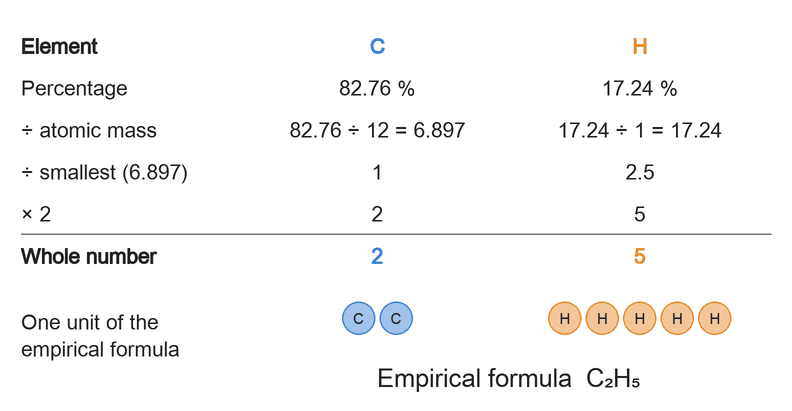
Step 3 — Find the empirical formula mass.
We add the atomic masses of the atoms in C₂H₅.
Step 4 — Find the molecular mass.
The relative molecular mass is twice the vapour density.
Step 5 — Find n and the molecular formula.
We divide the molecular mass by the empirical formula mass to see how many C₂H₅ units are in one molecule.
So the molecular formula is (C₂H₅)₂, that is C₄H₁₀ (butane).
Watch out: A ratio of 1 : 2.5 is not yet a formula; multiply every value by 2 to make it whole before writing C₂H₅.
Therefore, the molecular formula of the hydrocarbon is (butane).
- 53 marks
Board paper question 5
The equation :
represents the catalytic oxidation of ammonia. If 100 of ammonia is used calculate the volume of oxygen required to oxidize the ammonia completely.
Solve with AIWritten solution
Solution:
Concept: Gay-Lussac's law of combining volumes: when gases react, they do so in volumes that bear a simple whole-number ratio to one another and to the volumes of any gaseous products, all measured at the same temperature and pressure. The ratio is read from the coefficients of the balanced equation.
Step 1 — Read the volume ratio from the equation.
By Gay-Lussac's law the coefficients of the gases give their volume ratio.
So 4 volumes of ammonia react with 5 volumes of oxygen.
Step 2 — Scale up to 100 cm³ of ammonia.
The oxygen needed is 5/4 of the volume of ammonia.
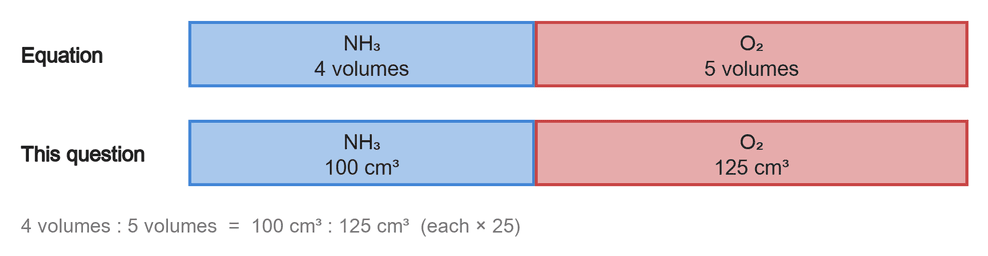
Watch out: The ratio is oxygen : ammonia = 5 : 4, so multiply by 5/4, not by 4/5.
Therefore, 125 cm³ of oxygen is required to oxidise 100 cm³ of ammonia completely (both measured at the same temperature and pressure).
- 65 marks
Board paper question 6
(i) Calculate the number of gram atoms in 4.6 grams of sodium (Na = 23).
(ii) Calculate the percentage of water of crystallization in (H = 1, O = 16, S = 32, Cu = 64)
(iii) A compound of X and Y has the empirical formula . Its vapour density is equal to its empirical formula weight. Determine its molecular formula.
Solve with AIWritten solution
Solution:
Concept: One gram atom of an element is its atomic mass in grams (one mole of its atoms). Percentage composition: the percentage of an element in a compound is . To find an empirical formula (the simplest whole-number ratio of atoms): divide each element's percentage (or mass) by its atomic mass to get the relative number of gram atoms, divide every value by the smallest one, and, if needed, multiply by a small whole number to clear fractions. The molecular formula is n × (empirical formula), where n = molecular mass ÷ empirical formula mass, and molecular mass = 2 × vapour density.
(i) Gram atoms in 4.6 g of sodium
Step 1 — Divide the mass by the gram atomic mass.
One gram atom of sodium weighs 23 g, so we divide 4.6 g by 23 g.
(ii) Percentage of water of crystallisation in CuSO₄·5H₂O
Step 2 — Find the molar mass.
We add the masses of CuSO₄ and five water molecules (H₂O = 18).
Step 3 — Find the percentage of water.
Five water molecules weigh 5 × 18 = 90 g in every 250 g of the crystal, so we divide and multiply by 100.
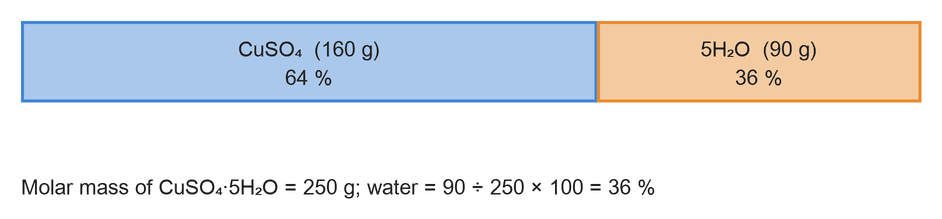
(iii) Molecular formula of the compound of X and Y
Step 4 — Find the molecular mass.
The molecular mass is twice the vapour density, and here the vapour density equals the empirical formula mass, so the molecular mass is twice the empirical formula mass.
Step 5 — Find n.
We divide the molecular mass by the empirical formula mass.
So the molecular formula is (XY₂)₂, that is X₂Y₄.
Watch out: In (ii) use the mass of all five water molecules (90 g), and in (iii) remember that the molecular mass is TWICE the vapour density.
Therefore, (i) 4.6 g of sodium is 0.2 gram atom; (ii) the water of crystallisation is 36 % of CuSO₄·5H₂O; (iii) the molecular formula is X₂Y₄.
All 55 board paper questions for this chapter, solved the same way.
Class 10 Chemistry Ch 5 questions students ask
How many questions are there in Class 10 Chemistry Ch 5?
159 questions. Every one is solved step by step on this page.
Are these Class 10 Chemistry solutions free?
Yes. Every question and its full working is free to read, with no account needed.
Can I download the Class 10 Chemistry Ch 5 solutions as a PDF?
There is no PDF to download. Every solution is on this page instead, which means it is searchable, always the current syllabus, and readable on a phone. Use your browser's print option if you want it on paper.