
Question 44 marksMedium
112 cm³ of is mixed with 120 cm³ of at STP to produce and sulphur(s). Write a balanced equation for this reaction and calculate (i) the volume of gaseous product formed (ii) composition of the resulting mixture.
Confirming your payment
Sign up now and get 250 free tokens.
Mole Concept and Stoichiometry · Question 4 of 159
112 cm³ of is mixed with 120 cm³ of at STP to produce and sulphur(s). Write a balanced equation for this reaction and calculate (i) the volume of gaseous product formed (ii) composition of the resulting mixture.
Solution:
Concept: Gay-Lussac's law of combining volumes: when gases react, they do so in volumes that bear a simple whole-number ratio to one another and to the volumes of any gaseous products, all measured at the same temperature and pressure. The ratio is read from the coefficients of the balanced equation. Solids such as sulphur have almost no volume compared with gases, so they are not counted.
Step 1 — Write the balanced equation.
Hydrogen sulphide reacts with chlorine to give hydrogen chloride gas and solid sulphur:
So 1 volume of H₂S reacts with 1 volume of Cl₂ to give 2 volumes of HCl.
Step 2 — Find the limiting gas.
Since the ratio H₂S : Cl₂ is 1 : 1, the 112 cm³ of H₂S needs only 112 cm³ of chlorine. As 120 cm³ of chlorine is present, all the H₂S reacts and chlorine is in excess.
Step 3 — (i) Find the volume of HCl formed.
Each volume of H₂S gives two volumes of HCl.
Step 4 — (ii) Find the chlorine left.
We subtract the chlorine used from the chlorine taken.
So the gas mixture left is 224 cm³ of HCl and 8 cm³ of Cl₂ (232 cm³ in all), and solid sulphur is deposited.
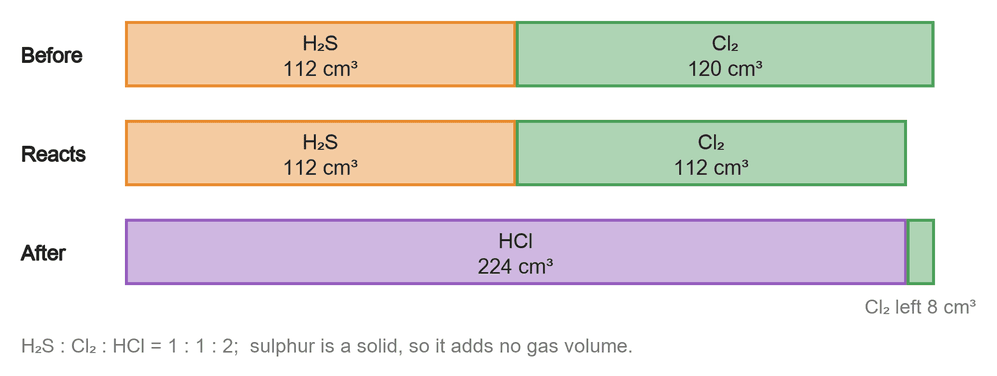
Watch out: The 2 in '2HCl' doubles the volume of HCl, so 112 cm³ of H₂S gives 224 cm³ of HCl, not 112 cm³.
Therefore, the balanced equation is H₂S + Cl₂ → 2HCl + S; (i) 224 cm³ of HCl gas is formed; (ii) the resulting mixture is 224 cm³ of HCl and 8 cm³ of unreacted chlorine (with solid sulphur).