
Question 582 marksEasy
A gaseous hydrocarbon contains 82.76% of carbon. Given that its vapour density is 29, find its molecular formula.
Confirming your payment
Sign up now and get 250 free tokens.
Mole Concept and Stoichiometry · Question 58 of 159
A gaseous hydrocarbon contains 82.76% of carbon. Given that its vapour density is 29, find its molecular formula.
Solution:
Concept: To find an empirical formula (the simplest whole-number ratio of atoms): divide each element's percentage (or mass) by its atomic mass to get the relative number of gram atoms, divide every value by the smallest one, and, if needed, multiply by a small whole number to clear fractions. The molecular formula is n × (empirical formula), where n = molecular mass ÷ empirical formula mass, and molecular mass = 2 × vapour density.
Step 1 — Find the percentage of hydrogen.
A hydrocarbon contains only carbon and hydrogen.
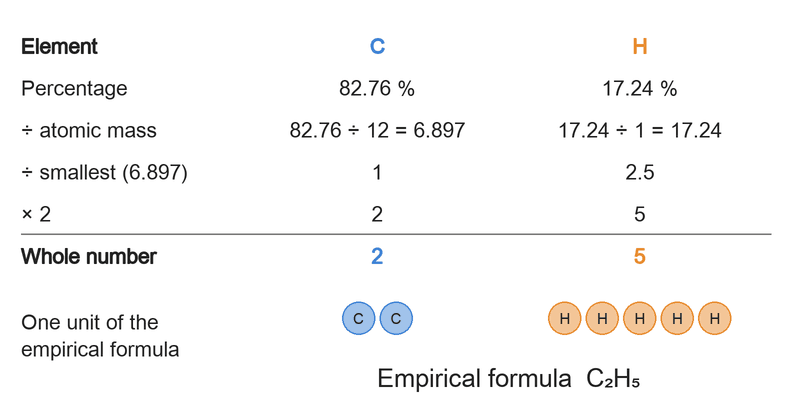
Step 2 — Find the empirical formula.
We divide by the atomic masses, then by the smallest value, 6.897; the ratio 1 : 2.5 is doubled to make it whole.
| Element | % | Atomic mass | Gram atoms (÷ atomic mass) | ÷ smallest | × 2 |
|---|---|---|---|---|---|
| C | 82.76 | 12 | 82.76 ÷ 12 = 6.897 | 1 | 2 |
| H | 17.24 | 1 | 17.24 | 2.5 | 5 |
So the empirical formula is C₂H₅, of mass 29.
Step 3 — Find n.
The molecular mass is twice the vapour density.
Step 4 — Write the molecular formula.
We double every subscript of C₂H₅, giving C₄H₁₀ (butane).
Watch out: C₂H₅ cannot be a real molecule (carbon needs four bonds); the molecular formula C₄H₁₀ is.
Therefore, the molecular formula of the hydrocarbon is C₄H₁₀.