
Question 1392 marksEasy
The percentage composition of sodium phosphate as determined by analysis is 42.1% sodium, 18.9% phosphorus and 39% oxygen. Find the empirical formula of the compound.
Confirming your payment
Sign up now and get 250 free tokens.
Mole Concept and Stoichiometry · Question 139 of 159
The percentage composition of sodium phosphate as determined by analysis is 42.1% sodium, 18.9% phosphorus and 39% oxygen. Find the empirical formula of the compound.
Solution:
Concept: To find an empirical formula (the simplest whole-number ratio of atoms): divide each element's percentage (or mass) by its atomic mass to get the relative number of gram atoms, divide every value by the smallest one, and, if needed, multiply by a small whole number to clear fractions. The molecular formula is n × (empirical formula), where n = molecular mass ÷ empirical formula mass, and molecular mass = 2 × vapour density.
Step 1 — Find the simplest ratio.
We divide by the atomic masses (Na = 23, P = 31, O = 16), then by the smallest value, 0.610.
| Element | % | Atomic mass | Gram atoms (÷ atomic mass) | ÷ smallest |
|---|---|---|---|---|
| Na | 42.1 | 23 | 42.1 ÷ 23 = 1.83 | 3 |
| P | 18.9 | 31 | 18.9 ÷ 31 = 0.61 | 1 |
| O | 39 | 16 | 39 ÷ 16 = 2.438 | 4 |
Step 2 — Write the empirical formula.
Na : P : O = 3 : 1 : 4, so the empirical formula is Na₃PO₄ (sodium phosphate).
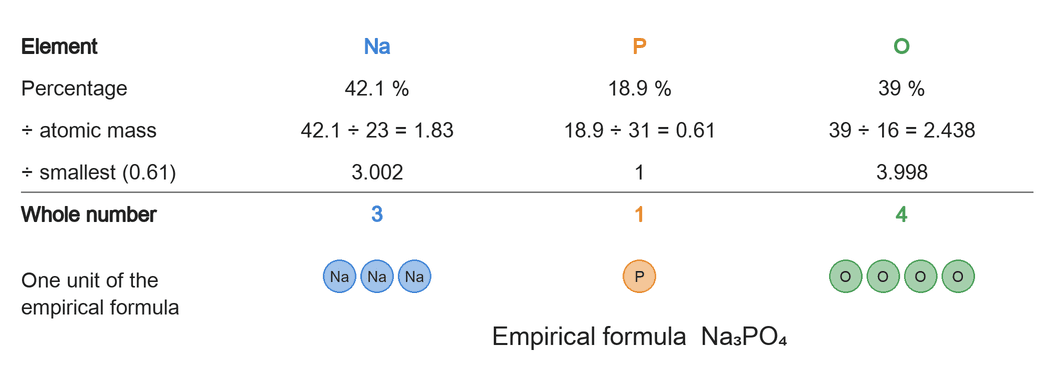
Therefore, the empirical formula of the compound is Na₃PO₄.