
Question 22 marksEasy
24 cc Marsh gas () was mixed with 106 cc oxygen and then exploded. On cooling, the volume of the mixture became 82 cc, of which, 58 cc was unchanged oxygen. Which law does this experiment support? Explain with calculations.
Confirming your payment
Sign up now and get 250 free tokens.
Mole Concept and Stoichiometry · Question 2 of 159
24 cc Marsh gas () was mixed with 106 cc oxygen and then exploded. On cooling, the volume of the mixture became 82 cc, of which, 58 cc was unchanged oxygen. Which law does this experiment support? Explain with calculations.
Solution:
Concept: Gay-Lussac's law of combining volumes: when gases react, they do so in volumes that bear a simple whole-number ratio to one another and to the volumes of any gaseous products, all measured at the same temperature and pressure. The ratio is read from the coefficients of the balanced equation.
Step 1 — Write the balanced equation.
Methane burns in oxygen to give carbon dioxide and water:
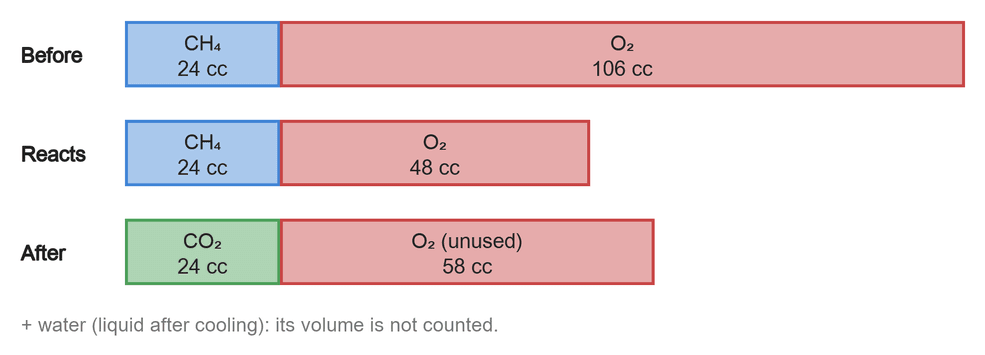
So 1 volume of methane reacts with 2 volumes of oxygen and gives 1 volume of carbon dioxide (1 : 2 : 1). On cooling, the water becomes a liquid and takes up no gas volume.
Step 2 — Find the oxygen used.
Each volume of methane uses two volumes of oxygen.
Step 3 — Find the oxygen left.
We subtract the oxygen used from the 106 cc taken.
Step 4 — Find the carbon dioxide formed.
Each volume of methane gives one volume of carbon dioxide, so 24 cc of methane gives 24 cc of carbon dioxide.
Step 5 — Compare with the experiment.
The calculated volume after cooling is the oxygen left plus the carbon dioxide formed.
This matches the experiment exactly: 82 cc in all, of which 58 cc is unchanged oxygen.
Watch out: Water formed in these reactions condenses to a liquid on cooling, so it has no gas volume; never add its coefficient to the gas volumes.
Therefore, the experiment supports Gay-Lussac's law of combining volumes: methane, oxygen and carbon dioxide react in the simple volume ratio 1 : 2 : 1.