Solution:
Concept: When a hydrocarbon is oxidised completely, all its carbon ends up in carbon dioxide. Each mole of CO₂ (22400 cm³ at S.T.P.) contains 1 mole (12 g) of carbon; the rest of the sample's mass is hydrogen.
Step 1 — (a) Elements in X.
X is a hydrocarbon, so it contains only carbon and hydrogen.
Step 2 — (b) Purpose of copper (II) oxide.
Copper (II) oxide is an oxidising agent. It supplies oxygen, which oxidises the carbon of X to carbon dioxide (and the hydrogen to water), so the carbon can be measured as CO₂.
Step 3 — (c)(i) Moles of carbon dioxide.
We divide the volume by the molar volume at S.T.P.
moles of CO2=22400224=0.01
Step 4 — (c)(ii) Mass of carbon.
Each mole of CO₂ contains 12 g of carbon, and all of it came from X.
mass of C=0.01×12 g=0.12 g
Step 5 — (c)(iii) Mass of hydrogen.
The rest of the sample is hydrogen.
mass of H=0.145−0.12 g=0.025 g
Step 6 — (c)(iv) Ratio of atoms.
We change both masses to gram atoms, then make the ratio whole.
C:H=120.12:10.025=0.01:0.025=2:5
So the empirical formula is C₂H₅.
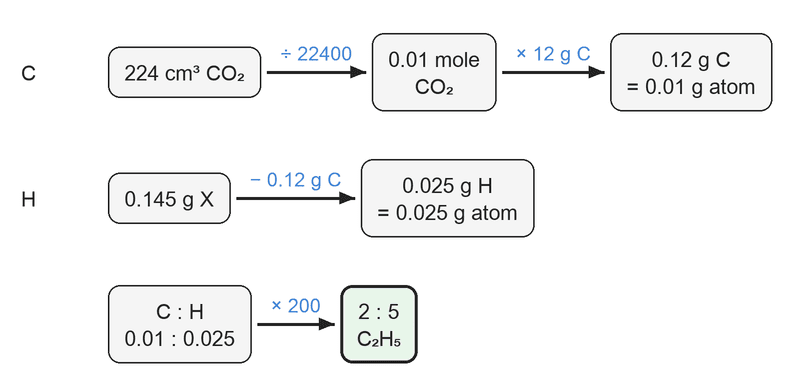
Watch out: The hydrogen is found by difference (0.145 − 0.12), because only the CO₂ was measured.
Therefore, (a) X contains carbon and hydrogen; (b) copper (II) oxide oxidises X so that its carbon forms CO₂; (c) 0.01 mole of CO₂, 0.12 g of carbon and 0.025 g of hydrogen, giving the empirical formula C₂H₅.
