Solution:
Concept: Stoichiometry: the coefficients of a balanced equation give the ratio of moles in which substances react and form. So we change the given quantity to moles (mass ÷ molar mass, or volume at S.T.P. ÷ 22.4 L), use the mole ratio, and change back to mass (moles × molar mass) or volume (moles × 22.4 L at S.T.P.).
Step 1 — Read the mole ratio.
From the balanced equation:
(NH4)2Cr2O7→N2+Cr2O3+4H2O
So 1 mole of ammonium dichromate gives 1 mole of N₂, 1 mole of Cr₂O₃ and 4 moles of H₂O.
Step 2 — (a) Moles of ammonium dichromate.
Its molar mass is 2 × 18 + 2 × 52 + 7 × 16 = 252 g.
moles=25263=0.25
Step 3 — (b) Moles of nitrogen.
The ratio is 1 : 1, so 0.25 mole of N₂ forms.
Step 4 — (c) Volume of nitrogen at S.T.P.
Each mole occupies 22.4 L.
volume=0.25×22.4 L=5.6 L
Step 5 — (d) Loss of mass.
The nitrogen and the steam escape as gases.
mass of N2=0.25×28 g=7 g
mass of steam=4×0.25×18 g=18 g
loss of mass=7+18 g=25 g
Step 6 — (e) Mass of chromium (III) oxide.
The molar mass of Cr₂O₃ is 104 + 48 = 152 g.
mass=0.25×152 g=38 g
Check: 63 − 25 = 38 g, so mass is conserved.
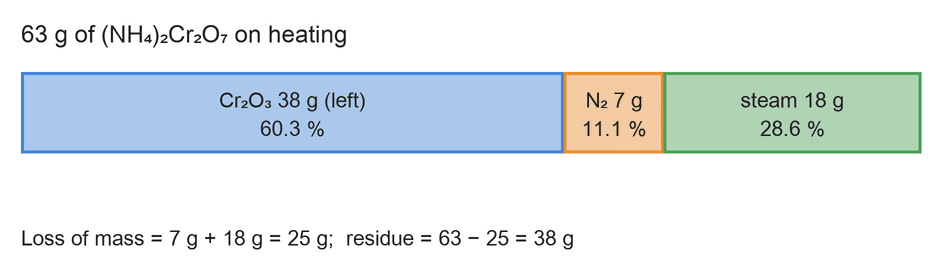
Watch out: The loss of mass is the gases that escape (N₂ and steam), not the solid Cr₂O₃ left behind.
Therefore, (a) 0.25 mole; (b) 0.25 mole of N₂; (c) 5.6 litres of N₂ at S.T.P.; (d) a loss of 25 g; (e) 38 g of chromium (III) oxide.
