
Question 1025 marksEasy
(a) What do you mean by stoichiometry ?
(b) Define atomicity of a gas. State the atomicity of Hydrogen, Phosphorus and Sulphur.
(b) Differentiate between and 2N.
Confirming your payment
Sign up now and get 250 free tokens.
Mole Concept and Stoichiometry · Question 102 of 159
(a) What do you mean by stoichiometry ?
(b) Define atomicity of a gas. State the atomicity of Hydrogen, Phosphorus and Sulphur.
(b) Differentiate between and 2N.
Solution:
Concept: Stoichiometry uses balanced equations to calculate quantities; atomicity counts the atoms in one molecule of an element.
Step 1 — (a) Stoichiometry.
Stoichiometry is the calculation of the quantities of reactants and products in a chemical reaction. It uses the mole ratios from the balanced equation.
For example, 2 moles (4 g) of hydrogen need 1 mole (32 g) of oxygen and give 2 moles (36 g) of water.
Step 2 — (b) Atomicity.
The number of atoms in one molecule of an element is its atomicity:
Step 3 — N₂ and 2N.
The two are different:
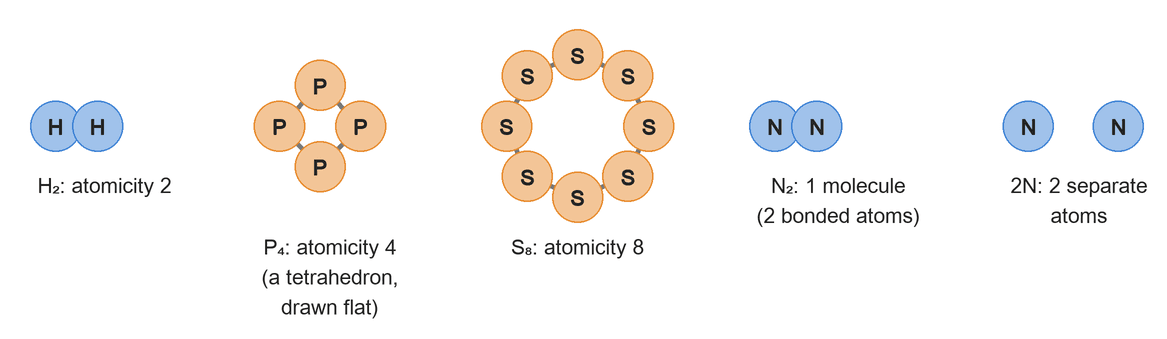
Watch out: The 2 in N₂ (a subscript) is inside one molecule; the 2 in 2N (a coefficient) counts separate atoms.
Therefore, (a) stoichiometry is the calculation of reacting quantities from a balanced equation; (b) atomicity is the number of atoms in a molecule of an element: hydrogen 2, phosphorus 4, sulphur 8; N₂ is one diatomic molecule, while 2N is two separate nitrogen atoms.