
Question 492 marksEasy
Find the empirical formula of the compounds with the following percentage composition. :
Pb = 62.5%; N = 8.5%; O = 29.0%.
Confirming your payment
Sign up now and get 250 free tokens.
Mole Concept and Stoichiometry · Question 49 of 159
Find the empirical formula of the compounds with the following percentage composition. :
Pb = 62.5%; N = 8.5%; O = 29.0%.
Solution:
Concept: To find an empirical formula (the simplest whole-number ratio of atoms): divide each element's percentage (or mass) by its atomic mass to get the relative number of gram atoms, divide every value by the smallest one, and, if needed, multiply by a small whole number to clear fractions. The molecular formula is n × (empirical formula), where n = molecular mass ÷ empirical formula mass, and molecular mass = 2 × vapour density.
Step 1 — Find the simplest ratio.
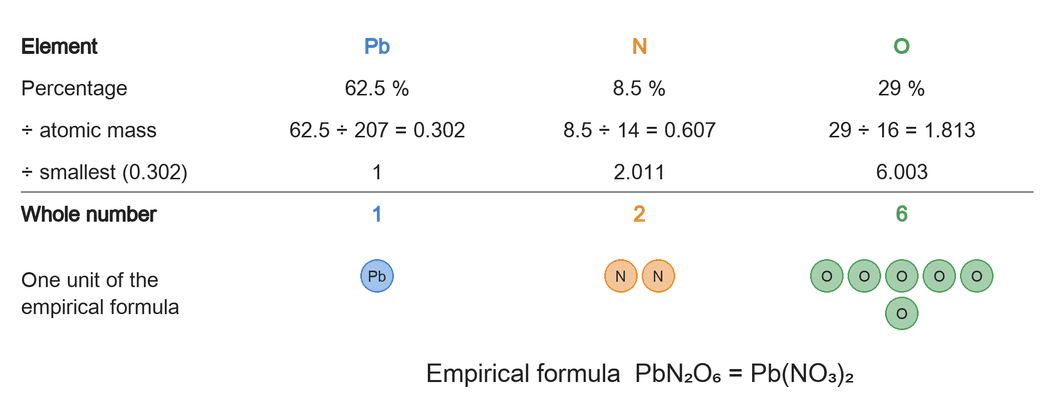
We divide each percentage by the atomic mass (Pb = 207, N = 14, O = 16), then by the smallest value, 0.302.
| Element | % | Atomic mass | Gram atoms (÷ atomic mass) | ÷ smallest |
|---|---|---|---|---|
| Pb | 62.5 | 207 | 62.5 ÷ 207 = 0.302 | 1 |
| N | 8.5 | 14 | 8.5 ÷ 14 = 0.607 | 2.01 |
| O | 29.0 | 16 | 29.0 ÷ 16 = 1.813 | 6 |
Step 2 — Write the empirical formula.
The ratio Pb : N : O is 1 : 2 : 6, which gives PbN₂O₆. Grouped as nitrate ions (NO₃), this is Pb(NO₃)₂, lead nitrate.
Watch out: Do not round 2.01 to anything other than 2; small differences come only from rounding the data.
Therefore, the empirical formula is PbN₂O₆, that is Pb(NO₃)₂.