
Question 1064 marksEasy
From the equation,
(At. mass Cu = 64, H = 1, N = 14, O = 16)
calculate :
(a) mass of copper needed to react with 63 g of ,
(b) volume of nitric oxide at STP that can be collected.
Confirming your payment
Sign up now and get 250 free tokens.
Mole Concept and Stoichiometry · Question 106 of 159
From the equation,
(At. mass Cu = 64, H = 1, N = 14, O = 16)
calculate :
(a) mass of copper needed to react with 63 g of ,
(b) volume of nitric oxide at STP that can be collected.
Solution:
Concept: Stoichiometry: the coefficients of a balanced equation give the ratio of moles in which substances react and form. So we change the given quantity to moles (mass ÷ molar mass, or volume at S.T.P. ÷ 22.4 L), use the mole ratio, and change back to mass (moles × molar mass) or volume (moles × 22.4 L at S.T.P.).
Step 1 — Read the mole ratio.
From the balanced equation:
So Cu : HNO₃ : NO = 3 : 8 : 2 by moles.
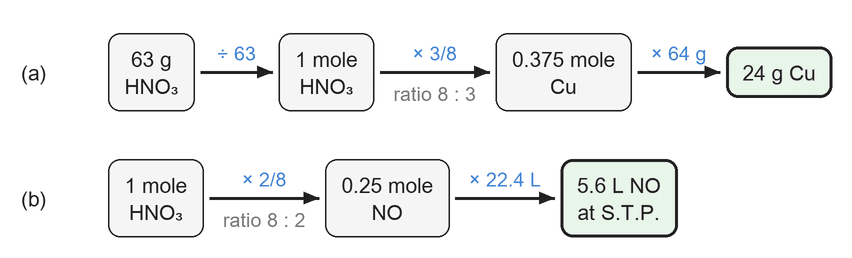
Step 2 — Find the moles of nitric acid.
The molar mass of HNO₃ is 1 + 14 + 48 = 63 g.
Step 3 — (a) Moles of copper.
Copper reacts in the ratio 3 : 8 with the acid.
Step 4 — (a) Mass of copper.
We multiply by the atomic mass of copper, 64.
Step 5 — (b) Moles of nitric oxide.
NO forms in the ratio 2 : 8 with the acid.
Step 6 — (b) Volume at S.T.P.
Each mole occupies 22.4 L at S.T.P.
Watch out: Only 2 of the 8 moles of acid become NO; do not use all 8.
Therefore, (a) 24 g of copper is needed; (b) 5.6 litres of nitric oxide can be collected at S.T.P.