
Opening your dashboard
Class 10 Chemistry Chapter 5 Mole Concept and Stoichiometry: Previous Year Questions
55 questions on Chapter 5, each solved step by step. Class 10 Chemistry, ICSE 2026-27.
55 questions with solutions
1–5 marks · Mixed difficulty
- 11 mark
Question 1
The ratio between the number of molecules in 2g of hydrogen and 32g of oxygen is:
[Given that H=1, O=16]
Solve with AIAnswer
(A) 1:2
(B) 1:0.01
- Correct
(C) 1:1
(D) 0.01:1
Answer: (C) 1:1
Concept: The mole concept: one mole of any substance contains the Avogadro number, , of particles (atoms, molecules or formula units), and its mass in grams equals its atomic or molecular mass (the gram atomic / gram molecular mass). So and . So equal numbers of moles always contain equal numbers of molecules, whatever the gas.
Step 1 — Find the moles of hydrogen.
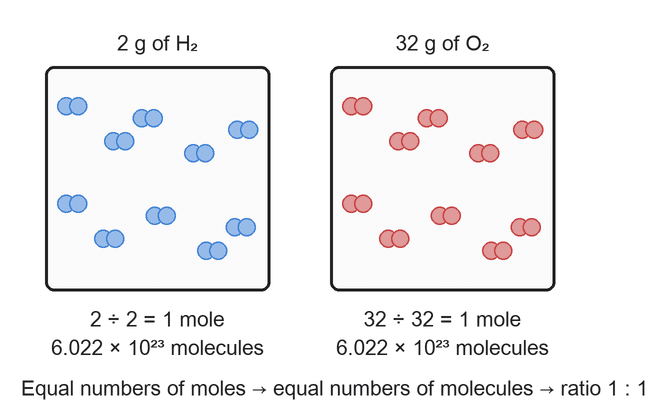
The molar mass of hydrogen gas, H₂, is 2 × 1 = 2 g, so we divide the mass by 2 g.
Step 2 — Find the moles of oxygen.
The molar mass of oxygen gas, O₂, is 2 × 16 = 32 g, so we divide the mass by 32 g.
Step 3 — Compare the numbers of molecules.
Both samples are exactly 1 mole, so each contains 6.022 × 10²³ molecules. Equal numbers of molecules give the ratio 1 : 1.
Watch out: Do not compare the masses (2 g and 32 g). It is equal numbers of moles, not equal masses, that give equal numbers of molecules.
Why the other options are wrong:
- (A) 1:2: a ratio of 1 : 2 would need 2 moles of oxygen, that is 64 g; 32 g of oxygen is only 1 mole, the same as the hydrogen.
- (B) 1:0.01: this would mean the oxygen has only one-hundredth as many molecules, which would be 0.01 mole or 0.32 g of oxygen, not 32 g.
- (D) 0.01:1: this would mean the hydrogen has only one-hundredth as many molecules, which would be 0.01 mole or 0.02 g of hydrogen, not 2 g.
Therefore, 2 g of hydrogen and 32 g of oxygen contain molecules in the ratio 1 : 1, option (C).
- 25 marks
Question 2
(i) A gas of mass 32 gms has a volume of 20 litres at S.T.P. Calculate the gram molecular weight of the gas.
(ii) How much Calcium oxide is formed when 82 g of calcium nitrate is heated? Also find the volume of nitrogen dioxide evolved:
[Ca = 40, N = 14, O = 16]
Solve with AIWritten solution
Solution:
Concept: The mole concept: one mole of any substance contains the Avogadro number, , of particles (atoms, molecules or formula units), and its mass in grams equals its atomic or molecular mass (the gram atomic / gram molecular mass). So and . Molar volume: one mole of any gas occupies 22.4 litres (22400 cm³) at S.T.P. (273 K and 760 mm of Hg, that is 1 atm). Stoichiometry: the coefficients of a balanced equation give the ratio of moles in which substances react and form. So we change the given quantity to moles (mass ÷ molar mass, or volume at S.T.P. ÷ 22.4 L), use the mole ratio, and change back to mass (moles × molar mass) or volume (moles × 22.4 L at S.T.P.).
(i) Gram molecular weight of the gas
Step 1 — Write what is given.
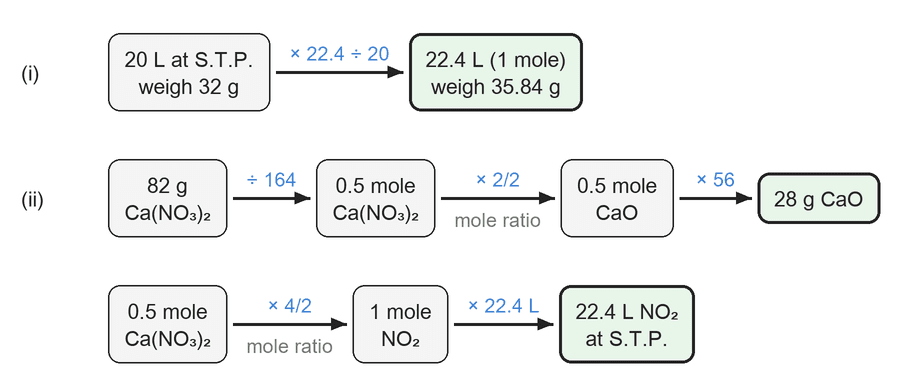
We know that 20 L of the gas at S.T.P. weighs 32 g. The gram molecular weight is the mass of one mole, that is, of 22.4 L at S.T.P.
Step 2 — Scale the mass up to 22.4 L.
The mass is proportional to the volume, so we multiply the mass of 1 L (32 ÷ 20 g) by 22.4.
So one mole of the gas weighs 35.84 g, and its relative molecular mass is 35.84.
(ii) Calcium oxide formed and nitrogen dioxide evolved
Step 3 — Write the balanced equation and the molar masses.
The equation shows the mole ratio in which the substances react and form.
Using Ca = 40, N = 14 and O = 16, we work out the two molar masses we need.
Step 4 — Change 82 g of calcium nitrate to moles.
We divide the mass by the molar mass.
Step 5 — Find the mass of calcium oxide.
The equation shows that 2 moles of Ca(NO₃)₂ give 2 moles of CaO, a 1 : 1 ratio, so 0.5 mol of calcium nitrate gives 0.5 mol of calcium oxide. We then multiply by its molar mass.
Step 6 — Find the volume of nitrogen dioxide.
The equation shows that 2 moles of Ca(NO₃)₂ give 4 moles of NO₂, a 1 : 2 ratio, so 0.5 mol gives 1 mol of NO₂. One mole of a gas occupies 22.4 L at S.T.P.
Watch out: The coefficients give MOLES, not grams: change 82 g to moles first, use the mole ratio, and only then change back to grams or litres.
Note: As the question expects, nitrogen dioxide is treated as a gas at S.T.P. (Real NO₂ condenses, mostly as N₂O₄, below about 21 °C, so this is the ideal-gas volume the mole method gives.)
Therefore, (i) the gram molecular weight of the gas is 35.84 g; (ii) 28 g of calcium oxide is formed and 22.4 litres of nitrogen dioxide (at S.T.P.) is evolved.
- 32 marks
Question 3
A gas cylinder contains molecules of oxygen gas. If Avogadro's number is ; Calculate:
(i) the mass of oxygen present in the cylinder.
(ii) the volume of oxygen at S.T.P. present in the cylinder. [O=16]
Solve with AIWritten solution
Solution:
Concept: The mole concept: one mole of any substance contains the Avogadro number, , of particles (atoms, molecules or formula units), and its mass in grams equals its atomic or molecular mass (the gram atomic / gram molecular mass). So and . Molar volume: one mole of any gas occupies 22.4 litres (22400 cm³) at S.T.P. (273 K and 760 mm of Hg, that is 1 atm).
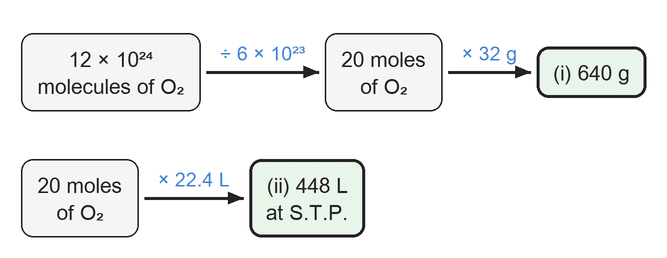
Step 1 — Change the number of molecules to moles.
One mole contains Avogadro's number of molecules, which the question gives as 6 × 10²³, so we divide by it.
(i) Mass of oxygen
Step 2 — Multiply the moles by the molar mass.
The molar mass of oxygen gas, O₂, is 2 × 16 = 32 g, so each mole weighs 32 g.
(ii) Volume of oxygen at S.T.P.
Step 3 — Multiply the moles by the molar volume.
Each mole of a gas occupies 22.4 L at S.T.P.
Watch out: The gas is O₂ (molar mass 32 g), not O atoms (16 g); the molecules in the cylinder are O₂ molecules.
Therefore, (i) the cylinder holds 640 g of oxygen and (ii) this oxygen occupies 448 litres at S.T.P.
- 43 marks
Question 4
A gaseous hydrocarbon contains 82.76% of carbon. Given that its vapour density is 29, find its molecular formula.
[C=12, H=1]
Solve with AIWritten solution
Solution:
Concept: To find an empirical formula (the simplest whole-number ratio of atoms): divide each element's percentage (or mass) by its atomic mass to get the relative number of gram atoms, divide every value by the smallest one, and, if needed, multiply by a small whole number to clear fractions. The molecular formula is n × (empirical formula), where n = molecular mass ÷ empirical formula mass, and molecular mass = 2 × vapour density.
Step 1 — Find the percentage of hydrogen.
A hydrocarbon contains only carbon and hydrogen, so the rest of the 100 % is hydrogen.
Step 2 — Find the empirical formula.
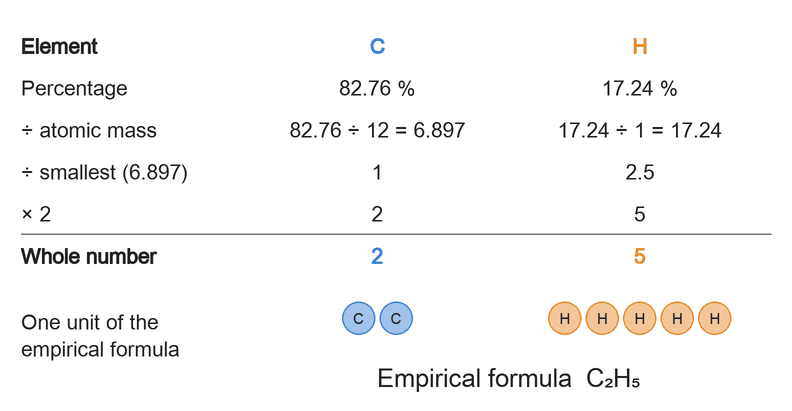
We divide each percentage by the atomic mass and then by the smallest value (6.897). The hydrogen value is 2.5, not a whole number, so we multiply both values by 2.
Element % Atomic mass Gram atoms (÷ atomic mass) ÷ smallest × 2 C 82.76 12 82.76 ÷ 12 = 6.897 1 2 H 17.24 1 17.24 2.5 5 So C : H is 2 : 5, and the empirical formula is C₂H₅.
Step 3 — Find the empirical formula mass.
We add the atomic masses of the atoms in C₂H₅.
Step 4 — Find the molecular mass.
The relative molecular mass is twice the vapour density.
Step 5 — Find n and the molecular formula.
We divide the molecular mass by the empirical formula mass to see how many C₂H₅ units are in one molecule.
So the molecular formula is (C₂H₅)₂, that is C₄H₁₀ (butane).
Watch out: A ratio of 1 : 2.5 is not yet a formula; multiply every value by 2 to make it whole before writing C₂H₅.
Therefore, the molecular formula of the hydrocarbon is (butane).
- 53 marks
Question 5
The equation :
represents the catalytic oxidation of ammonia. If 100 of ammonia is used calculate the volume of oxygen required to oxidize the ammonia completely.
Solve with AIWritten solution
Solution:
Concept: Gay-Lussac's law of combining volumes: when gases react, they do so in volumes that bear a simple whole-number ratio to one another and to the volumes of any gaseous products, all measured at the same temperature and pressure. The ratio is read from the coefficients of the balanced equation.
Step 1 — Read the volume ratio from the equation.
By Gay-Lussac's law the coefficients of the gases give their volume ratio.
So 4 volumes of ammonia react with 5 volumes of oxygen.
Step 2 — Scale up to 100 cm³ of ammonia.
The oxygen needed is 5/4 of the volume of ammonia.
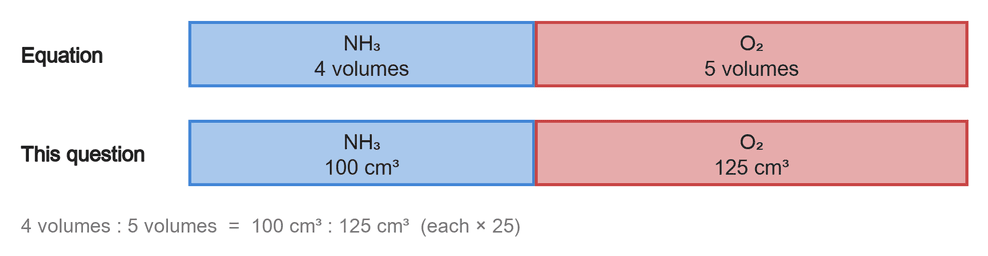
Watch out: The ratio is oxygen : ammonia = 5 : 4, so multiply by 5/4, not by 4/5.
Therefore, 125 cm³ of oxygen is required to oxidise 100 cm³ of ammonia completely (both measured at the same temperature and pressure).
- 65 marks
Question 6
(i) Calculate the number of gram atoms in 4.6 grams of sodium (Na = 23).
(ii) Calculate the percentage of water of crystallization in (H = 1, O = 16, S = 32, Cu = 64)
(iii) A compound of X and Y has the empirical formula . Its vapour density is equal to its empirical formula weight. Determine its molecular formula.
Solve with AIWritten solution
Solution:
Concept: One gram atom of an element is its atomic mass in grams (one mole of its atoms). Percentage composition: the percentage of an element in a compound is . To find an empirical formula (the simplest whole-number ratio of atoms): divide each element's percentage (or mass) by its atomic mass to get the relative number of gram atoms, divide every value by the smallest one, and, if needed, multiply by a small whole number to clear fractions. The molecular formula is n × (empirical formula), where n = molecular mass ÷ empirical formula mass, and molecular mass = 2 × vapour density.
(i) Gram atoms in 4.6 g of sodium
Step 1 — Divide the mass by the gram atomic mass.
One gram atom of sodium weighs 23 g, so we divide 4.6 g by 23 g.
(ii) Percentage of water of crystallisation in CuSO₄·5H₂O
Step 2 — Find the molar mass.
We add the masses of CuSO₄ and five water molecules (H₂O = 18).
Step 3 — Find the percentage of water.
Five water molecules weigh 5 × 18 = 90 g in every 250 g of the crystal, so we divide and multiply by 100.
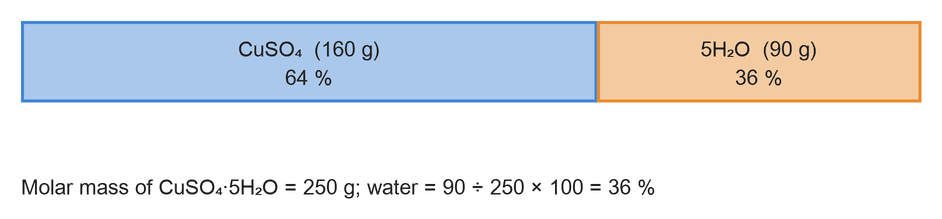
(iii) Molecular formula of the compound of X and Y
Step 4 — Find the molecular mass.
The molecular mass is twice the vapour density, and here the vapour density equals the empirical formula mass, so the molecular mass is twice the empirical formula mass.
Step 5 — Find n.
We divide the molecular mass by the empirical formula mass.
So the molecular formula is (XY₂)₂, that is X₂Y₄.
Watch out: In (ii) use the mass of all five water molecules (90 g), and in (iii) remember that the molecular mass is TWICE the vapour density.
Therefore, (i) 4.6 g of sodium is 0.2 gram atom; (ii) the water of crystallisation is 36 % of CuSO₄·5H₂O; (iii) the molecular formula is X₂Y₄.
- 74 marks
Question 7
(i) Propane burns in air according to the following equation :
What volume of propane is consumed on using 1000 of air, considering only 20% of air contains oxygen.
(ii) The mass of 11.2 litres of a certain gas at s.t.p. is 24 g. Find the gram molecular mass of the gas.
Solve with AIWritten solution
Solution:
Concept: Gay-Lussac's law of combining volumes: when gases react, they do so in volumes that bear a simple whole-number ratio to one another and to the volumes of any gaseous products, all measured at the same temperature and pressure. The ratio is read from the coefficients of the balanced equation. Molar volume: one mole of any gas occupies 22.4 litres (22400 cm³) at S.T.P. (273 K and 760 mm of Hg, that is 1 atm).
(i) Volume of propane consumed
Step 1 — Find the volume of oxygen in the air.
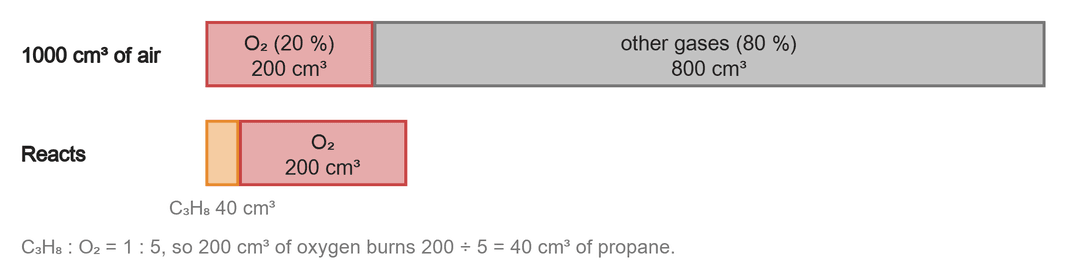
Only 20 % of the air is oxygen, and only the oxygen takes part in burning.
Step 2 — Read the volume ratio.
By Gay-Lussac's law, the equation shows that 1 volume of propane uses 5 volumes of oxygen.
Step 3 — Find the volume of propane.
The propane burnt is one-fifth of the oxygen used.
(ii) Gram molecular mass of the gas
Step 4 — Scale the mass up to 22.4 L.
We know that 11.2 L at S.T.P. weighs 24 g. One mole occupies 22.4 L, which is twice 11.2 L, so one mole weighs twice as much.
Watch out: Use the 200 cm³ of OXYGEN, not the 1000 cm³ of air, with the 1 : 5 ratio.
Therefore, (i) 40 cm³ of propane is consumed and (ii) the gram molecular mass of the gas is 48 g.
- 84 marks
Question 8
A gas cylinder can hold 1 kg of hydrogen at room temperature and pressure:
(i) Find the number of moles of hydrogen present.
(ii) What weight of can the cylinder hold under similar conditions of temperature and pressure? (H= 1, C = 12, O = 16)
(iii) If the number of molecules of hydrogen in the cylinder is X, calculate the number of molecules in the cylinder under the same conditions of temperature and pressure.
(iv) State the law that helped you to arrive at the above result.
Solve with AIWritten solution
Solution:
Concept: Avogadro's law: equal volumes of all gases, under the same conditions of temperature and pressure, contain an equal number of molecules. So, at fixed temperature and pressure, the number of molecules is proportional to the volume. The mole concept: one mole of any substance contains the Avogadro number, , of particles (atoms, molecules or formula units), and its mass in grams equals its atomic or molecular mass (the gram atomic / gram molecular mass). So and .
(i) Moles of hydrogen
Step 1 — Divide the mass by the molar mass.
The cylinder holds 1 kg, that is 1000 g, of hydrogen gas, H₂, whose molar mass is 2 g.
(ii) Mass of carbon dioxide the cylinder can hold
Step 2 — Use Avogadro's law.
The same cylinder at the same temperature and pressure holds the same volume of any gas, so it holds the same number of molecules, that is the same number of moles: 500 mol of CO₂.
Step 3 — Change the moles of CO₂ to grams.
The molar mass of CO₂ is 12 + 2 × 16 = 44 g.
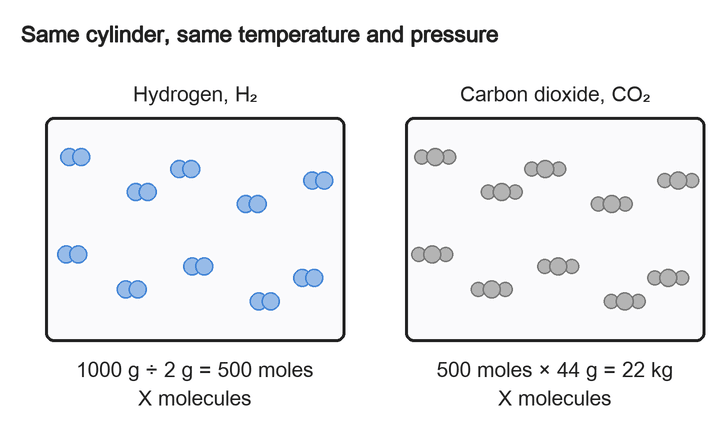
(iii) Number of CO₂ molecules
Step 4 — Apply Avogadro's law to molecules.
Equal volumes at the same temperature and pressure contain equal numbers of molecules, so the cylinder holds X molecules of CO₂, the same as of hydrogen.
(iv) The law used
Step 5 — Name the law.
Every step above used the idea that equal volumes of gases at the same temperature and pressure contain equal numbers of molecules. This is Avogadro's law.
Watch out: The cylinder holds equal NUMBERS of molecules, not equal masses: 1 kg of hydrogen does not mean 1 kg of CO₂.
Therefore, (i) there are 500 moles of hydrogen; (ii) the cylinder can hold 22 kg (22,000 g) of CO₂; (iii) it holds X molecules of CO₂; (iv) the law used is Avogadro's law.
- 92 marks
Question 9
The percentage composition of a gas is:
Nitrogen 82.35%, Hydrogen 17.64%.
Find the empirical formula of the gas. [N = 14, H = 1]
Solve with AIWritten solution
Solution:
Concept: To find an empirical formula (the simplest whole-number ratio of atoms): divide each element's percentage (or mass) by its atomic mass to get the relative number of gram atoms, divide every value by the smallest one, and, if needed, multiply by a small whole number to clear fractions. The molecular formula is n × (empirical formula), where n = molecular mass ÷ empirical formula mass, and molecular mass = 2 × vapour density.
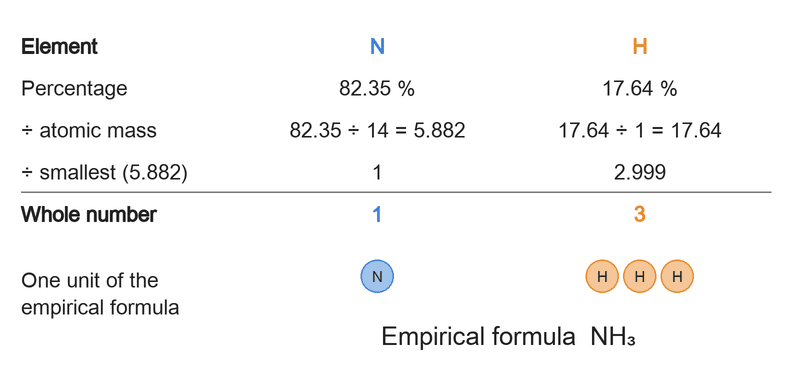
Step 1 — Divide by the atomic masses and by the smallest value.
Dividing each percentage by the atomic mass gives the relative number of gram atoms; dividing by the smallest value (5.882) gives the simplest ratio.
Element % Atomic mass Gram atoms (÷ atomic mass) ÷ smallest N 82.35 14 82.35 ÷ 14 = 5.882 1 H 17.64 1 17.64 3 Step 2 — Write the formula.
The ratio N : H is 1 : 2.999, which rounds to the whole numbers 1 : 3 (the small difference comes from rounding in the percentages). So one N atom goes with three H atoms.
Watch out: Round 2.999 to 3 only because it is within a rounding error; a value like 2.5 would need multiplying by 2.
Therefore, the empirical formula of the gas is (ammonia).
- 104 marks
Question 10
Aluminum carbide reacts with water according to the following equation:
(i) What mass of aluminum hydroxide is formed from 12g of aluminum carbide?
(ii) What volume of methane at s.t.p. is obtained from 12g of aluminum carbide?
[Relative molecular weight of = 144; = 78]
Solve with AIWritten solution
Solution:
Concept: Stoichiometry: the coefficients of a balanced equation give the ratio of moles in which substances react and form. So we change the given quantity to moles (mass ÷ molar mass, or volume at S.T.P. ÷ 22.4 L), use the mole ratio, and change back to mass (moles × molar mass) or volume (moles × 22.4 L at S.T.P.).
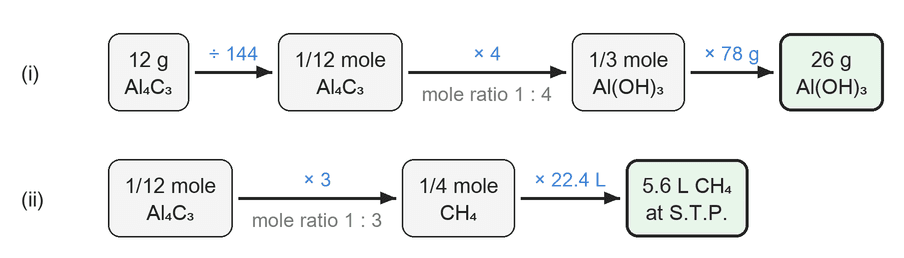
Step 1 — Read the mole ratio.
The balanced equation shows how many moles of each product one mole of aluminium carbide gives.
So 1 mole of Al₄C₃ gives 4 moles of Al(OH)₃ and 3 moles of CH₄.
Step 2 — Change 12 g of aluminium carbide to moles.
We divide by its relative molecular mass, 144.
(i) Mass of aluminium hydroxide
Step 3 — Use the 1 : 4 ratio and the molar mass.
The moles of Al(OH)₃ are 4 times the moles of Al₄C₃, and each mole weighs 78 g.
(ii) Volume of methane at S.T.P.
Step 4 — Use the 1 : 3 ratio and the molar volume.
The moles of CH₄ are 3 times the moles of Al₄C₃, and each mole occupies 22.4 L at S.T.P.
Watch out: Multiply by the mole ratio from the equation (4 for Al(OH)₃, 3 for CH₄); do not just divide 12 g in the ratio of the molar masses.
Therefore, 12 g of aluminium carbide gives (i) 26 g of aluminium hydroxide and (ii) 5.6 litres of methane at S.T.P.
- 112 marks
Question 11
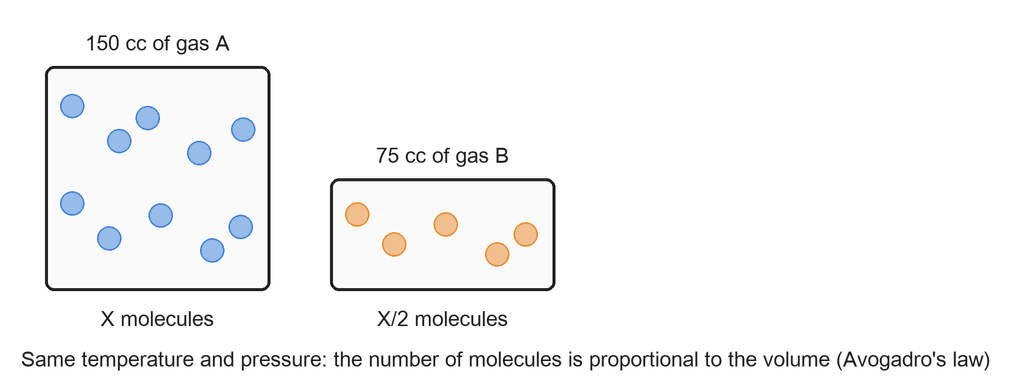
(i) If 150 cc of gas A contains X molecules, how many molecules of gas B will be present in 75 cc of B?
The gases A and B are under the same conditions of temperature and pressure.
(ii) Name the law on which the above problem is based.
Solve with AIWritten solution
Solution:
Concept: Avogadro's law: equal volumes of all gases, under the same conditions of temperature and pressure, contain an equal number of molecules. So, at fixed temperature and pressure, the number of molecules is proportional to the volume.
(i) Molecules of gas B
Step 1 — Compare the volumes.
Both gases are at the same temperature and pressure, so the number of molecules is proportional to the volume. We compare 75 cc with 150 cc.
Step 2 — Scale the number of molecules.
Gas B has half the volume of gas A, so it has half as many molecules. It does not matter that B is a different gas.
(ii) The law used
Step 3 — Name the law.
We used the rule that equal volumes of all gases at the same temperature and pressure contain equal numbers of molecules. This is Avogadro's law.
Watch out: The kind of gas does not matter; at the same temperature and pressure only the volume decides the number of molecules.
Therefore, (i) 75 cc of gas B contains X/2 molecules and (ii) the problem is based on Avogadro's law.
- 124 marks
Question 12
Ethane burns in oxygen to form and according to the equation:
If 1250 cc of oxygen is burnt with 300 cc of ethane.
Calculate:
(i) the volume of formed.
(ii) the volume of unused .
Solve with AIWritten solution
Solution:
Concept: Gay-Lussac's law of combining volumes: when gases react, they do so in volumes that bear a simple whole-number ratio to one another and to the volumes of any gaseous products, all measured at the same temperature and pressure. The ratio is read from the coefficients of the balanced equation.
Step 1 — Read the volume ratio.
By Gay-Lussac's law, the equation shows that 2 volumes of ethane react with 7 volumes of oxygen and give 4 volumes of carbon dioxide.
Step 2 — Check which gas is in excess.
We find how much oxygen 300 cc of ethane needs.
Only 1050 cc of the 1250 cc of oxygen is needed, so oxygen is in excess and all the ethane burns.
(i) Volume of carbon dioxide formed
Step 3 — Use the ethane : CO₂ ratio.
Carbon dioxide is formed in the ratio 4 : 2, that is twice the volume of ethane burnt.
(ii) Volume of unused oxygen
Step 4 — Subtract the oxygen used.
The oxygen left over is the oxygen taken minus the oxygen that reacted.

Watch out: Work out the volumes from the gas that is used up completely (the ethane), not from the oxygen, which is in excess.
Therefore, (i) 600 cc of carbon dioxide is formed and (ii) 200 cc of oxygen remains unused.
- 135 marks
Question 13
(i) Calculate:
(a) The number of moles in 12g of oxygen gas. [O = 16]
(b) The weight of atoms of carbon.
[C = 12, Avogadro’s No. = ]
(ii) Molecular formula of a compound is . Find its empirical formula.
Solve with AIWritten solution
Solution:
Concept: The mole concept: one mole of any substance contains the Avogadro number, , of particles (atoms, molecules or formula units), and its mass in grams equals its atomic or molecular mass (the gram atomic / gram molecular mass). So and . The empirical formula is the simplest whole-number ratio of the atoms, found by dividing every subscript by their highest common factor (HCF).
(i)(a) Moles in 12 g of oxygen gas
Step 1 — Divide by the molar mass of O₂.
Oxygen gas is made of O₂ molecules, whose molar mass is 2 × 16 = 32 g.
(i)(b) Mass of 10²² atoms of carbon
Step 2 — Change the atoms to moles.
We divide the number of atoms by Avogadro's number, given as 6 × 10²³.
Step 3 — Change the moles to grams.
One mole of carbon atoms weighs 12 g.
(ii) Empirical formula of C₆H₁₈O₃
Step 4 — Divide the subscripts by their HCF.
The subscripts are 6, 18 and 3, and their highest common factor is 3. Dividing each by 3 gives 2, 6 and 1.
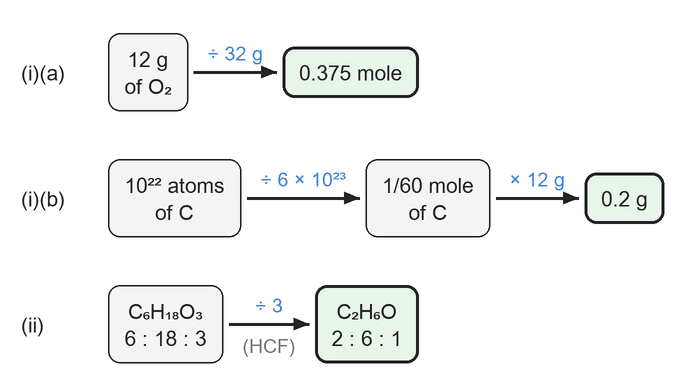
So the simplest ratio C : H : O is 2 : 6 : 1, and the empirical formula is C₂H₆O.
Watch out: Oxygen gas is O₂, so use 32 g per mole, not 16 g; 12 ÷ 16 = 0.75 would be the moles of oxygen ATOMS.
Therefore, (i)(a) 12 g of oxygen gas is 0.375 mole, (i)(b) 10²² carbon atoms weigh 0.2 g, and (ii) the empirical formula is .
- 141 mark
Question 14
Give the appropriate term defined by the statements given below:
The formula that represents the simplest ratio of the various elements present in one molecule of the compound.
Solve with AIWritten solution
Solution:
Concept: A compound can be described by two formulae. The molecular formula gives the actual number of atoms of each element in one molecule; the empirical formula gives only the simplest whole-number ratio of those atoms.
Step 1 — Read what the statement describes.
The statement asks for the formula that shows only the SIMPLEST RATIO of the atoms of the elements in a molecule, not their actual numbers.
Step 2 — Match it with the term.
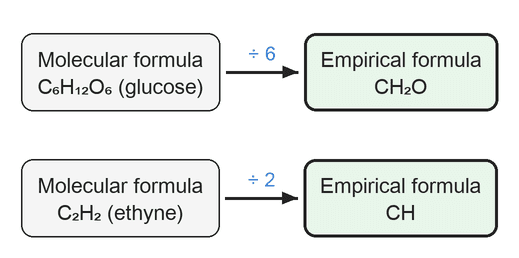
That is the empirical formula. For example, glucose has the molecular formula C₆H₁₂O₆; dividing by 6 gives its empirical formula CH₂O.
Watch out: The molecular formula gives the ACTUAL numbers of atoms; the empirical formula only their simplest ratio.
Therefore, the term is empirical formula.
- 153 marks
Question 15
Copper sulphate solution reacts with sodium hydroxide solution to form a precipitate of copper hydroxide according to the equation:
(i) What mass of copper hydroxide is precipitated by using 200 g of sodium hydroxide?
[H = 1, O = 16, Na = 23, S = 32, Cu = 64]
(ii) What is the colour of the precipitate formed?
Solve with AIWritten solution
Solution:
Concept: Stoichiometry: the coefficients of a balanced equation give the ratio of moles in which substances react and form. So we change the given quantity to moles (mass ÷ molar mass, or volume at S.T.P. ÷ 22.4 L), use the mole ratio, and change back to mass (moles × molar mass) or volume (moles × 22.4 L at S.T.P.).
(i) Mass of copper hydroxide
Step 1 — Read the mole ratio.
The balanced equation shows that 2 moles of sodium hydroxide give 1 mole of copper hydroxide.
Step 2 — Find the molar masses.
We use Na = 23, O = 16, H = 1 and Cu = 64.
Step 3 — Change 200 g of NaOH to moles.
We divide the mass by the molar mass.
Step 4 — Use the 2 : 1 ratio and change to grams.
The moles of Cu(OH)₂ are half the moles of NaOH; then we multiply by 98 g.

(ii) Colour of the precipitate
Step 5 — Name the colour.
Copper(II) hydroxide is an insoluble solid that comes down as a pale blue (light blue) precipitate.
Watch out: The ratio NaOH : Cu(OH)₂ is 2 : 1, so halve the moles of NaOH; using 1 : 1 would give twice the right mass.
Therefore, (i) 245 g of copper hydroxide is precipitated and (ii) the precipitate is pale blue.
- 164 marks
Question 16
Find the empirical formula and the molecular formula of an organic compound from the data given below:
C = 75.92%, H = 6.32% and N = 17.76%
The vapour density of the compound is 39.5.
[C = 12, H = 1, N = 14]
Solve with AIWritten solution
Solution:
Concept: To find an empirical formula (the simplest whole-number ratio of atoms): divide each element's percentage (or mass) by its atomic mass to get the relative number of gram atoms, divide every value by the smallest one, and, if needed, multiply by a small whole number to clear fractions. The molecular formula is n × (empirical formula), where n = molecular mass ÷ empirical formula mass, and molecular mass = 2 × vapour density.
Step 1 — Find the simplest ratio of atoms.
We divide each percentage by the atomic mass and then by the smallest value (1.269, for nitrogen).
Element % Atomic mass Gram atoms (÷ atomic mass) ÷ smallest C 75.92 12 75.92 ÷ 12 = 6.327 4.99 H 6.32 1 6.32 4.98 N 17.76 14 17.76 ÷ 14 = 1.269 1 The ratio C : H : N is 4.99 : 4.98 : 1, which rounds to 5 : 5 : 1, so the empirical formula is C₅H₅N.

Step 2 — Find the empirical formula mass.
We add the atomic masses of the atoms in C₅H₅N.
Step 3 — Find the molecular mass.
The relative molecular mass is twice the vapour density.
Step 4 — Find n and the molecular formula.
We divide the molecular mass by the empirical formula mass.
Since n = 1, the molecular formula is the same as the empirical formula, C₅H₅N.
Watch out: When n works out to 1, the molecular formula is the same as the empirical formula; do not double it.
Therefore, the empirical formula is and the molecular formula is also .
- 175 marks
Question 17
Calculate:
(i) The amount of each reactant required to produce 750 ml of carbon dioxide, when two volumes of carbon monoxide combine with one volume of oxygen to produce two volumes of carbon dioxide.
(ii) The volume occupied by 80 g of carbon dioxide at STP.
(iii) Calculate the number of molecules in 4.4 gm of .
[Atomic mass of C = 12, O = 16]
(iv) State the law associated in question no. (f)(i) above.
Solve with AIWritten solution
Solution:
Concept: Gay-Lussac's law of combining volumes: when gases react, they do so in volumes that bear a simple whole-number ratio to one another and to the volumes of any gaseous products, all measured at the same temperature and pressure. The ratio is read from the coefficients of the balanced equation. The mole concept: one mole of any substance contains the Avogadro number, , of particles (atoms, molecules or formula units), and its mass in grams equals its atomic or molecular mass (the gram atomic / gram molecular mass). So and . Molar volume: one mole of any gas occupies 22.4 litres (22400 cm³) at S.T.P. (273 K and 760 mm of Hg, that is 1 atm).
(i) Volumes of the reactants for 750 ml of carbon dioxide
Step 1 — Read the volume ratio.
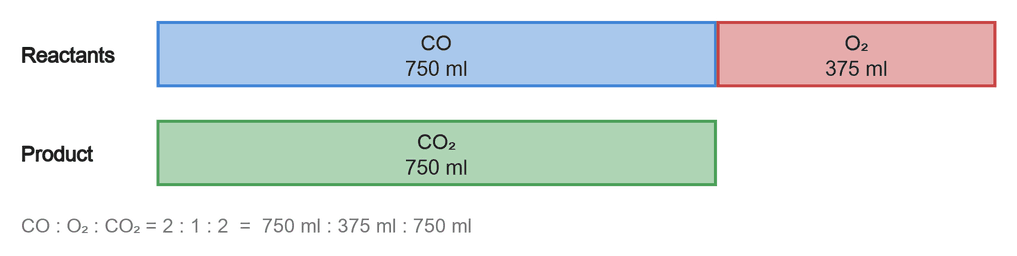
The equation shows that 2 volumes of CO and 1 volume of O₂ give 2 volumes of CO₂.
Step 2 — Scale to 750 ml of CO₂.
Carbon monoxide is needed in the ratio 2 : 2 (the same volume as the CO₂), and oxygen in the ratio 1 : 2 (half that volume).
(ii) Volume of 80 g of carbon dioxide at S.T.P.
Step 3 — Change the mass to moles.
The molar mass of CO₂ is 12 + 2 × 16 = 44 g.
Step 4 — Multiply by the molar volume.
Each mole of a gas occupies 22.4 L at S.T.P.
(iii) Molecules in 4.4 g of carbon dioxide
Step 5 — Change the mass to moles.
We divide by the molar mass, 44 g.
Step 6 — Multiply by Avogadro's number.
One mole contains 6.022 × 10²³ molecules.
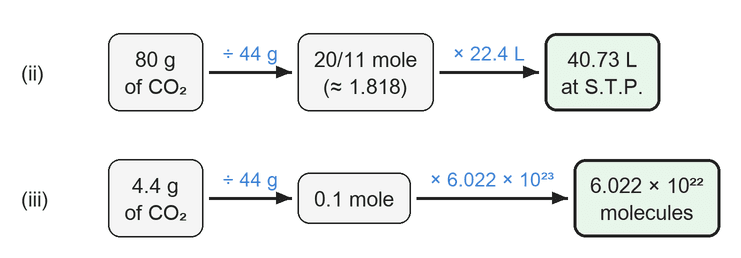
If Avogadro's number is taken as 6 × 10²³, the answer is 6 × 10²² molecules.
(iv) The law used in (i)
Step 7 — Name the law.
In (i) we used the simple whole-number ratio of the volumes of reacting gases and of the gaseous product. This is Gay-Lussac's law of combining volumes.
Watch out: In (ii) the mass must first be changed to moles; 80 g of CO₂ is not 80 ÷ 22.4 of anything.
Therefore, (i) 750 ml of carbon monoxide and 375 ml of oxygen are needed; (ii) 80 g of CO₂ occupies about 40.73 litres at S.T.P.; (iii) 4.4 g of CO₂ contains 6.022 × 10²² molecules; (iv) the law is Gay-Lussac's law of combining volumes.
- 181 mark
Question 18
Fill in the blanks from the choices given in brackets:
(iii) The number of moles in 11gm of nitrogen gas is ...............
(0.39, 0.49, 0.29) [atomic mass of N=14]
Solve with AIWritten solution
Solution:
Concept: The mole concept: one mole of any substance contains the Avogadro number, , of particles (atoms, molecules or formula units), and its mass in grams equals its atomic or molecular mass (the gram atomic / gram molecular mass). So and .
Step 1 — Find the molar mass of nitrogen gas.
Nitrogen gas is made of N₂ molecules, so its molar mass is 2 × 14 = 28 g.
Step 2 — Divide the mass by the molar mass.
We divide 11 g by 28 g and round to two decimal places to match the choices.
Watch out: Nitrogen gas is N₂ (28 g per mole); dividing by 14 would give 0.79, which is the moles of nitrogen ATOMS.
Therefore, the number of moles in 11 g of nitrogen gas is 0.39.
- 193 marks
Question 19
Calculate the percentage of:
(i) Fluorine
(ii) Sodium and
(iii) Aluminium
in sodium aluminium fluoride [], to the nearest whole number.
[Atomic Mass: Na = 23, Al = 27, F = 19]
Solve with AIWritten solution
Solution:
Concept: Percentage composition: the percentage of an element in a compound is .
Step 1 — Find the molar mass of Na₃AlF₆.
One formula unit has 3 Na, 1 Al and 6 F atoms, so we add their masses.
(i) Fluorine
Step 2 — Find the percentage of fluorine.
Six fluorine atoms weigh 114 g in every 210 g.
(ii) Sodium
Step 3 — Find the percentage of sodium.
Three sodium atoms weigh 69 g in every 210 g.
(iii) Aluminium
Step 4 — Find the percentage of aluminium.
One aluminium atom weighs 27 g in every 210 g.
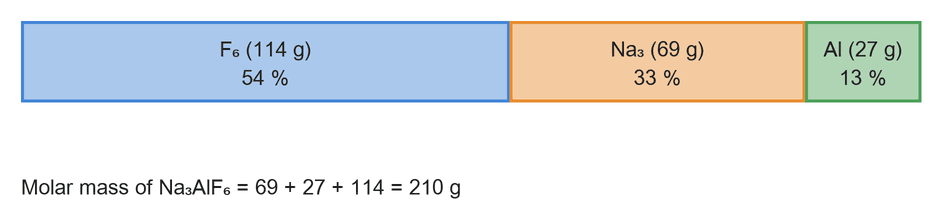
Check: 54 + 33 + 13 makes 100, as it should.
Watch out: Count every atom: there are 6 fluorine and 3 sodium atoms, so use 6 × 19 and 3 × 23, not 19 and 23.
Therefore, sodium aluminium fluoride contains (i) 54 % fluorine, (ii) 33 % sodium and (iii) 13 % aluminium, to the nearest whole number.
- 204 marks
Question 20
(i) State the volume occupied by 40 gm of methane at STP, if its vapour density (V.D.) is 8.
(ii) Calculate the number of moles present in 160 gm of NaOH.
[Atomic Mass: Na = 23, H= 1, O= 16]
Solve with AIWritten solution
Solution:
Concept: Vapour density (V.D.) is the ratio of the mass of a certain volume of a gas to the mass of the same volume of hydrogen at the same temperature and pressure. Since one molecule of hydrogen has mass 2, The mole concept: one mole of any substance contains the Avogadro number, , of particles (atoms, molecules or formula units), and its mass in grams equals its atomic or molecular mass (the gram atomic / gram molecular mass). So and . Molar volume: one mole of any gas occupies 22.4 litres (22400 cm³) at S.T.P. (273 K and 760 mm of Hg, that is 1 atm).
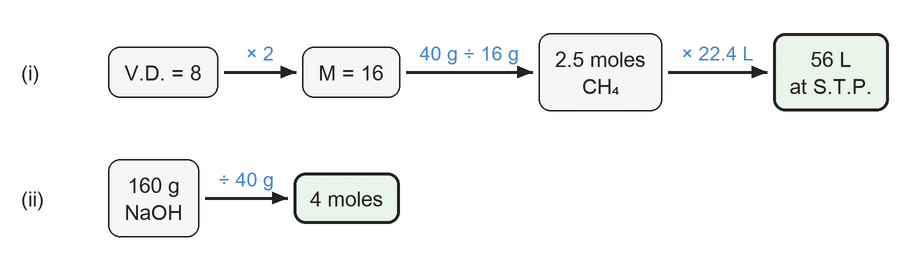
(i) Volume of 40 g of methane at S.T.P.
Step 1 — Find the molecular mass from the vapour density.
The molecular mass is twice the vapour density.
Step 2 — Change 40 g to moles.
One mole of methane weighs 16 g.
Step 3 — Multiply by the molar volume.
Each mole of a gas occupies 22.4 L at S.T.P.
(ii) Moles in 160 g of NaOH
Step 4 — Find the molar mass and divide.
The molar mass of NaOH is 23 + 16 + 1 = 40 g, so we divide 160 g by 40 g.
Watch out: The vapour density (8) is not the molar mass; double it to 16 before changing grams to moles.
Therefore, (i) 40 g of methane occupies 56 litres at S.T.P. and (ii) 160 g of NaOH is 4 moles.
- 211 mark
Question 21
The vapour density of is ............... (At. Wt. C = 12, H = 1, O = 16)
Solve with AIAnswer
(A) 32
(B) 18
- Correct
(C) 16
(D) 34
Answer: (C) 16
Concept: Vapour density (V.D.) is the ratio of the mass of a certain volume of a gas to the mass of the same volume of hydrogen at the same temperature and pressure. Since one molecule of hydrogen has mass 2,
Step 1 — Find the molecular mass of CH₃OH.
We add the atomic masses: one C, four H (three in CH₃ and one in OH) and one O.
Step 2 — Halve it to get the vapour density.
The vapour density is half the relative molecular mass.
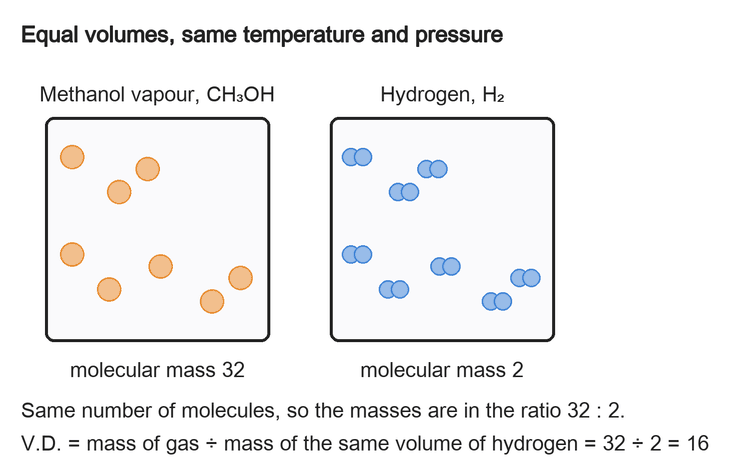
Watch out: 32 is the molecular mass; the vapour density is half of it.
Why the other options are wrong:
- (A) 32: 32 is the relative molecular mass of methanol; the vapour density is half of it.
- (B) 18: 18 would need a molecular mass of 36; methanol's molecular mass is 32.
- (D) 34: 34 would need a molecular mass of 68, more than twice that of methanol.
Therefore, the vapour density of CH₃OH is 16, option (C).
- 221 mark
Question 22
State the terms/process for the following:
(e) The ratio of the mass of a certain volume of gas to the same volume of hydrogen measured under the same conditions of temperature and pressure.
Solve with AIWritten solution
Solution:
Concept: Vapour density (V.D.) is the ratio of the mass of a certain volume of a gas to the mass of the same volume of hydrogen at the same temperature and pressure. Since one molecule of hydrogen has mass 2,
Step 1 — Read what the statement describes.
The statement compares the mass of a volume of a gas with the mass of the SAME volume of hydrogen, at the same temperature and pressure.
Step 2 — Match it with the term.
This ratio is called the vapour density (relative vapour density). For example, carbon dioxide (molecular mass 44) is 22 times as heavy as the same volume of hydrogen, so its vapour density is 22.
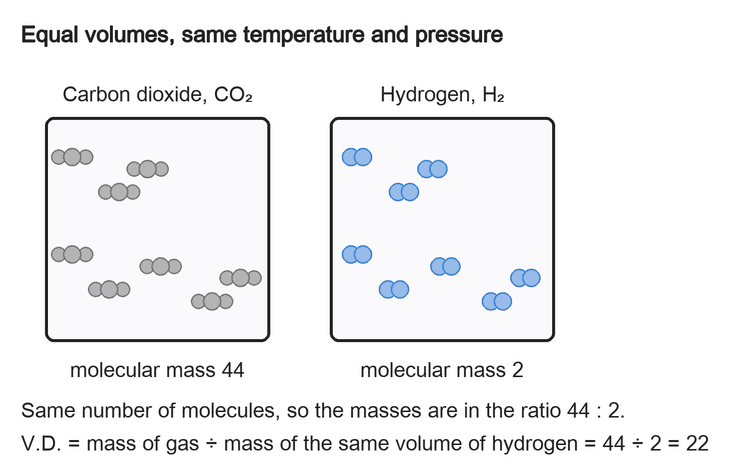
Watch out: Vapour density has no unit, because it is a ratio of two masses.
Therefore, the term is vapour density.
- 233 marks
Question 23
Solve the following numerical problem.
Ethane burns in oxygen according to the chemical equation:
If 80 ml of ethane is burnt in 300 ml of oxygen, find the composition of the resultant gaseous mixture when measured at room temperature.
Solve with AIWritten solution
Solution:
Concept: Gay-Lussac's law of combining volumes: when gases react, they do so in volumes that bear a simple whole-number ratio to one another and to the volumes of any gaseous products, all measured at the same temperature and pressure. The ratio is read from the coefficients of the balanced equation.
Step 1 — Read the volume ratio.
By Gay-Lussac's law, 2 volumes of ethane react with 7 volumes of oxygen and give 4 volumes of carbon dioxide.
Step 2 — Find the oxygen used.
We work out how much oxygen 80 ml of ethane needs.
There is 300 ml of oxygen, so oxygen is in excess and all the ethane burns.
Step 3 — Find the carbon dioxide formed.
Carbon dioxide forms in the ratio 4 : 2, twice the volume of ethane.
Step 4 — Find the oxygen left over.
The unused oxygen is the oxygen taken minus the oxygen used.
At room temperature the water formed is a liquid, so it adds no gas volume.
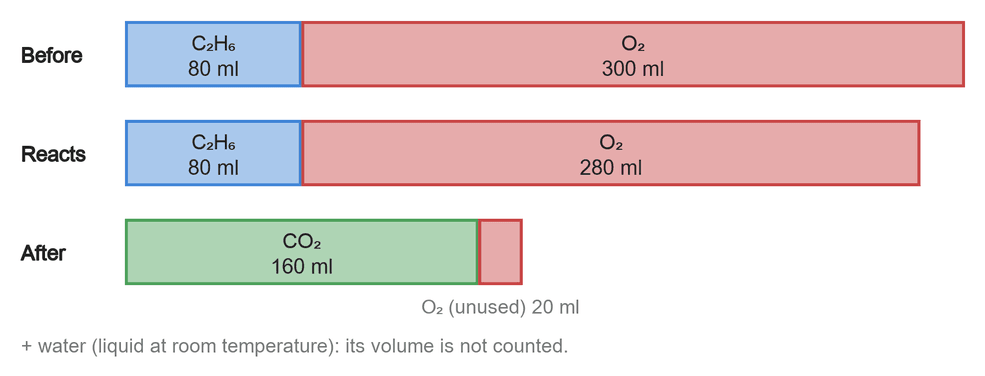
Watch out: Water formed in these reactions condenses to a liquid at room temperature, so it has no gas volume; never add its coefficient to the gas volumes.
Therefore, the resultant gaseous mixture is 160 ml of carbon dioxide and 20 ml of unused oxygen (180 ml in all).
- 241 mark
Question 24
Define / State:
(b) Gay-Lussac's Law of combining volumes
Solve with AIWritten solution
Solution:
Concept: Gay-Lussac's law is about the VOLUMES of gases that react together. It holds only when every volume is measured at the same temperature and pressure.
Step 1 — State the law.
Gay-Lussac's law of combining volumes: when gases react together, they do so in volumes which bear a simple whole-number ratio to one another and to the volumes of the gaseous products, provided all the volumes are measured at the same temperature and pressure.
Step 2 — Give an example.
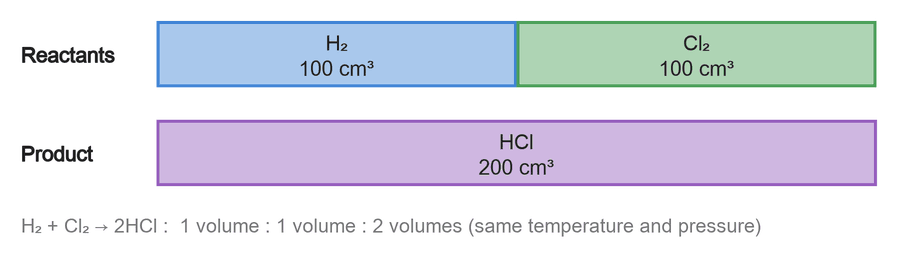
Hydrogen and chlorine combine to form hydrogen chloride gas.
So 100 cm³ of hydrogen reacts with 100 cm³ of chlorine to give 200 cm³ of hydrogen chloride, a ratio of 1 : 1 : 2.
Watch out: The law applies only to gases; a solid or liquid in the reaction (such as water at room temperature) is left out of the volume ratio.
Therefore, gases react in volumes that bear a simple whole-number ratio to one another and to the volumes of the gaseous products, at the same temperature and pressure.
- 252 marks
Question 25
The Empirical formula of an organic compound is .
If its relative molecular mass is 168, what is its molecular formula?
[At. Wt. C = 12, H = 1, Cl = 35.5]
Solve with AIWritten solution
Solution:
Concept: To find an empirical formula (the simplest whole-number ratio of atoms): divide each element's percentage (or mass) by its atomic mass to get the relative number of gram atoms, divide every value by the smallest one, and, if needed, multiply by a small whole number to clear fractions. The molecular formula is n × (empirical formula), where n = molecular mass ÷ empirical formula mass, and molecular mass = 2 × vapour density.
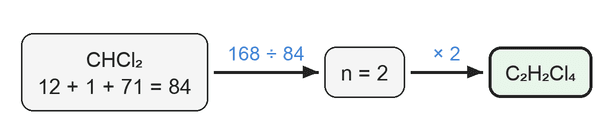
Step 1 — Find the empirical formula mass.
We add the atomic masses of one C, one H and two Cl atoms.
Step 2 — Find n.
We divide the relative molecular mass by the empirical formula mass to find how many CHCl₂ units are in one molecule.
Step 3 — Write the molecular formula.
We multiply every subscript of CHCl₂ by 2, which gives (CHCl₂)₂, that is C₂H₂Cl₄.
Watch out: Chlorine's atomic mass is 35.5, so two Cl atoms weigh 71, not 70.
Therefore, the molecular formula of the compound is .
- 263 marks
Question 26
Calculate:
(a) The percentage of phosphorus in the fertilizer super phosphate correct to 1 decimal point.
[At. Wt. H = 1, P = 31, O = 16, Ca = 40]
(b) Write the empirical formula of .
Solve with AIWritten solution
Solution:
Concept: Percentage composition: the percentage of an element in a compound is . The empirical formula is the simplest whole-number ratio of the atoms, found by dividing every subscript by their highest common factor (HCF).
(a) Percentage of phosphorus in superphosphate
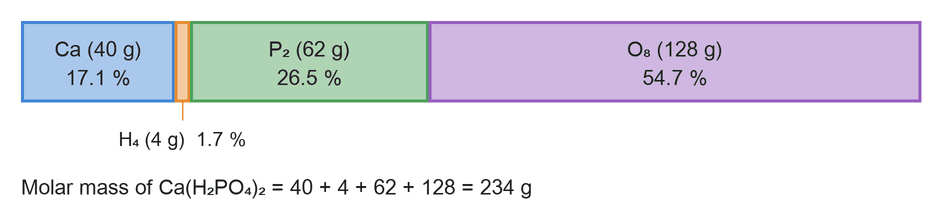
Step 1 — Find the molar mass of Ca(H₂PO₄)₂.
The bracket is taken twice, so there are 1 Ca, 4 H, 2 P and 8 O atoms.
Step 2 — Find the percentage of phosphorus.
Two phosphorus atoms weigh 2 × 31 = 62 g in every 234 g.
(b) Empirical formula of C₈H₁₈
Step 3 — Divide the subscripts by their HCF.
The subscripts 8 and 18 have the highest common factor 2. Dividing both by 2 gives 4 and 9, so the empirical formula is C₄H₉.
Watch out: The subscript 2 outside the bracket doubles everything inside it, so there are TWO phosphorus atoms (62 g), not one.
Therefore, (a) superphosphate contains 26.5 % phosphorus (to 1 decimal place) and (b) the empirical formula of C₈H₁₈ is .
- 271 mark
Question 27
Arrange the following according to the instructions given in brackets:
(a) , , , (In the increasing order of the molecular weight)
Solve with AIWritten solution
Solution:
Concept: The molecular weight (relative molecular mass) of a compound is the sum of the atomic masses of all the atoms in one molecule. Here C = 12 and H = 1.
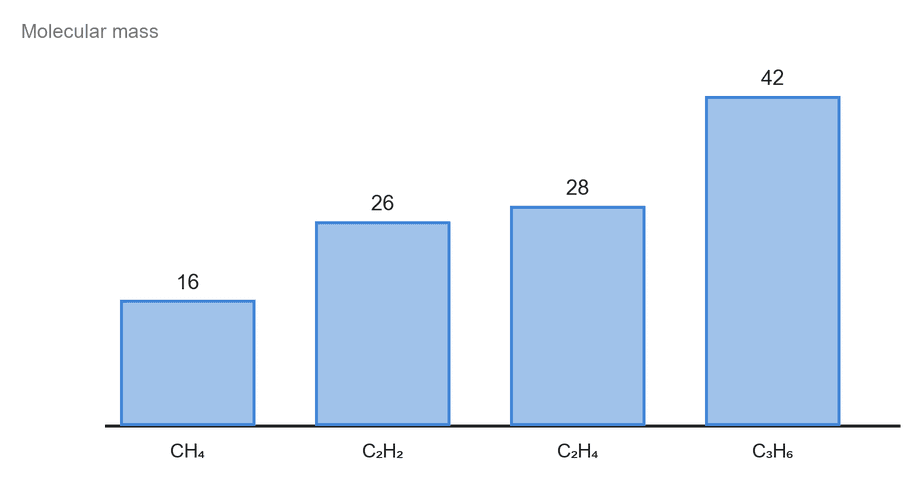
Step 1 — Work out each molecular weight.
We add 12 for every carbon atom and 1 for every hydrogen atom.
Step 2 — Arrange from the smallest to the largest.
Putting the values 16, 26, 28 and 42 in increasing order gives the order of the compounds.
Watch out: C₂H₂ and C₂H₄ have the same number of carbon atoms; the one with more hydrogen (C₂H₄) is the heavier.
Therefore, the increasing order of molecular weight is < < < .
- 281 mark
Question 28
Which of the following would occupy 22.4 litres at S.T.P.?
-
32 g of oxygen gas
-
2 moles of hydrogen gas
-
molecules of ammonia
[Atomic weights: O = 16, H = 1, N = 14]
Solve with AIAnswer
(A) 1 & 2
- Correct
(B) 1 & 3
(C) 2 & 3
(D) 1, 2 & 3
Answer: (B) 1 & 3
Concept: Molar volume: one mole of any gas occupies 22.4 litres (22400 cm³) at S.T.P. (273 K and 760 mm of Hg, that is 1 atm). So a gas occupies 22.4 L at S.T.P. only if exactly 1 mole of it is present.
Step 1 — Check statement 1.
The molar mass of oxygen gas, O₂, is 32 g, so 32 g is exactly 1 mole and occupies 22.4 L.
Step 2 — Check statement 2.
Two moles of hydrogen occupy twice the molar volume.
This is not 22.4 L, so statement 2 does not fit.
Step 3 — Check statement 3.
6.022 × 10²³ molecules is Avogadro's number of molecules, which is exactly 1 mole of ammonia, so it occupies 22.4 L.

Step 4 — Pick the option.
Only statements 1 and 3 describe 1 mole of gas, so the answer is the option that names 1 and 3.
Watch out: 2 moles of any gas occupy 44.8 L, not 22.4 L; check the number of moles, not just whether a gas is named.
Why the other options are wrong:
- (A) 1 & 2: it includes statement 2, but 2 moles of hydrogen occupy 44.8 L at S.T.P.
- (C) 2 & 3: it includes statement 2 (44.8 L) and leaves out statement 1, although 32 g of oxygen is 1 mole.
- (D) 1, 2 & 3: it includes statement 2, which gives 44.8 L, not 22.4 L.
Therefore, 32 g of oxygen and 6.022 × 10²³ molecules of ammonia each occupy 22.4 L at S.T.P., option (B).
-
- 291 mark
Question 29
State the terms for the following:
(c) The amount of substance which contains the same number of units as the number of atoms in carbon-12.
Solve with AIWritten solution
Solution:
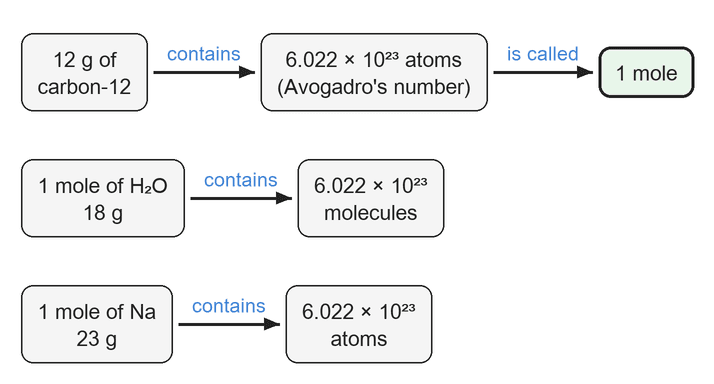
Concept: Chemists count particles in moles. The mole was defined from carbon-12: one mole is the amount of a substance that contains as many units (atoms, molecules, ions) as there are atoms in exactly 12 g of carbon-12, that is 6.022 × 10²³ units (Avogadro's number).
Step 1 — Read what the statement describes.
The statement describes an AMOUNT of a substance, fixed by counting its units against the atoms in carbon-12 (it means 12 g of carbon-12).
Step 2 — Match it with the term.
This amount is the mole. For example, 1 mole of water (18 g) contains 6.022 × 10²³ molecules, and 1 mole of sodium (23 g) contains 6.022 × 10²³ atoms.
Watch out: The mole is an amount (a number of units), not a mass; its mass in grams depends on the substance.
Note: Since 2019 the SI defines the mole directly as exactly 6.02214076 × 10²³ units; this is the same as the number of atoms in 12 g of carbon-12 to the accuracy used here.
Therefore, the term is mole.
- 301 mark
Question 30
State the terms for the following:
(e) The formula which represents the simplest ratio between the atoms of elements present in a compound.
Solve with AIWritten solution
Solution:
Concept: A compound can be described by two formulae. The molecular formula gives the actual number of atoms of each element in one molecule; the empirical formula gives only the simplest whole-number ratio of those atoms.
Step 1 — Read what the statement describes.
The statement asks for the formula that shows the SIMPLEST RATIO between the atoms of the elements in a compound.
Step 2 — Match it with the term.
That is the empirical formula. For example, ethyne has the molecular formula C₂H₂; dividing by 2 gives its empirical formula CH.
Watch out: Do not confuse it with the molecular formula, which gives the ACTUAL numbers of atoms in one molecule.
Therefore, the term is empirical formula.
- 311 mark
Question 31
Define the following terms:
(a) Molar volume
Solve with AIWritten solution
Solution:
Concept: By Avogadro's law, equal volumes of gases at the same temperature and pressure contain equal numbers of molecules. So one mole of EVERY gas (6.022 × 10²³ molecules) takes up the same volume at a given temperature and pressure.
Step 1 — State the definition.
Molar volume is the volume occupied by one mole (one gram molecular mass) of any gas at S.T.P. Its value is 22.4 litres (22,400 cm³).
Step 2 — Say what S.T.P. means.
S.T.P. (standard temperature and pressure) is 0 °C (273 K) and 760 mm of mercury (1 atm). For example, 2 g of hydrogen, 32 g of oxygen and 44 g of carbon dioxide each occupy 22.4 L at S.T.P.

Watch out: 22.4 L holds only at S.T.P.; at room temperature and pressure one mole of a gas takes up about 24 L.
Therefore, molar volume is the volume occupied by one mole of any gas at S.T.P., which is 22.4 litres.
- 323 marks
Question 32
Calcium carbonate reacts with dilute hydrochloric acid as given below:
(a) What is the mass of 5 moles of calcium carbonate? (Relative molecular mass of calcium carbonate is 100)
(b) How many moles of HCl will react with 5 moles of calcium carbonate?
(c) What is the volume of carbon dioxide liberated at S.T.P. at the same time?
Solve with AIWritten solution
Solution:
Concept: Stoichiometry: the coefficients of a balanced equation give the ratio of moles in which substances react and form. So we change the given quantity to moles (mass ÷ molar mass, or volume at S.T.P. ÷ 22.4 L), use the mole ratio, and change back to mass (moles × molar mass) or volume (moles × 22.4 L at S.T.P.). Molar volume: one mole of any gas occupies 22.4 litres (22400 cm³) at S.T.P. (273 K and 760 mm of Hg, that is 1 atm).
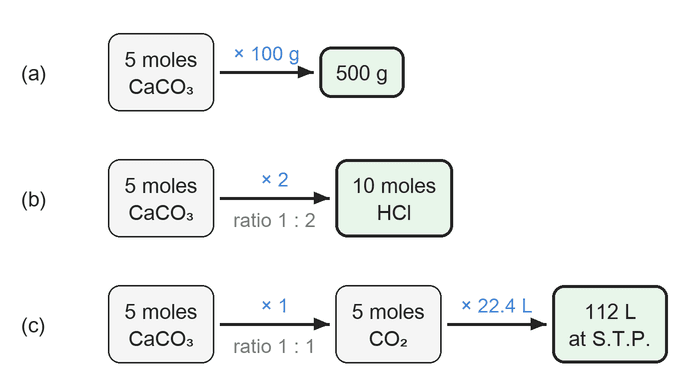
Step 1 — Read the mole ratio.
The balanced equation shows that 1 mole of calcium carbonate reacts with 2 moles of HCl and gives 1 mole of carbon dioxide.
(a) Mass of 5 moles of calcium carbonate
Step 2 — Multiply the moles by the molar mass.
The relative molecular mass of CaCO₃ is 100, so one mole weighs 100 g.
(b) Moles of HCl that react
Step 3 — Use the 1 : 2 ratio.
Each mole of CaCO₃ needs 2 moles of HCl.
(c) Volume of carbon dioxide at S.T.P.
Step 4 — Use the 1 : 1 ratio and the molar volume.
Each mole of CaCO₃ gives 1 mole of CO₂, so 5 moles of CO₂ are formed, and each mole occupies 22.4 L at S.T.P.
Watch out: HCl is needed in the ratio 1 : 2, so the moles of HCl are twice the moles of CaCO₃, not equal to them.
Therefore, (a) 5 moles of calcium carbonate weigh 500 g; (b) 10 moles of HCl react; (c) 112 litres of carbon dioxide is liberated at S.T.P.
- 333 marks
Question 33
Ammonia burns in oxygen as shown below.
If 240 cc of ammonia is burnt in 300 cc of oxygen, find out the composition of the resultant gaseous mixture at room temperature.
Solve with AIWritten solution
Solution:
Concept: Gay-Lussac's law of combining volumes: when gases react, they do so in volumes that bear a simple whole-number ratio to one another and to the volumes of any gaseous products, all measured at the same temperature and pressure. The ratio is read from the coefficients of the balanced equation.
Step 1 — Read the volume ratio.
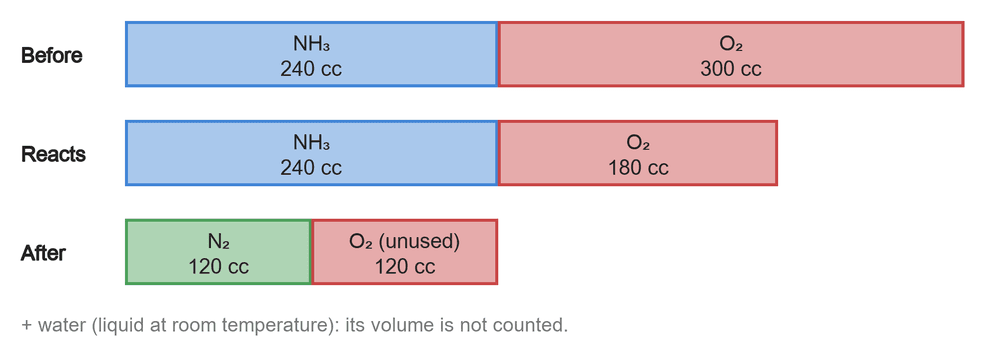
By Gay-Lussac's law, 4 volumes of ammonia react with 3 volumes of oxygen and give 2 volumes of nitrogen.
Step 2 — Find the oxygen used.
We work out how much oxygen 240 cc of ammonia needs.
There is 300 cc of oxygen, so oxygen is in excess and all the ammonia burns.
Step 3 — Find the nitrogen formed.
Nitrogen forms in the ratio 2 : 4, half the volume of ammonia.
Step 4 — Find the oxygen left over.
The unused oxygen is the oxygen taken minus the oxygen used.
At room temperature the water formed is a liquid, so it adds no gas volume.
Watch out: Water formed in these reactions condenses to a liquid at room temperature, so it has no gas volume; never add its coefficient to the gas volumes.
Therefore, the resultant gaseous mixture is 120 cc of nitrogen and 120 cc of unused oxygen (240 cc in all).
- 341 mark
Question 34
Choose the correct answer from the list given below:
(b) Empirical formula of Ethyne.
Solve with AIWritten solution
Solution:
Concept: The empirical formula is the simplest whole-number ratio of the atoms in a compound. We write the molecular formula and divide every subscript by their highest common factor (HCF).
Step 1 — Write the molecular formula of ethyne.
Ethyne (acetylene) has two carbon atoms and two hydrogen atoms in each molecule, so its molecular formula is C₂H₂.
Step 2 — Divide by the HCF.
The subscripts 2 and 2 have the HCF 2. Dividing both by 2 gives the ratio C : H of 1 : 1, so the empirical formula is CH, which is in the list.
Watch out: C₂H₂ in the list is the MOLECULAR formula of ethyne; the question asks for the empirical formula.
Therefore, the empirical formula of ethyne is CH.
- 351 mark
Question 35
An organic compound has a vapour density of 22. The molecular formula of the organic compound is: [Atomic weight: C = 12, H = 1]
Solve with AIAnswer
(A)
(B)
(C)
- Correct
(D)
Answer: (D)
Concept: Vapour density (V.D.) is the ratio of the mass of a certain volume of a gas to the mass of the same volume of hydrogen at the same temperature and pressure. Since one molecule of hydrogen has mass 2,
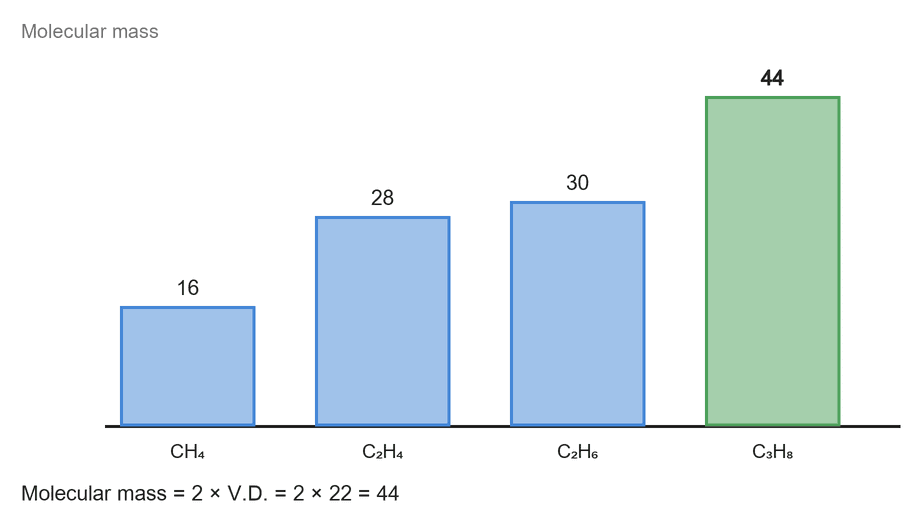
Step 1 — Find the molecular mass.
The relative molecular mass is twice the vapour density.
Step 2 — Find the option with molecular mass 44.
We work out the molecular mass of the keyed choice, propane (three C and eight H atoms).
The other choices are worked out in the bullets below; only C₃H₈ gives 44.
Watch out: 22 is the vapour density, not the molecular mass; double it before matching a formula.
Why the other options are wrong:
- (A) : CH₄ has molecular mass 16, so its vapour density is 8.
- (B) : C₂H₄ has molecular mass 28, so its vapour density is 14.
- (C) : C₂H₆ has molecular mass 30, so its vapour density is 15.
Therefore, the compound is propane, C₃H₈, option (D).
- 361 mark
Question 36
40 of methane () is reacted with 60 of oxygen. The equation for the reaction is given below:
All volumes are measured at room temperature. What is the total volume of the gases remaining at the end of the reaction?
Solve with AIAnswer
(A) 60
- Correct
(B) 40
(C) 45
(D) 50
Answer: (B) 40
Concept: Gay-Lussac's law of combining volumes: when gases react, they do so in volumes that bear a simple whole-number ratio to one another and to the volumes of any gaseous products, all measured at the same temperature and pressure. The ratio is read from the coefficients of the balanced equation. The gas that runs out first (the limiting gas) decides how much reacts.
Step 1 — Read the volume ratio.
By Gay-Lussac's law, 1 volume of methane reacts with 2 volumes of oxygen and gives 1 volume of carbon dioxide.
Step 2 — Find the limiting gas.
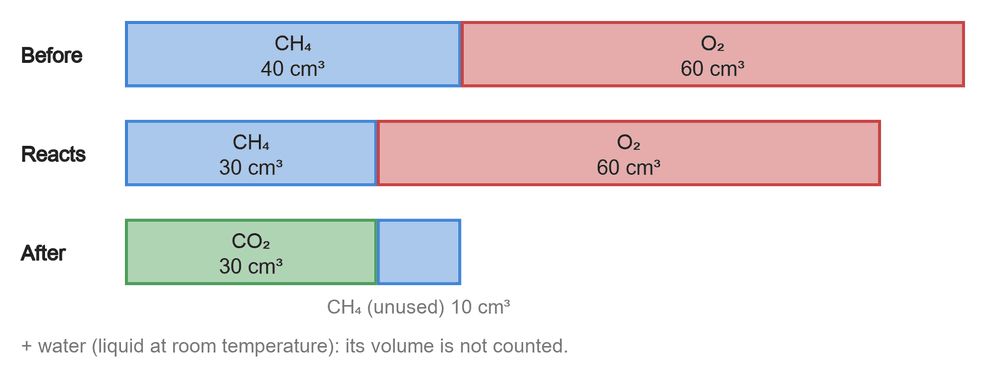
40 cm³ of methane would need 80 cm³ of oxygen, but only 60 cm³ is present. So oxygen runs out first, and it reacts with half its volume of methane.
Step 3 — Find what is left after the reaction.
Some methane is left over, carbon dioxide is formed, and all the oxygen is used up.
Step 4 — Add the gas volumes.
At room temperature the water is a liquid, so only methane and carbon dioxide count.
Watch out: Methane is NOT the limiting gas here; check which gas runs out before using the 1 : 2 ratio.
Why the other options are wrong:
- (A) 60 : 60 cm³ is the oxygen taken at the start, and all of that oxygen is used up in the reaction.
- (C) 45 : 45 cm³ would need 15 cm³ of methane left over; only 40 − 30 = 10 cm³ of methane is left.
- (D) 50 : 50 cm³ would need 20 cm³ of methane left over with the 30 cm³ of CO₂; only 10 cm³ of methane is left.
Therefore, 40 cm³ of gas (10 cm³ of methane and 30 cm³ of carbon dioxide) remains, option (B).
- 373 marks
Question 37
The reaction between concentrated sulphuric acid and magnesium can be represented by the equation given below:
If 60 g of magnesium is used in the reaction, calculate the following:
(a) The mass of sulphuric acid needed for the reaction.
(b) The volume of sulphur dioxide gas liberated at S.T.P. [Atomic weight: Mg=24, H=1, S=32, O=16]
Solve with AIWritten solution
Solution:
Concept: Stoichiometry: the coefficients of a balanced equation give the ratio of moles in which substances react and form. So we change the given quantity to moles (mass ÷ molar mass, or volume at S.T.P. ÷ 22.4 L), use the mole ratio, and change back to mass (moles × molar mass) or volume (moles × 22.4 L at S.T.P.). Molar volume: one mole of any gas occupies 22.4 litres (22400 cm³) at S.T.P. (273 K and 760 mm of Hg, that is 1 atm).
Step 1 — Read the mole ratio.
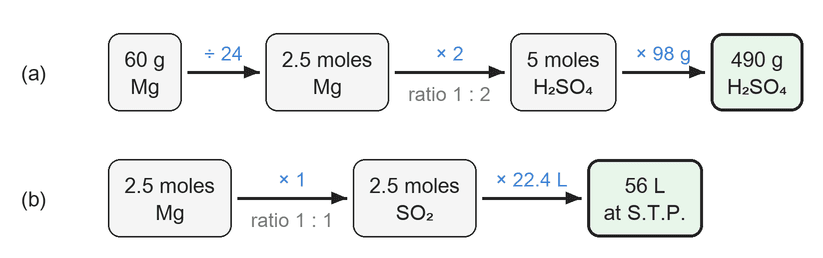
The balanced equation shows that 1 mole of magnesium reacts with 2 moles of sulphuric acid and gives 1 mole of sulphur dioxide.
Step 2 — Change 60 g of magnesium to moles.
One mole of magnesium atoms weighs 24 g.
(a) Mass of sulphuric acid needed
Step 3 — Use the 1 : 2 ratio.
The moles of acid are twice the moles of magnesium.
Step 4 — Change the moles of acid to grams.
The molar mass of H₂SO₄ is 2 × 1 + 32 + 4 × 16 = 98 g.
(b) Volume of sulphur dioxide at S.T.P.
Step 5 — Use the 1 : 1 ratio and the molar volume.
Each mole of magnesium gives 1 mole of SO₂, so 2.5 moles of SO₂ are formed, and each mole occupies 22.4 L at S.T.P.
Watch out: The acid is needed in the ratio 1 : 2, so use 5 moles of H₂SO₄, not 2.5 moles.
Therefore, (a) 490 g of sulphuric acid is needed and (b) 56 litres of sulphur dioxide is liberated at S.T.P.
- 382 marks
Question 38
A gas cylinder can hold 150 g of hydrogen under certain conditions of temperature and pressure. If an identical cylinder with the same capacity can hold 450 g of gas ‘G’ under the same conditions of temperature and pressure, find:
(a) the vapour density of the gas ‘G’.
(b) the molecular weight of gas ‘G’.
Solve with AIWritten solution
Solution:
Concept: Vapour density (V.D.) is the ratio of the mass of a certain volume of a gas to the mass of the same volume of hydrogen at the same temperature and pressure. Since one molecule of hydrogen has mass 2, Avogadro's law: equal volumes of all gases, under the same conditions of temperature and pressure, contain an equal number of molecules. So, at fixed temperature and pressure, the number of molecules is proportional to the volume.
(a) Vapour density of G
Step 1 — See that the volumes are equal.
The two cylinders are identical and are at the same temperature and pressure, so they hold equal volumes, and by Avogadro's law equal numbers of molecules.
Step 2 — Divide the mass of G by the mass of hydrogen.
The vapour density is the mass of a volume of the gas divided by the mass of the same volume of hydrogen.

(b) Molecular weight of G
Step 3 — Double the vapour density.
The relative molecular mass is twice the vapour density.
Watch out: The vapour density is a ratio of the two masses (450 ÷ 150), not their difference; then double it for the molecular weight.
Note: These are the paper's numbers, worked as printed. No real gas has a molecular weight as low as 6 (hydrogen, the lightest, is 2 and helium is 4), so treat G as a number exercise.
Therefore, (a) the vapour density of G is 3 and (b) the molecular weight of G is 6.
- 394 marks
Question 39
An organic compound ‘X’ contains carbon, oxygen and hydrogen only. The percentage of carbon and hydrogen are 47.4% and 10.5% respectively. The relative molecular mass of ‘X’ is 76. Find the empirical formula and the molecular formula of ‘X’. [Atomic weight: C = 12, O = 16, H = 1]
Solve with AIWritten solution
Solution:
Concept: To find an empirical formula (the simplest whole-number ratio of atoms): divide each element's percentage (or mass) by its atomic mass to get the relative number of gram atoms, divide every value by the smallest one, and, if needed, multiply by a small whole number to clear fractions. The molecular formula is n × (empirical formula), where n = molecular mass ÷ empirical formula mass, and molecular mass = 2 × vapour density.
Step 1 — Find the percentage of oxygen.
The compound contains only carbon, hydrogen and oxygen, so oxygen makes up the rest of the 100 %.
Step 2 — Find the empirical formula.
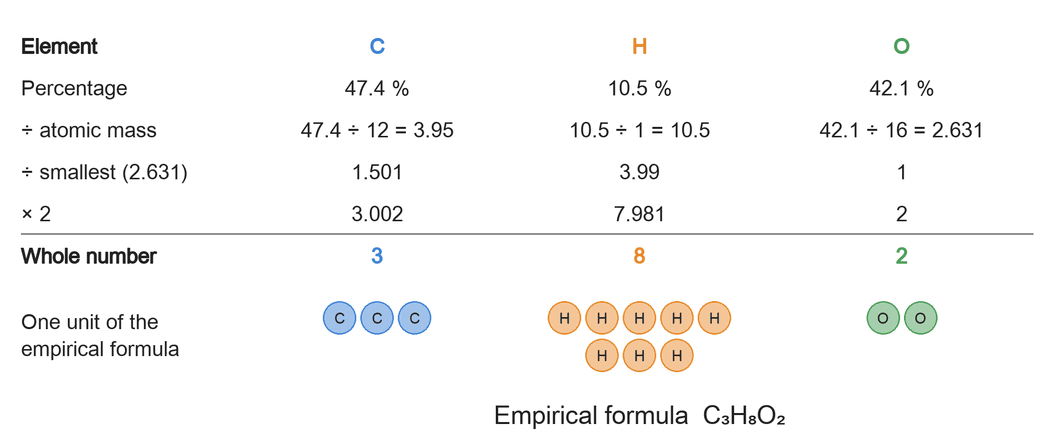
We divide each percentage by the atomic mass and then by the smallest value (2.631, for oxygen). Carbon comes out as 1.5, not a whole number, so we multiply every value by 2.
Element % Atomic mass Gram atoms (÷ atomic mass) ÷ smallest × 2 C 47.4 12 47.4 ÷ 12 = 3.95 1.5 3 H 10.5 1 10.5 3.99 8 O 42.1 16 42.1 ÷ 16 = 2.631 1 2 So C : H : O is 3 : 8 : 2, and the empirical formula is C₃H₈O₂.
Step 3 — Find the empirical formula mass.
We add the atomic masses of the atoms in C₃H₈O₂.
Step 4 — Find n and the molecular formula.
We divide the relative molecular mass by the empirical formula mass.
Since n = 1, the molecular formula is the same as the empirical formula.
Watch out: A ratio of 1.5 : 4 : 1 is not yet a formula; multiply every value by 2 to make all of them whole.
Therefore, the empirical formula of X is and its molecular formula is also .
- 401 mark
Question 40
State Avogadro’s Law.
Solve with AIWritten solution
Solution:
Concept: Avogadro's law links the VOLUME of a gas to the NUMBER of its molecules. It is the basis of the mole concept for gases and of vapour density.
Step 1 — State the law.
Avogadro's law: equal volumes of all gases, under the same conditions of temperature and pressure, contain an equal number of molecules.
Step 2 — Give an example.
One litre each of hydrogen, oxygen and carbon dioxide, all at the same temperature and pressure, contain the same number (n) of molecules, even though the gases are different.

Watch out: The law is about equal numbers of MOLECULES, not equal numbers of atoms or equal masses.
Therefore, Avogadro's law states that equal volumes of all gases, under the same conditions of temperature and pressure, contain an equal number of molecules.
- 411 mark
Question 41
How many moles are present in 10g of ? [Atomic weight: Ca = 40, C = 12, O = 16]
Solve with AIAnswer
(A) 10 moles
(B) 1 mole
- Correct
(C) 0.1 mole
(D) 0.11 mole
Answer: (C) 0.1 mole
Concept: The mole concept: one mole of any substance contains the Avogadro number, , of particles (atoms, molecules or formula units), and its mass in grams equals its atomic or molecular mass (the gram atomic / gram molecular mass). So and .
Step 1 — Find the molar mass of CaCO₃.
We add the atomic masses of one Ca, one C and three O atoms.
Step 2 — Divide the mass by the molar mass.
One mole of calcium carbonate weighs 100 g.
Watch out: Divide the mass by the molar mass; the mass (10 g) on its own is not the number of moles.
Why the other options are wrong:
- (A) 10 moles: 10 moles of CaCO₃ would weigh 10 × 100 = 1000 g.
- (B) 1 mole: 1 mole of CaCO₃ weighs 100 g, ten times the 10 g given.
- (D) 0.11 mole: 0.11 mole would weigh 0.11 × 100 = 11 g, not 10 g.
Therefore, 10 g of calcium carbonate is 0.1 mole, option (C).
- 421 mark
Question 42
Which of the following will occupy the volume 2.8 litres at S.T.P.? (Atomic weight: C = 12, O = 16, Cl = 35.5, S = 32)
Solve with AIAnswer
(A) 2 moles of carbon dioxide
(B) 7.1 g of chlorine
- Correct
(C) 8 g of sulphur dioxide
(D) 56 g of carbon monoxide
Answer: (C) 8 g of sulphur dioxide
Concept: Molar volume: one mole of any gas occupies 22.4 litres (22400 cm³) at S.T.P. (273 K and 760 mm of Hg, that is 1 atm). So the volume at S.T.P. is the number of moles × 22.4 L.
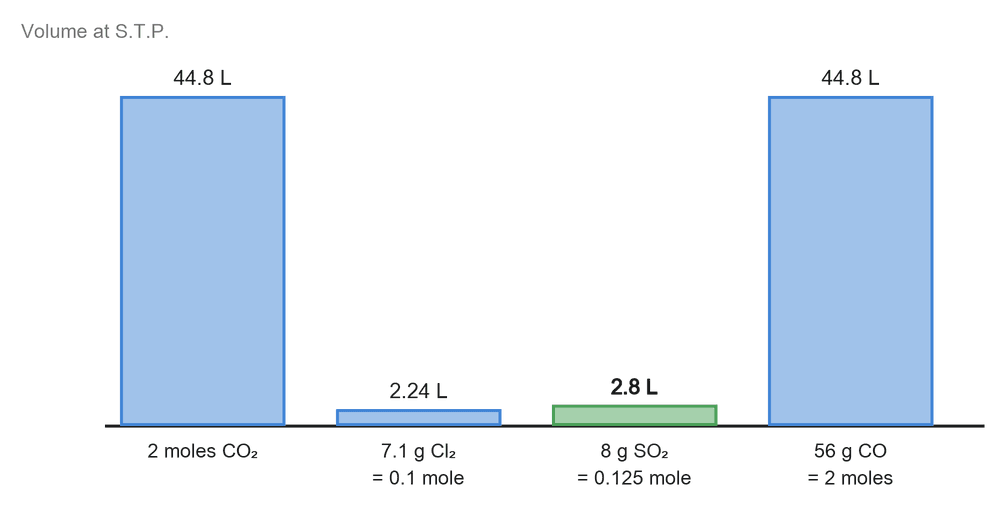
Step 1 — Find the moles that occupy 2.8 L.
We divide the volume by the molar volume.
Step 2 — Test the keyed option.
The molar mass of SO₂ is 32 + 2 × 16 = 64 g, so we find the moles in 8 g.
Step 3 — Test the other options.
Each of the other amounts is changed to moles the same way in the bullets below; none of them is 0.125 mole.
Watch out: Chlorine gas is Cl₂ (71 g per mole), so 7.1 g of chlorine is 0.1 mole, not 0.2 mole.
Why the other options are wrong:
- (A) 2 moles of carbon dioxide: 2 moles of carbon dioxide occupy 2 × 22.4 = 44.8 L.
- (B) 7.1 g of chlorine: 7.1 g of chlorine (Cl₂, 71 g per mole) is 0.1 mole and occupies 2.24 L.
- (D) 56 g of carbon monoxide: 56 g of carbon monoxide (28 g per mole) is 2 moles and occupies 44.8 L.
Therefore, 8 g of sulphur dioxide occupies 2.8 litres at S.T.P., option (C).
- 433 marks
Question 43
Ethane burns in oxygen to produce carbon dioxide and water as shown in the equation given below:
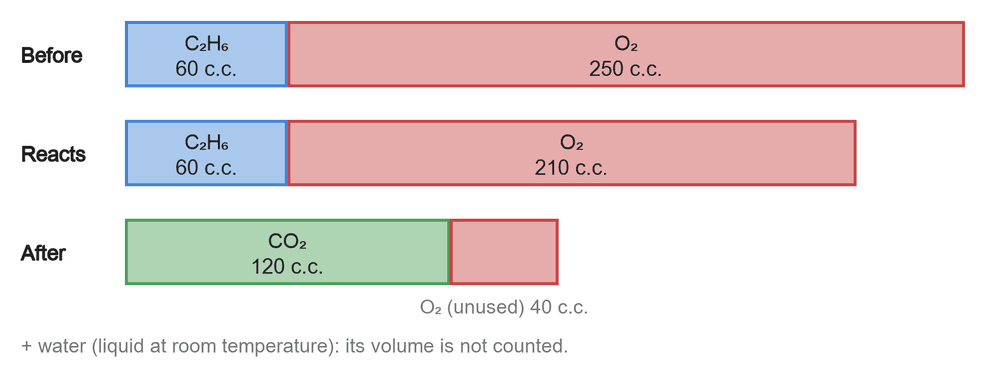
Calculate the composition of the resulting gaseous mixture at room temperature when 60 c.c. of ethane burns in 250 c.c. of oxygen.
Solve with AIWritten solution
Solution:
Concept: Gay-Lussac's law of combining volumes: when gases react, they do so in volumes that bear a simple whole-number ratio to one another and to the volumes of any gaseous products, all measured at the same temperature and pressure. The ratio is read from the coefficients of the balanced equation.
Step 1 — Read the volume ratio.
By Gay-Lussac's law, 2 volumes of ethane react with 7 volumes of oxygen and give 4 volumes of carbon dioxide.
Step 2 — Find the oxygen used.
We work out how much oxygen 60 c.c. of ethane needs.
There is 250 c.c. of oxygen, so oxygen is in excess and all the ethane burns.
Step 3 — Find the carbon dioxide formed.
Carbon dioxide forms in the ratio 4 : 2, twice the volume of ethane.
Step 4 — Find the oxygen left over.
The unused oxygen is the oxygen taken minus the oxygen used.
At room temperature the water formed is a liquid, so it adds no gas volume.
Watch out: Water formed in these reactions condenses to a liquid at room temperature, so it has no gas volume; never add its coefficient to the gas volumes.
Therefore, the resulting gaseous mixture is 120 c.c. of carbon dioxide and 40 c.c. of unused oxygen (160 c.c. in all).
- 442 marks
Question 44
1 mole of occupies 24 at room temperature and pressure. Calculate the following:
(a) The mass of 6 litres of .
(b) The volume occupied by 60 g of .
[Atomic weight: C=12, O=16]
Solve with AIWritten solution
Solution:
Concept: The mole concept: one mole of any substance contains the Avogadro number, , of particles (atoms, molecules or formula units), and its mass in grams equals its atomic or molecular mass (the gram atomic / gram molecular mass). So and . The question gives the molar volume at room temperature and pressure: one mole of any gas occupies 24 dm³ (24 litres), so moles = volume ÷ 24 dm³.
Step 1 — Find the molar mass of CO₂.
We add the atomic masses of one C and two O atoms.
(a) Mass of 6 litres of CO₂
Step 2 — Change the volume to moles.
One litre is one cubic decimetre, so 6 L is 6 dm³, and we divide by 24 dm³.
Step 3 — Change the moles to grams.
Each mole weighs 44 g.
(b) Volume of 60 g of CO₂
Step 4 — Change the mass to moles.
We divide by the molar mass, 44 g.
Step 5 — Change the moles to a volume.
Each mole occupies 24 dm³ at room temperature and pressure.
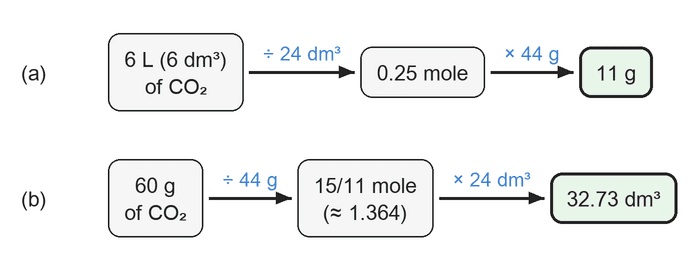
Watch out: Use the 24 dm³ given for room conditions here, not 22.4 L, which is the molar volume at S.T.P.
Therefore, (a) 6 litres of CO₂ has a mass of 11 g and (b) 60 g of CO₂ occupies about 32.73 dm³ at room temperature and pressure.
- 451 mark
Question 45
What volume of carbon dioxide is produced at STP when 5 litres of propane is burnt completely according to the equation given below?
Solve with AIAnswer
(A) 10 litres
- Correct
(B) 15 litres
(C) 20 litres
(D) 25 litres
Answer: (B) 15 litres
Concept: Gay-Lussac's law of combining volumes: when gases react, they do so in volumes that bear a simple whole-number ratio to one another and to the volumes of any gaseous products, all measured at the same temperature and pressure. The ratio is read from the coefficients of the balanced equation.
Step 1 — Read the volume ratio.
By Gay-Lussac's law, 1 volume of propane gives 3 volumes of carbon dioxide.
Step 2 — Scale to 5 litres of propane.
The carbon dioxide formed is 3 times the volume of propane burnt.
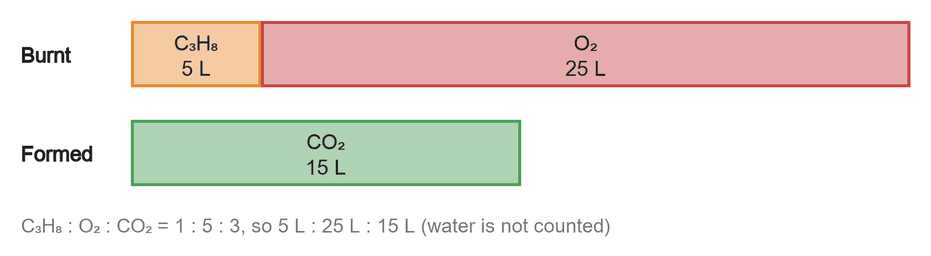
Watch out: Use the coefficient of CO₂ (3), not of O₂ (5) or of water (4); water is not a gas at S.T.P.
Why the other options are wrong:
- (A) 10 litres: 10 litres would need a propane : CO₂ ratio of 1 : 2, but the equation gives 1 : 3.
- (C) 20 litres: 20 litres comes from using the coefficient 4 of water, which is not carbon dioxide (and is not a gas at S.T.P.).
- (D) 25 litres: 25 litres is the volume of OXYGEN used (5 × 5 L), not the carbon dioxide formed.
Therefore, 5 litres of propane gives 15 litres of carbon dioxide at S.T.P., option (B).
- 461 mark
Question 46
Identify the following terms / compounds:
The relative molecular mass of a substance expressed in grams.
Solve with AIWritten solution
Solution:
Concept: The relative molecular mass of a substance is a pure number: the sum of the relative atomic masses of the atoms in one molecule. Taking that number of GRAMS gives one mole of the substance.
Step 1 — Read what the statement describes.
The statement takes the relative molecular mass and expresses it in grams.
Step 2 — Match it with the term.
This is the gram molecular mass (also called the molar mass, or one gram molecule). For example, the relative molecular mass of water is 18, so its gram molecular mass is 18 g.
Watch out: Relative molecular mass has no unit; the gram molecular mass is the same number with the unit grams.
Therefore, the term is gram molecular mass.
- 471 mark
Question 47
Complete the following sentences by choosing the correct option from the brackets:
The volume occupied by 8 grams of oxygen gas at STP is ............... litres. [5.6 / 8.96] [Atomic weight of O = 16]
Solve with AIWritten solution
Solution:
Concept: The mole concept: one mole of any substance contains the Avogadro number, , of particles (atoms, molecules or formula units), and its mass in grams equals its atomic or molecular mass (the gram atomic / gram molecular mass). So and . Molar volume: one mole of any gas occupies 22.4 litres (22400 cm³) at S.T.P. (273 K and 760 mm of Hg, that is 1 atm).
Step 1 — Change 8 g of oxygen to moles.
Oxygen gas is made of O₂ molecules, whose molar mass is 2 × 16 = 32 g.
Step 2 — Multiply by the molar volume.
Each mole of a gas occupies 22.4 L at S.T.P.
So 5.6 is the correct choice from the brackets.
Watch out: Oxygen gas is O₂ (32 g per mole); using 16 g would give 11.2 L, which is not one of the choices.
Therefore, the volume occupied by 8 grams of oxygen gas at S.T.P. is 5.6 litres.
- 482 marks
Question 48
Equal volumes of ammonia gas and chlorine gas are kept in two different containers under the same conditions of temperature and pressure.
Find the number of molecules contained in chlorine gas when the mass of ammonia is 34 g.
[Atomic weight: Cl=35.5, H=1, N=14]
Solve with AIWritten solution
Solution:
Concept: Avogadro's law: equal volumes of all gases, under the same conditions of temperature and pressure, contain an equal number of molecules. So, at fixed temperature and pressure, the number of molecules is proportional to the volume. The mole concept: one mole of any substance contains the Avogadro number, , of particles (atoms, molecules or formula units), and its mass in grams equals its atomic or molecular mass (the gram atomic / gram molecular mass). So and .
Step 1 — Change 34 g of ammonia to moles.
The molar mass of NH₃ is 14 + 3 × 1 = 17 g.
Step 2 — Use Avogadro's law.
The chlorine has the same volume at the same temperature and pressure, so it has the same number of molecules as the ammonia: 2 moles of Cl₂ molecules. Its own molar mass is not needed.
Step 3 — Change the moles to molecules.
One mole contains 6.022 × 10²³ molecules.
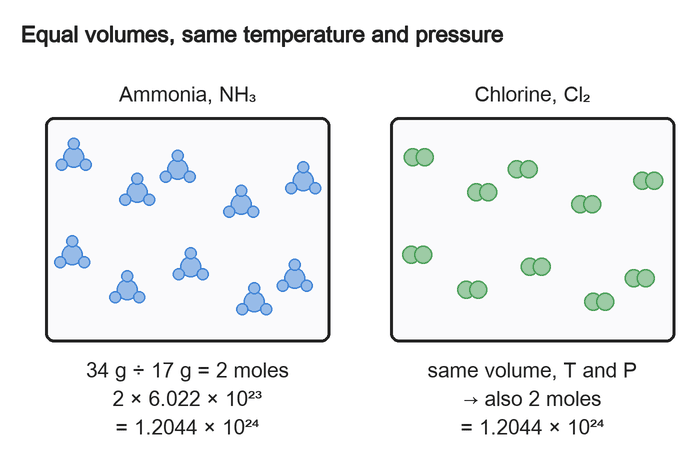
Watch out: The masses of the two gases are different, but the NUMBERS of molecules are equal; do not use the mass of chlorine at all.
Therefore, the chlorine gas contains 1.2044 × 10²⁴ molecules (about 1.2 × 10²⁴).
- 493 marks
Question 49
32.5 g of zinc reacts with concentrated nitric acid as given in the above equation.
(a) How many moles of zinc was required in the reaction?
(b) Find the mass of nitric acid needed to react with 32.5 g of zinc.
(c) Find the volume of nitrogen dioxide liberated in (b).
[Atomic weight: H=1, N=14, O=16, Zn=65]
Solve with AIWritten solution
Solution:
Concept: Stoichiometry: the coefficients of a balanced equation give the ratio of moles in which substances react and form. So we change the given quantity to moles (mass ÷ molar mass, or volume at S.T.P. ÷ 22.4 L), use the mole ratio, and change back to mass (moles × molar mass) or volume (moles × 22.4 L at S.T.P.). Molar volume: one mole of any gas occupies 22.4 litres (22400 cm³) at S.T.P. (273 K and 760 mm of Hg, that is 1 atm).
Step 1 — Read the mole ratio.
The balanced equation shows that 1 mole of zinc reacts with 4 moles of nitric acid and gives 2 moles of nitrogen dioxide.
(a) Moles of zinc
Step 2 — Divide the mass by the gram atomic mass.
One mole of zinc atoms weighs 65 g.
(b) Mass of nitric acid needed
Step 3 — Use the 1 : 4 ratio.
The moles of nitric acid are four times the moles of zinc.
Step 4 — Change the moles of acid to grams.
The molar mass of HNO₃ is 1 + 14 + 3 × 16 = 63 g.
(c) Volume of nitrogen dioxide
Step 5 — Use the 1 : 2 ratio and the molar volume.
Each mole of zinc gives 2 moles of NO₂, so 1 mole of NO₂ is formed, and one mole of a gas occupies 22.4 L at S.T.P.

Watch out: The acid is needed in the ratio 1 : 4, so 0.5 mole of zinc needs 2 moles (126 g) of HNO₃, not 0.5 mole.
Note: As the question expects, nitrogen dioxide is treated as a gas at S.T.P. (Real NO₂ condenses, mostly as N₂O₄, below about 21 °C, so this is the ideal-gas volume the mole method gives.)
Therefore, (a) 0.5 mole of zinc is required; (b) 126 g of nitric acid is needed; (c) 22.4 litres of nitrogen dioxide is liberated at S.T.P.
- 502 marks
Question 50
5.6 litres of gas Z weighs 32 g at STP. What is the molecular weight and vapour density of Z?
Solve with AIWritten solution
Solution:
Concept: Molar volume: one mole of any gas occupies 22.4 litres (22400 cm³) at S.T.P. (273 K and 760 mm of Hg, that is 1 atm). Vapour density (V.D.) is the ratio of the mass of a certain volume of a gas to the mass of the same volume of hydrogen at the same temperature and pressure. Since one molecule of hydrogen has mass 2,
Step 1 — Change the volume to moles.
One mole of a gas occupies 22.4 L at S.T.P., so we divide 5.6 L by 22.4 L.
Step 2 — Find the molecular weight.
A quarter of a mole weighs 32 g, so one mole weighs 32 ÷ 0.25 g. That mass in grams is the gram molecular weight, so the molecular weight is the same number.
Step 3 — Find the vapour density.
The vapour density is half the molecular weight.

Watch out: 5.6 L is only a quarter of a mole, so 32 g is not the molecular weight; scale it up to 22.4 L first.
Therefore, the molecular weight of Z is 128 and its vapour density is 64.
- 511 mark
Question 51
Which of the following occupies the maximum volume at STP? [At. wt. C=12, O=16]
Solve with AIAnswer
- Correct
(A) 3 moles of hydrogen
(B) 1 mole of helium
(C) 64 grams of oxygen
(D) 44 grams of carbon dioxide
Answer: (A) 3 moles of hydrogen
Concept: Molar volume: one mole of any gas occupies 22.4 litres (22400 cm³) at S.T.P. (273 K and 760 mm of Hg, that is 1 atm). So the gas with the MOST moles occupies the greatest volume.
Step 1 — Change every option to moles.
Options (A) and (B) are already in moles. For the masses we divide by the molar mass: O₂ is 32 g and CO₂ is 44 g per mole.
Step 2 — Compare the numbers of moles.
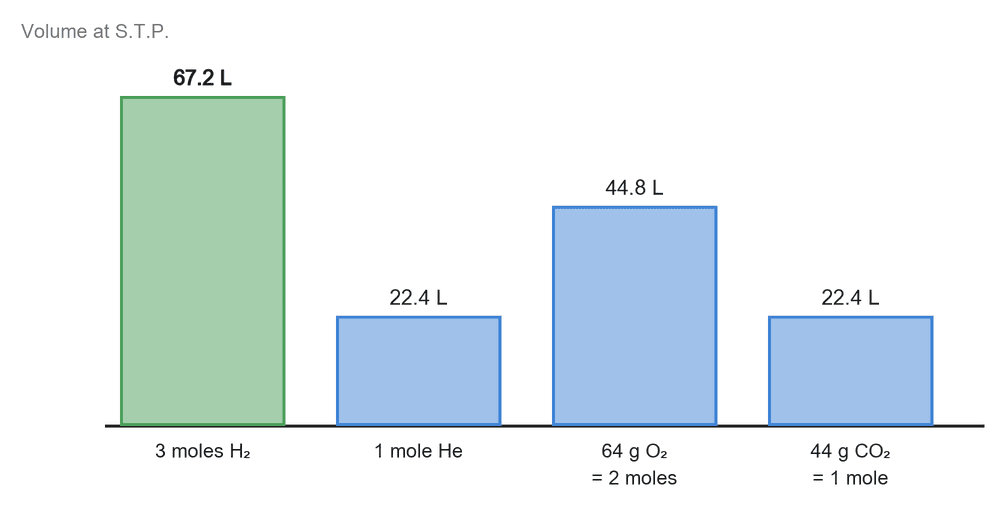
The amounts are 3, 1, 2 and 1 mole, so 3 moles of hydrogen is the largest amount.
Watch out: The volume of a gas at S.T.P. depends only on the number of moles, not on how heavy the gas is.
Why the other options are wrong:
- (B) 1 mole of helium: 1 mole of helium occupies 22.4 L.
- (C) 64 grams of oxygen: 64 g of oxygen is 2 moles and occupies 44.8 L.
- (D) 44 grams of carbon dioxide: 44 g of carbon dioxide is 1 mole and occupies 22.4 L.
Therefore, 3 moles of hydrogen occupy the maximum volume, 67.2 L at S.T.P., option (A).
- 521 mark
Question 52
The vapour density of nitrogen dioxide [At. wt. N = 14, O = 16] is:
Solve with AIAnswer
(A) 15
(B) 30
(C) 46
- Correct
(D) 23
Answer: (D) 23
Concept: Vapour density (V.D.) is the ratio of the mass of a certain volume of a gas to the mass of the same volume of hydrogen at the same temperature and pressure. Since one molecule of hydrogen has mass 2,
Step 1 — Find the molecular mass of NO₂.
We add the atomic masses of one N and two O atoms.
Step 2 — Halve it to get the vapour density.
The vapour density is half the relative molecular mass.
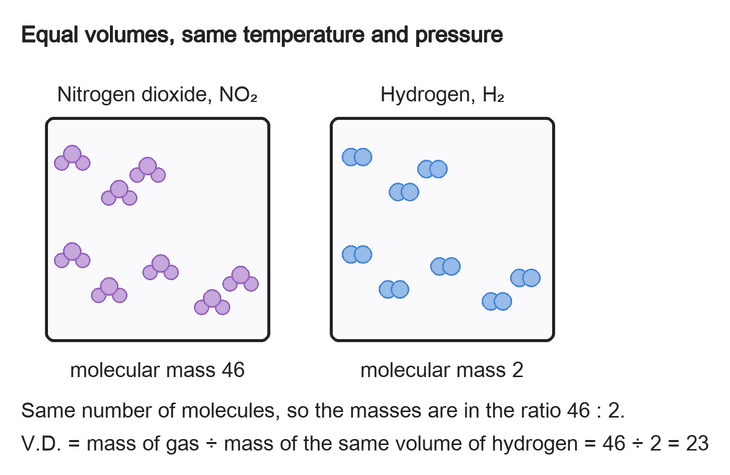
Watch out: 46 is the molecular mass; the vapour density is half of it.
Why the other options are wrong:
- (A) 15: 15 is the vapour density of nitric oxide, NO (molecular mass 30), not of NO₂.
- (B) 30: 30 is the molecular mass of nitric oxide, NO, not the vapour density of NO₂.
- (C) 46: 46 is the relative molecular mass of NO₂; the vapour density is half of it.
Therefore, the vapour density of nitrogen dioxide is 23, option (D).
- 531 mark
Question 53
Name the following:
The law which states that 'equal volumes of all gases, at the same temperature and pressure, have the same number of molecules'.
Solve with AIWritten solution
Solution:
Concept: This statement links the VOLUME of a gas with the NUMBER of molecules in it, whatever the gas. It was put forward by Amedeo Avogadro in 1811.
Step 1 — Read what the law says.
It says that equal volumes of all gases, at the same temperature and pressure, have the same number of molecules.
Step 2 — Name the law.
This is Avogadro's law. For example, 1 litre each of hydrogen, oxygen and carbon dioxide at the same temperature and pressure contain the same number of molecules.
Watch out: Do not confuse it with Gay-Lussac's law, which is about the ratio of the volumes of gases that REACT.
Therefore, the law is Avogadro's law.
- 543 marks
Question 54
20.2 g of potassium nitrate is decomposed by heating according to the equation given below:
Calculate the following:
(a) Volume of oxygen gas obtained at STP.
(b) Mass of formed.
[At. wt. of K = 39, N=14, O=16]
Solve with AIWritten solution
Solution:
Concept: Stoichiometry: the coefficients of a balanced equation give the ratio of moles in which substances react and form. So we change the given quantity to moles (mass ÷ molar mass, or volume at S.T.P. ÷ 22.4 L), use the mole ratio, and change back to mass (moles × molar mass) or volume (moles × 22.4 L at S.T.P.). Molar volume: one mole of any gas occupies 22.4 litres (22400 cm³) at S.T.P. (273 K and 760 mm of Hg, that is 1 atm).
Step 1 — Read the mole ratio.
The balanced equation shows that 2 moles of potassium nitrate give 2 moles of potassium nitrite and 1 mole of oxygen.
Step 2 — Change 20.2 g of KNO₃ to moles.
The molar mass of KNO₃ is 39 + 14 + 3 × 16 = 101 g.
(a) Volume of oxygen at S.T.P.
Step 3 — Use the 2 : 1 ratio and the molar volume.
The moles of oxygen are half the moles of KNO₃, and each mole occupies 22.4 L at S.T.P.
(b) Mass of KNO₂ formed
Step 4 — Use the 2 : 2 ratio and the molar mass.
Each mole of KNO₃ gives 1 mole of KNO₂, whose molar mass is 39 + 14 + 2 × 16 = 85 g.
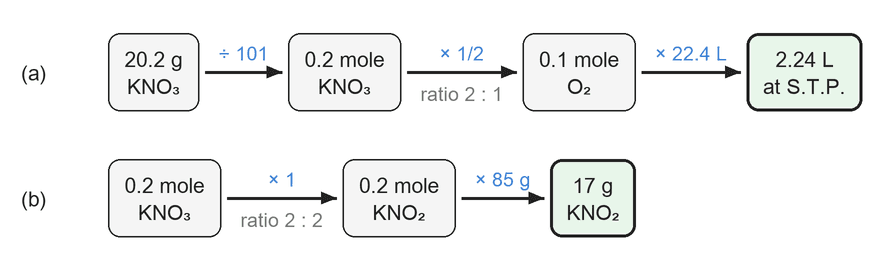
Watch out: Only 1 mole of O₂ forms from 2 moles of KNO₃, so halve the moles of KNO₃ before multiplying by 22.4 L.
Therefore, (a) 2.24 litres of oxygen is obtained at S.T.P. and (b) 17 g of potassium nitrite is formed.
- 553 marks
Question 55
The compound ‘A’ has the following percentage composition by mass, carbon 26.7%, oxygen 71.1%, hydrogen 2.2%. Determine the empirical formula of ‘A’. If the relative molecular mass of ‘A’ is 90, what is the molecular formula of ‘A’?
[At. wt. C=12, H=1, O=16]
Solve with AIWritten solution
Solution:
Concept: To find an empirical formula (the simplest whole-number ratio of atoms): divide each element's percentage (or mass) by its atomic mass to get the relative number of gram atoms, divide every value by the smallest one, and, if needed, multiply by a small whole number to clear fractions. The molecular formula is n × (empirical formula), where n = molecular mass ÷ empirical formula mass, and molecular mass = 2 × vapour density.
Step 1 — Find the simplest ratio of atoms.
We divide each percentage by the atomic mass and then by the smallest value (2.2, for hydrogen).
Element % Atomic mass Gram atoms (÷ atomic mass) ÷ smallest C 26.7 12 26.7 ÷ 12 = 2.225 1.01 H 2.2 1 2.2 1 O 71.1 16 71.1 ÷ 16 = 4.444 2.02 The ratio C : H : O is 1.011 : 1 : 2.02, which rounds to 1 : 1 : 2, so the empirical formula is CHO₂.
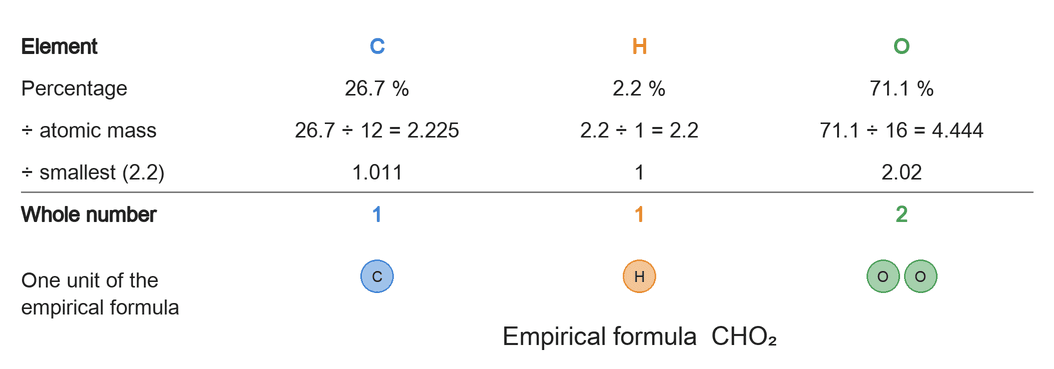
Step 2 — Find the empirical formula mass.
We add the atomic masses of the atoms in CHO₂.
Step 3 — Find n.
We divide the relative molecular mass by the empirical formula mass.
Step 4 — Write the molecular formula.
We multiply every subscript of CHO₂ by 2, which gives (CHO₂)₂, that is C₂H₂O₄. This is the formula of oxalic acid, (COOH)₂.
Watch out: The smallest value here belongs to hydrogen (2.2), not carbon; always divide by whichever value is smallest.
Therefore, the empirical formula of A is and its molecular formula is (oxalic acid).