Solution:
Concept: To find an empirical formula (the simplest whole-number ratio of atoms): divide each element's percentage (or mass) by its atomic mass to get the relative number of gram atoms, divide every value by the smallest one, and, if needed, multiply by a small whole number to clear fractions. The molecular formula is n × (empirical formula), where n = molecular mass ÷ empirical formula mass, and molecular mass = 2 × vapour density.
Step 1 — Find the simplest ratio of atoms.
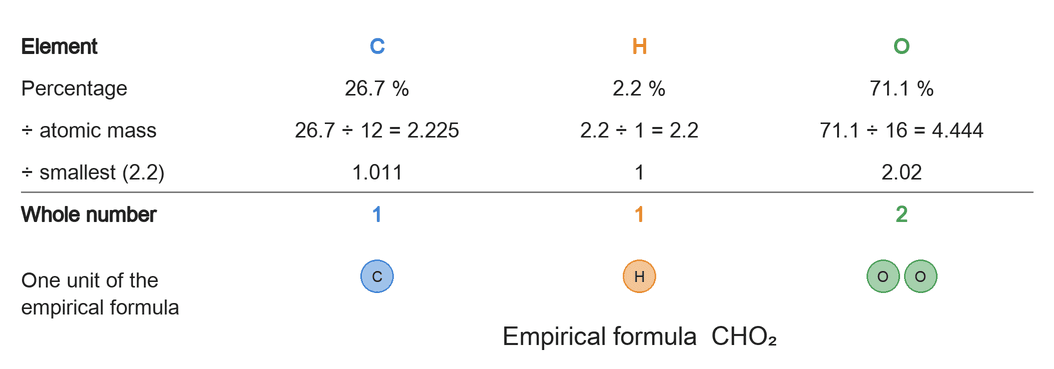
We divide each percentage by the atomic mass and then by the smallest value (2.2, for hydrogen).
| Element | % | Atomic mass | Gram atoms (÷ atomic mass) | ÷ smallest |
|---|
| C | 26.7 | 12 | 26.7 ÷ 12 = 2.225 | 1.01 |
| H | 2.2 | 1 | 2.2 | 1 |
| O | 71.1 | 16 | 71.1 ÷ 16 = 4.444 | 2.02 |
The ratio C : H : O is 1.011 : 1 : 2.02, which rounds to 1 : 1 : 2, so the empirical formula is CHO₂.
Step 2 — Find the empirical formula mass.
We add the atomic masses of the atoms in CHO₂.
E.F. mass=12+1+2×16=45
Step 3 — Find n.
We divide the relative molecular mass by the empirical formula mass.
n=4590=2
Step 4 — Write the molecular formula.
We multiply every subscript of CHO₂ by 2, which gives (CHO₂)₂, that is C₂H₂O₄. This is the formula of oxalic acid, (COOH)₂.
Watch out: The smallest value here belongs to hydrogen (2.2), not carbon; always divide by whichever value is smallest.
Therefore, the empirical formula of A is CHO2 and its molecular formula is C2H2O4 (oxalic acid).
