
Question 543 marksAsked 2026Medium
20.2 g of potassium nitrate is decomposed by heating according to the equation given below:
Calculate the following:
(a) Volume of oxygen gas obtained at STP.
(b) Mass of formed.
[At. wt. of K = 39, N=14, O=16]
Confirming your payment
Sign up now and get 250 free tokens.
Previous Year Questions · Question 54 of 55
20.2 g of potassium nitrate is decomposed by heating according to the equation given below:
Calculate the following:
(a) Volume of oxygen gas obtained at STP.
(b) Mass of formed.
[At. wt. of K = 39, N=14, O=16]
Solution:
Concept: Stoichiometry: the coefficients of a balanced equation give the ratio of moles in which substances react and form. So we change the given quantity to moles (mass ÷ molar mass, or volume at S.T.P. ÷ 22.4 L), use the mole ratio, and change back to mass (moles × molar mass) or volume (moles × 22.4 L at S.T.P.). Molar volume: one mole of any gas occupies 22.4 litres (22400 cm³) at S.T.P. (273 K and 760 mm of Hg, that is 1 atm).
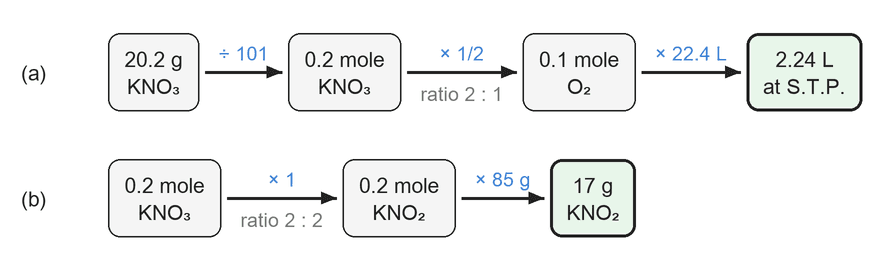
Step 1 — Read the mole ratio.
The balanced equation shows that 2 moles of potassium nitrate give 2 moles of potassium nitrite and 1 mole of oxygen.
Step 2 — Change 20.2 g of KNO₃ to moles.
The molar mass of KNO₃ is 39 + 14 + 3 × 16 = 101 g.
(a) Volume of oxygen at S.T.P.
Step 3 — Use the 2 : 1 ratio and the molar volume.
The moles of oxygen are half the moles of KNO₃, and each mole occupies 22.4 L at S.T.P.
(b) Mass of KNO₂ formed
Step 4 — Use the 2 : 2 ratio and the molar mass.
Each mole of KNO₃ gives 1 mole of KNO₂, whose molar mass is 39 + 14 + 2 × 16 = 85 g.
Watch out: Only 1 mole of O₂ forms from 2 moles of KNO₃, so halve the moles of KNO₃ before multiplying by 22.4 L.
Therefore, (a) 2.24 litres of oxygen is obtained at S.T.P. and (b) 17 g of potassium nitrite is formed.