Solution:
Concept: Gay-Lussac's law of combining volumes: when gases react, they do so in volumes that bear a simple whole-number ratio to one another and to the volumes of any gaseous products, all measured at the same temperature and pressure. The ratio is read from the coefficients of the balanced equation. The mole concept: one mole of any substance contains the Avogadro number, NA=6.022×10²³, of particles (atoms, molecules or formula units), and its mass in grams equals its atomic or molecular mass (the gram atomic / gram molecular mass). So moles=molar massmass and particles=moles×NA. Molar volume: one mole of any gas occupies 22.4 litres (22400 cm³) at S.T.P. (273 K and 760 mm of Hg, that is 1 atm).
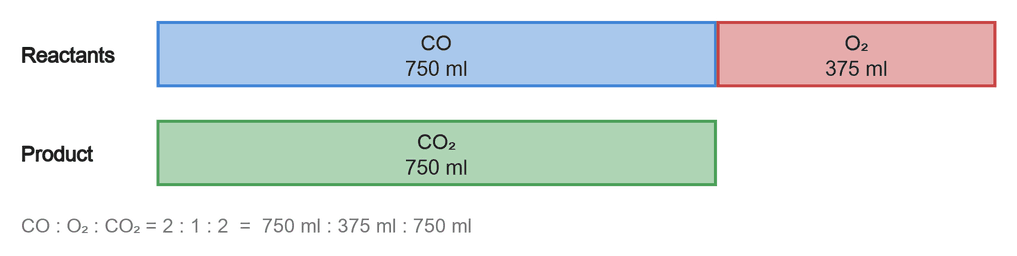
(i) Volumes of the reactants for 750 ml of carbon dioxide
Step 1 — Read the volume ratio.
The equation shows that 2 volumes of CO and 1 volume of O₂ give 2 volumes of CO₂.
2CO+O2→2CO2
Step 2 — Scale to 750 ml of CO₂.
Carbon monoxide is needed in the ratio 2 : 2 (the same volume as the CO₂), and oxygen in the ratio 1 : 2 (half that volume).
volume of CO=750×22 ml=750 ml
volume of O2=750×21 ml=375 ml
(ii) Volume of 80 g of carbon dioxide at S.T.P.
Step 3 — Change the mass to moles.
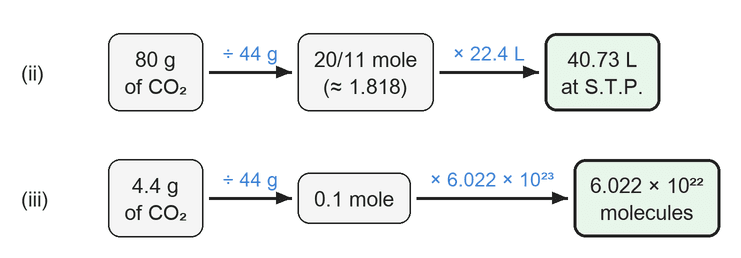
The molar mass of CO₂ is 12 + 2 × 16 = 44 g.
moles of CO2=4480=1120≈1.818 mol
Step 4 — Multiply by the molar volume.
Each mole of a gas occupies 22.4 L at S.T.P.
volume of CO2=1120×22.4 L≈40.73 L
(iii) Molecules in 4.4 g of carbon dioxide
Step 5 — Change the mass to moles.
We divide by the molar mass, 44 g.
moles of CO2=444.4=0.1 mol
Step 6 — Multiply by Avogadro's number.
One mole contains 6.022 × 10²³ molecules.
molecules=0.1×6.022×1023=6.022×10²²
If Avogadro's number is taken as 6 × 10²³, the answer is 6 × 10²² molecules.
(iv) The law used in (i)
Step 7 — Name the law.
In (i) we used the simple whole-number ratio of the volumes of reacting gases and of the gaseous product. This is Gay-Lussac's law of combining volumes.
Watch out: In (ii) the mass must first be changed to moles; 80 g of CO₂ is not 80 ÷ 22.4 of anything.
Therefore, (i) 750 ml of carbon monoxide and 375 ml of oxygen are needed; (ii) 80 g of CO₂ occupies about 40.73 litres at S.T.P.; (iii) 4.4 g of CO₂ contains 6.022 × 10²² molecules; (iv) the law is Gay-Lussac's law of combining volumes.
