Solution:
Concept: Stoichiometry: the coefficients of a balanced equation give the ratio of moles in which substances react and form. So we change the given quantity to moles (mass ÷ molar mass, or volume at S.T.P. ÷ 22.4 L), use the mole ratio, and change back to mass (moles × molar mass) or volume (moles × 22.4 L at S.T.P.). Molar volume: one mole of any gas occupies 22.4 litres (22400 cm³) at S.T.P. (273 K and 760 mm of Hg, that is 1 atm).
Step 1 — Read the mole ratio.
The balanced equation shows that 1 mole of calcium carbonate reacts with 2 moles of HCl and gives 1 mole of carbon dioxide.
CaCO3+2HCl→CaCl2+H2O+CO2↑
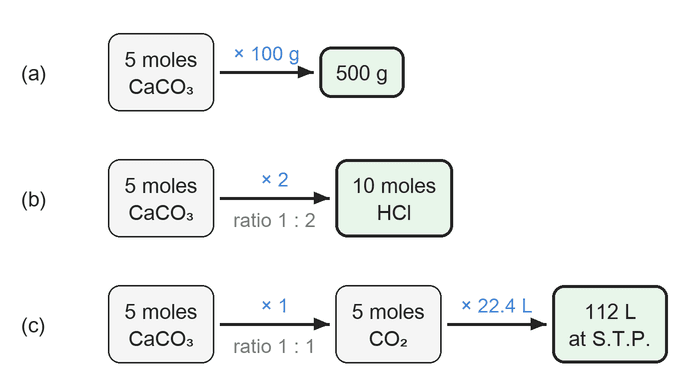
(a) Mass of 5 moles of calcium carbonate
Step 2 — Multiply the moles by the molar mass.
The relative molecular mass of CaCO₃ is 100, so one mole weighs 100 g.
mass of CaCO3=5×100 g=500 g
(b) Moles of HCl that react
Step 3 — Use the 1 : 2 ratio.
Each mole of CaCO₃ needs 2 moles of HCl.
moles of HCl=5×2=10 mol
(c) Volume of carbon dioxide at S.T.P.
Step 4 — Use the 1 : 1 ratio and the molar volume.
Each mole of CaCO₃ gives 1 mole of CO₂, so 5 moles of CO₂ are formed, and each mole occupies 22.4 L at S.T.P.
volume of CO2=5×22.4 L=112 L
Watch out: HCl is needed in the ratio 1 : 2, so the moles of HCl are twice the moles of CaCO₃, not equal to them.
Therefore, (a) 5 moles of calcium carbonate weigh 500 g; (b) 10 moles of HCl react; (c) 112 litres of carbon dioxide is liberated at S.T.P.
