
Question 333 marksAsked 2024Medium
Ammonia burns in oxygen as shown below.
If 240 cc of ammonia is burnt in 300 cc of oxygen, find out the composition of the resultant gaseous mixture at room temperature.
Confirming your payment
Sign up now and get 250 free tokens.
Previous Year Questions · Question 33 of 55
Ammonia burns in oxygen as shown below.
If 240 cc of ammonia is burnt in 300 cc of oxygen, find out the composition of the resultant gaseous mixture at room temperature.
Solution:
Concept: Gay-Lussac's law of combining volumes: when gases react, they do so in volumes that bear a simple whole-number ratio to one another and to the volumes of any gaseous products, all measured at the same temperature and pressure. The ratio is read from the coefficients of the balanced equation.
Step 1 — Read the volume ratio.
By Gay-Lussac's law, 4 volumes of ammonia react with 3 volumes of oxygen and give 2 volumes of nitrogen.
Step 2 — Find the oxygen used.
We work out how much oxygen 240 cc of ammonia needs.
There is 300 cc of oxygen, so oxygen is in excess and all the ammonia burns.
Step 3 — Find the nitrogen formed.
Nitrogen forms in the ratio 2 : 4, half the volume of ammonia.
Step 4 — Find the oxygen left over.
The unused oxygen is the oxygen taken minus the oxygen used.
At room temperature the water formed is a liquid, so it adds no gas volume.
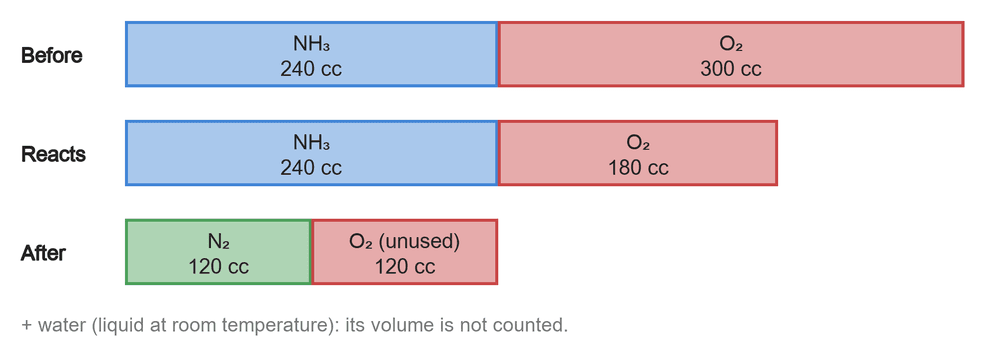
Watch out: Water formed in these reactions condenses to a liquid at room temperature, so it has no gas volume; never add its coefficient to the gas volumes.
Therefore, the resultant gaseous mixture is 120 cc of nitrogen and 120 cc of unused oxygen (240 cc in all).