
Question 241 markAsked 2023Easy
Define / State:
(b) Gay-Lussac's Law of combining volumes
Confirming your payment
Sign up now and get 250 free tokens.
Previous Year Questions · Question 24 of 55
Define / State:
(b) Gay-Lussac's Law of combining volumes
Solution:
Concept: Gay-Lussac's law is about the VOLUMES of gases that react together. It holds only when every volume is measured at the same temperature and pressure.
Step 1 — State the law.
Gay-Lussac's law of combining volumes: when gases react together, they do so in volumes which bear a simple whole-number ratio to one another and to the volumes of the gaseous products, provided all the volumes are measured at the same temperature and pressure.
Step 2 — Give an example.
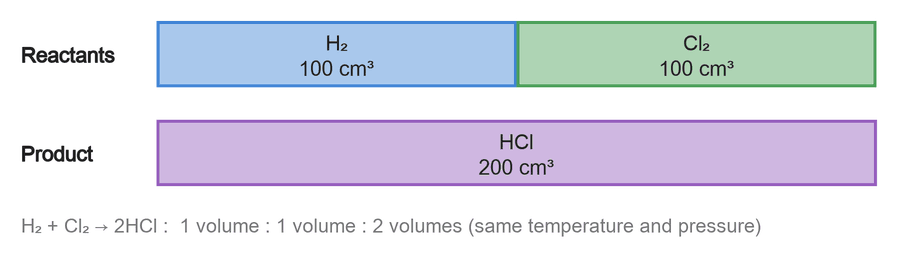
Hydrogen and chlorine combine to form hydrogen chloride gas.
So 100 cm³ of hydrogen reacts with 100 cm³ of chlorine to give 200 cm³ of hydrogen chloride, a ratio of 1 : 1 : 2.
Watch out: The law applies only to gases; a solid or liquid in the reaction (such as water at room temperature) is left out of the volume ratio.
Therefore, gases react in volumes that bear a simple whole-number ratio to one another and to the volumes of the gaseous products, at the same temperature and pressure.