
Question 252 marksAsked 2023Easy
The Empirical formula of an organic compound is .
If its relative molecular mass is 168, what is its molecular formula?
[At. Wt. C = 12, H = 1, Cl = 35.5]
Confirming your payment
Sign up now and get 250 free tokens.
Previous Year Questions · Question 25 of 55
The Empirical formula of an organic compound is .
If its relative molecular mass is 168, what is its molecular formula?
[At. Wt. C = 12, H = 1, Cl = 35.5]
Solution:
Concept: To find an empirical formula (the simplest whole-number ratio of atoms): divide each element's percentage (or mass) by its atomic mass to get the relative number of gram atoms, divide every value by the smallest one, and, if needed, multiply by a small whole number to clear fractions. The molecular formula is n × (empirical formula), where n = molecular mass ÷ empirical formula mass, and molecular mass = 2 × vapour density.
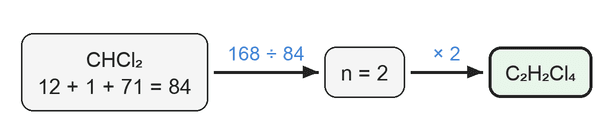
Step 1 — Find the empirical formula mass.
We add the atomic masses of one C, one H and two Cl atoms.
Step 2 — Find n.
We divide the relative molecular mass by the empirical formula mass to find how many CHCl₂ units are in one molecule.
Step 3 — Write the molecular formula.
We multiply every subscript of CHCl₂ by 2, which gives (CHCl₂)₂, that is C₂H₂Cl₄.
Watch out: Chlorine's atomic mass is 35.5, so two Cl atoms weigh 71, not 70.
Therefore, the molecular formula of the compound is .