Solution:
Concept: One gram atom of an element is its atomic mass in grams (one mole of its atoms). Percentage composition: the percentage of an element in a compound is molar massmass of the element in one mole×100. To find an empirical formula (the simplest whole-number ratio of atoms): divide each element's percentage (or mass) by its atomic mass to get the relative number of gram atoms, divide every value by the smallest one, and, if needed, multiply by a small whole number to clear fractions. The molecular formula is n × (empirical formula), where n = molecular mass ÷ empirical formula mass, and molecular mass = 2 × vapour density.
(i) Gram atoms in 4.6 g of sodium
Step 1 — Divide the mass by the gram atomic mass.
One gram atom of sodium weighs 23 g, so we divide 4.6 g by 23 g.
gram atoms of Na=234.6=0.2
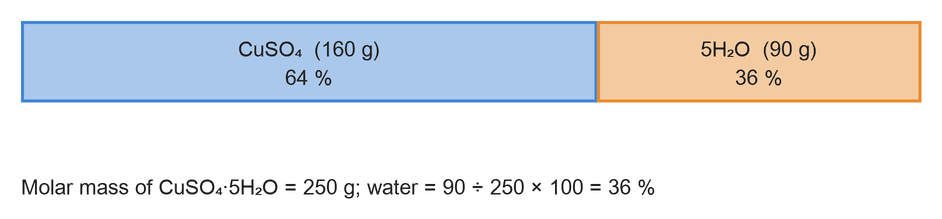
(ii) Percentage of water of crystallisation in CuSO₄·5H₂O
Step 2 — Find the molar mass.
We add the masses of CuSO₄ and five water molecules (H₂O = 18).
CuSO4⋅5H2O=64+32+4×16+5×18=160+90=250 g
Step 3 — Find the percentage of water.
Five water molecules weigh 5 × 18 = 90 g in every 250 g of the crystal, so we divide and multiply by 100.
% of water=25090×100=36%
(iii) Molecular formula of the compound of X and Y
Step 4 — Find the molecular mass.
The molecular mass is twice the vapour density, and here the vapour density equals the empirical formula mass, so the molecular mass is twice the empirical formula mass.
Step 5 — Find n.
We divide the molecular mass by the empirical formula mass.
n=E.F. mass2×E.F. mass=2
So the molecular formula is (XY₂)₂, that is X₂Y₄.
Watch out: In (ii) use the mass of all five water molecules (90 g), and in (iii) remember that the molecular mass is TWICE the vapour density.
Therefore, (i) 4.6 g of sodium is 0.2 gram atom; (ii) the water of crystallisation is 36 % of CuSO₄·5H₂O; (iii) the molecular formula is X₂Y₄.
