Solution:
Concept: Gay-Lussac's law of combining volumes: when gases react, they do so in volumes that bear a simple whole-number ratio to one another and to the volumes of any gaseous products, all measured at the same temperature and pressure. The ratio is read from the coefficients of the balanced equation. Molar volume: one mole of any gas occupies 22.4 litres (22400 cm³) at S.T.P. (273 K and 760 mm of Hg, that is 1 atm).
(i) Volume of propane consumed
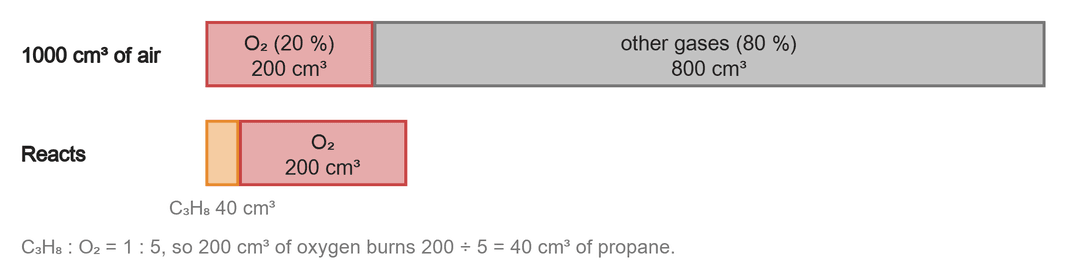
Step 1 — Find the volume of oxygen in the air.
Only 20 % of the air is oxygen, and only the oxygen takes part in burning.
volume of O2=10020×1000 cm3=200 cm3
Step 2 — Read the volume ratio.
By Gay-Lussac's law, the equation shows that 1 volume of propane uses 5 volumes of oxygen.
C3H8+5O2→3CO2+4H2O
Step 3 — Find the volume of propane.
The propane burnt is one-fifth of the oxygen used.
volume of C3H8=5200 cm3=40 cm3
(ii) Gram molecular mass of the gas
Step 4 — Scale the mass up to 22.4 L.
We know that 11.2 L at S.T.P. weighs 24 g. One mole occupies 22.4 L, which is twice 11.2 L, so one mole weighs twice as much.
gram molecular mass=11.224×22.4 g=48 g
Watch out: Use the 200 cm³ of OXYGEN, not the 1000 cm³ of air, with the 1 : 5 ratio.
Therefore, (i) 40 cm³ of propane is consumed and (ii) the gram molecular mass of the gas is 48 g.
