Solution:
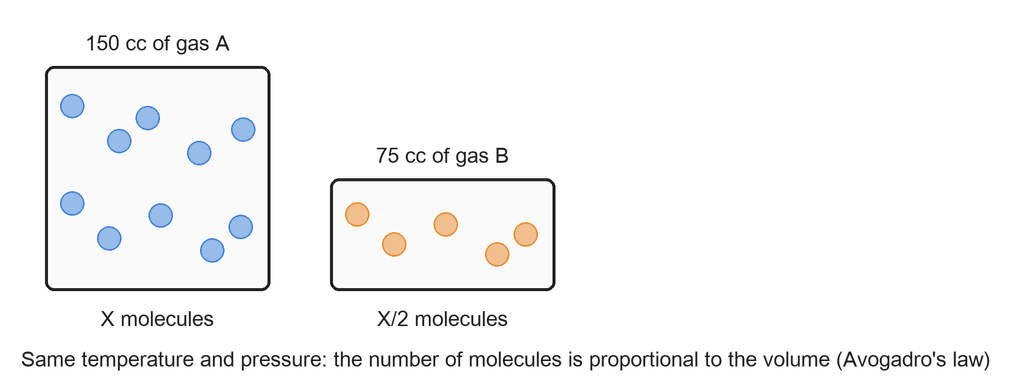
Concept: Avogadro's law: equal volumes of all gases, under the same conditions of temperature and pressure, contain an equal number of molecules. So, at fixed temperature and pressure, the number of molecules is proportional to the volume.
(i) Molecules of gas B
Step 1 — Compare the volumes.
Both gases are at the same temperature and pressure, so the number of molecules is proportional to the volume. We compare 75 cc with 150 cc.
ratio of volumes=15075=21
Step 2 — Scale the number of molecules.
Gas B has half the volume of gas A, so it has half as many molecules. It does not matter that B is a different gas.
molecules of B=21×X=2X
(ii) The law used
Step 3 — Name the law.
We used the rule that equal volumes of all gases at the same temperature and pressure contain equal numbers of molecules. This is Avogadro's law.
Watch out: The kind of gas does not matter; at the same temperature and pressure only the volume decides the number of molecules.
Therefore, (i) 75 cc of gas B contains X/2 molecules and (ii) the problem is based on Avogadro's law.
