Solution:
Concept: Stoichiometry: the coefficients of a balanced equation give the ratio of moles in which substances react and form. So we change the given quantity to moles (mass ÷ molar mass, or volume at S.T.P. ÷ 22.4 L), use the mole ratio, and change back to mass (moles × molar mass) or volume (moles × 22.4 L at S.T.P.).
Step 1 — Read the mole ratio.
The balanced equation shows how many moles of each product one mole of aluminium carbide gives.
Al4C3+12H2O→4Al(OH)3+3CH4
So 1 mole of Al₄C₃ gives 4 moles of Al(OH)₃ and 3 moles of CH₄.
Step 2 — Change 12 g of aluminium carbide to moles.
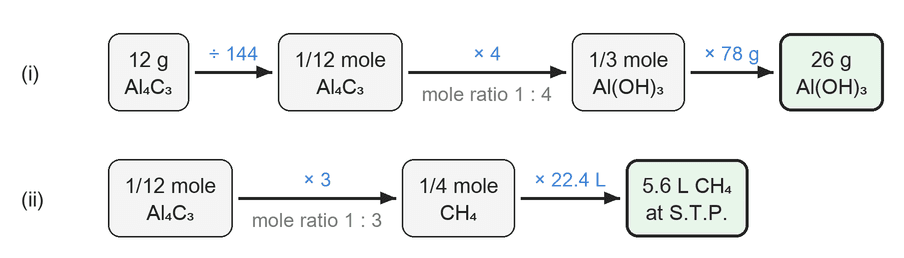
We divide by its relative molecular mass, 144.
moles of Al4C3=14412=121 mol
(i) Mass of aluminium hydroxide
Step 3 — Use the 1 : 4 ratio and the molar mass.
The moles of Al(OH)₃ are 4 times the moles of Al₄C₃, and each mole weighs 78 g.
moles of Al(OH)3=4×121=31 mol
mass of Al(OH)3=31×78 g=26 g
(ii) Volume of methane at S.T.P.
Step 4 — Use the 1 : 3 ratio and the molar volume.
The moles of CH₄ are 3 times the moles of Al₄C₃, and each mole occupies 22.4 L at S.T.P.
moles of CH4=3×121=41 mol
volume of CH4=41×22.4 L=5.6 L
Watch out: Multiply by the mole ratio from the equation (4 for Al(OH)₃, 3 for CH₄); do not just divide 12 g in the ratio of the molar masses.
Therefore, 12 g of aluminium carbide gives (i) 26 g of aluminium hydroxide and (ii) 5.6 litres of methane at S.T.P.
