
Question 92 marksAsked 2018Easy
The percentage composition of a gas is:
Nitrogen 82.35%, Hydrogen 17.64%.
Find the empirical formula of the gas. [N = 14, H = 1]
Confirming your payment
Sign up now and get 250 free tokens.
Previous Year Questions · Question 9 of 55
The percentage composition of a gas is:
Nitrogen 82.35%, Hydrogen 17.64%.
Find the empirical formula of the gas. [N = 14, H = 1]
Solution:
Concept: To find an empirical formula (the simplest whole-number ratio of atoms): divide each element's percentage (or mass) by its atomic mass to get the relative number of gram atoms, divide every value by the smallest one, and, if needed, multiply by a small whole number to clear fractions. The molecular formula is n × (empirical formula), where n = molecular mass ÷ empirical formula mass, and molecular mass = 2 × vapour density.
Step 1 — Divide by the atomic masses and by the smallest value.
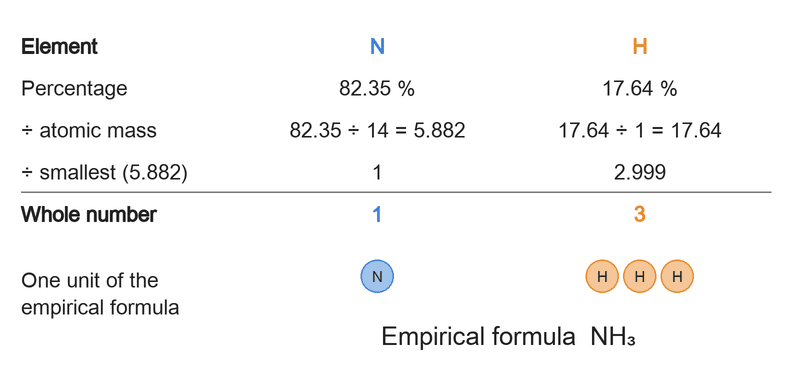
Dividing each percentage by the atomic mass gives the relative number of gram atoms; dividing by the smallest value (5.882) gives the simplest ratio.
| Element | % | Atomic mass | Gram atoms (÷ atomic mass) | ÷ smallest |
|---|---|---|---|---|
| N | 82.35 | 14 | 82.35 ÷ 14 = 5.882 | 1 |
| H | 17.64 | 1 | 17.64 | 3 |
Step 2 — Write the formula.
The ratio N : H is 1 : 2.999, which rounds to the whole numbers 1 : 3 (the small difference comes from rounding in the percentages). So one N atom goes with three H atoms.
Watch out: Round 2.999 to 3 only because it is within a rounding error; a value like 2.5 would need multiplying by 2.
Therefore, the empirical formula of the gas is (ammonia).