Solution:
Concept: Stoichiometry: the coefficients of a balanced equation give the ratio of moles in which substances react and form. So we change the given quantity to moles (mass ÷ molar mass, or volume at S.T.P. ÷ 22.4 L), use the mole ratio, and change back to mass (moles × molar mass) or volume (moles × 22.4 L at S.T.P.). Molar volume: one mole of any gas occupies 22.4 litres (22400 cm³) at S.T.P. (273 K and 760 mm of Hg, that is 1 atm).
Step 1 — Read the mole ratio.
The balanced equation shows that 1 mole of magnesium reacts with 2 moles of sulphuric acid and gives 1 mole of sulphur dioxide.
Mg+2H2SO4→MgSO4+2H2O+SO2↑
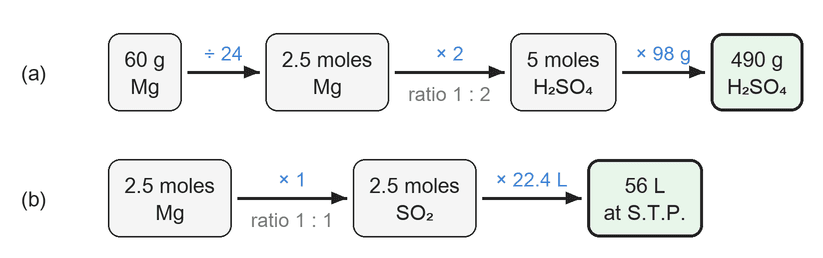
Step 2 — Change 60 g of magnesium to moles.
One mole of magnesium atoms weighs 24 g.
moles of Mg=2460=2.5 mol
(a) Mass of sulphuric acid needed
Step 3 — Use the 1 : 2 ratio.
The moles of acid are twice the moles of magnesium.
moles of H2SO4=2.5×2=5 mol
Step 4 — Change the moles of acid to grams.
The molar mass of H₂SO₄ is 2 × 1 + 32 + 4 × 16 = 98 g.
mass of H2SO4=5×98 g=490 g
(b) Volume of sulphur dioxide at S.T.P.
Step 5 — Use the 1 : 1 ratio and the molar volume.
Each mole of magnesium gives 1 mole of SO₂, so 2.5 moles of SO₂ are formed, and each mole occupies 22.4 L at S.T.P.
volume of SO2=2.5×22.4 L=56 L
Watch out: The acid is needed in the ratio 1 : 2, so use 5 moles of H₂SO₄, not 2.5 moles.
Therefore, (a) 490 g of sulphuric acid is needed and (b) 56 litres of sulphur dioxide is liberated at S.T.P.
