Answer: (B) 40 cm3
Concept: Gay-Lussac's law of combining volumes: when gases react, they do so in volumes that bear a simple whole-number ratio to one another and to the volumes of any gaseous products, all measured at the same temperature and pressure. The ratio is read from the coefficients of the balanced equation. The gas that runs out first (the limiting gas) decides how much reacts.
Step 1 — Read the volume ratio.
By Gay-Lussac's law, 1 volume of methane reacts with 2 volumes of oxygen and gives 1 volume of carbon dioxide.
CH4+2O2→CO2+2H2O
Step 2 — Find the limiting gas.
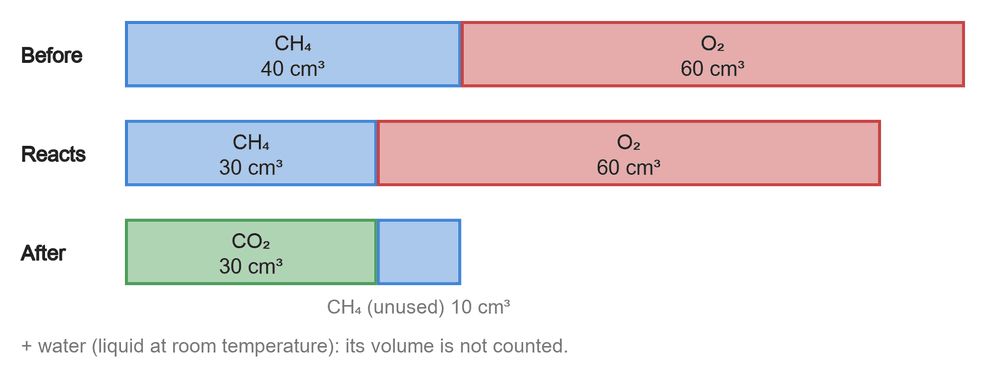
40 cm³ of methane would need 80 cm³ of oxygen, but only 60 cm³ is present. So oxygen runs out first, and it reacts with half its volume of methane.
CH4 used=260 cm3=30 cm3
Step 3 — Find what is left after the reaction.
Some methane is left over, carbon dioxide is formed, and all the oxygen is used up.
CH4 left=40−30 cm3=10 cm3
CO2 formed=30×1 cm3=30 cm3
Step 4 — Add the gas volumes.
At room temperature the water is a liquid, so only methane and carbon dioxide count.
total gas volume=10+30 cm3=40 cm3
Watch out: Methane is NOT the limiting gas here; check which gas runs out before using the 1 : 2 ratio.
Why the other options are wrong:
- (A) 60 cm3: 60 cm³ is the oxygen taken at the start, and all of that oxygen is used up in the reaction.
- (C) 45 cm3: 45 cm³ would need 15 cm³ of methane left over; only 40 − 30 = 10 cm³ of methane is left.
- (D) 50 cm3: 50 cm³ would need 20 cm³ of methane left over with the 30 cm³ of CO₂; only 10 cm³ of methane is left.
Therefore, 40 cm³ of gas (10 cm³ of methane and 30 cm³ of carbon dioxide) remains, option (B).
