
Question 43 marksAsked 2016Medium
A gaseous hydrocarbon contains 82.76% of carbon. Given that its vapour density is 29, find its molecular formula.
[C=12, H=1]
Confirming your payment
Sign up now and get 250 free tokens.
Previous Year Questions · Question 4 of 55
A gaseous hydrocarbon contains 82.76% of carbon. Given that its vapour density is 29, find its molecular formula.
[C=12, H=1]
Solution:
Concept: To find an empirical formula (the simplest whole-number ratio of atoms): divide each element's percentage (or mass) by its atomic mass to get the relative number of gram atoms, divide every value by the smallest one, and, if needed, multiply by a small whole number to clear fractions. The molecular formula is n × (empirical formula), where n = molecular mass ÷ empirical formula mass, and molecular mass = 2 × vapour density.
Step 1 — Find the percentage of hydrogen.
A hydrocarbon contains only carbon and hydrogen, so the rest of the 100 % is hydrogen.
Step 2 — Find the empirical formula.
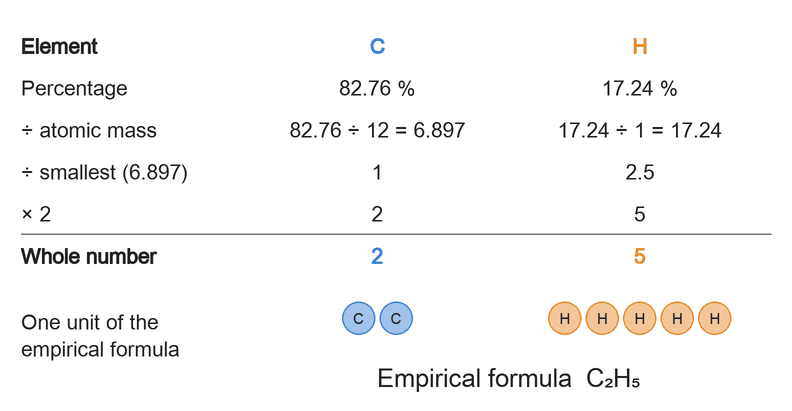
We divide each percentage by the atomic mass and then by the smallest value (6.897). The hydrogen value is 2.5, not a whole number, so we multiply both values by 2.
| Element | % | Atomic mass | Gram atoms (÷ atomic mass) | ÷ smallest | × 2 |
|---|---|---|---|---|---|
| C | 82.76 | 12 | 82.76 ÷ 12 = 6.897 | 1 | 2 |
| H | 17.24 | 1 | 17.24 | 2.5 | 5 |
So C : H is 2 : 5, and the empirical formula is C₂H₅.
Step 3 — Find the empirical formula mass.
We add the atomic masses of the atoms in C₂H₅.
Step 4 — Find the molecular mass.
The relative molecular mass is twice the vapour density.
Step 5 — Find n and the molecular formula.
We divide the molecular mass by the empirical formula mass to see how many C₂H₅ units are in one molecule.
So the molecular formula is (C₂H₅)₂, that is C₄H₁₀ (butane).
Watch out: A ratio of 1 : 2.5 is not yet a formula; multiply every value by 2 to make it whole before writing C₂H₅.
Therefore, the molecular formula of the hydrocarbon is (butane).