
Question 135 marksAsked 2019Medium
(i) Calculate:
(a) The number of moles in 12g of oxygen gas. [O = 16]
(b) The weight of atoms of carbon.
[C = 12, Avogadro’s No. = ]
(ii) Molecular formula of a compound is . Find its empirical formula.
Confirming your payment
Sign up now and get 250 free tokens.
Previous Year Questions · Question 13 of 55
(i) Calculate:
(a) The number of moles in 12g of oxygen gas. [O = 16]
(b) The weight of atoms of carbon.
[C = 12, Avogadro’s No. = ]
(ii) Molecular formula of a compound is . Find its empirical formula.
Solution:
Concept: The mole concept: one mole of any substance contains the Avogadro number, , of particles (atoms, molecules or formula units), and its mass in grams equals its atomic or molecular mass (the gram atomic / gram molecular mass). So and . The empirical formula is the simplest whole-number ratio of the atoms, found by dividing every subscript by their highest common factor (HCF).
(i)(a) Moles in 12 g of oxygen gas
Step 1 — Divide by the molar mass of O₂.
Oxygen gas is made of O₂ molecules, whose molar mass is 2 × 16 = 32 g.
(i)(b) Mass of 10²² atoms of carbon
Step 2 — Change the atoms to moles.
We divide the number of atoms by Avogadro's number, given as 6 × 10²³.
Step 3 — Change the moles to grams.
One mole of carbon atoms weighs 12 g.
(ii) Empirical formula of C₆H₁₈O₃
Step 4 — Divide the subscripts by their HCF.
The subscripts are 6, 18 and 3, and their highest common factor is 3. Dividing each by 3 gives 2, 6 and 1.
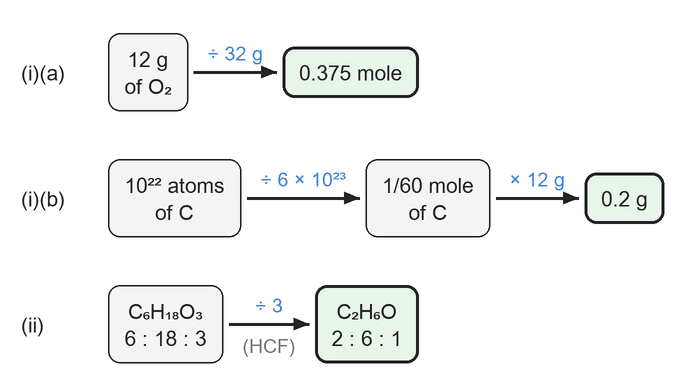
So the simplest ratio C : H : O is 2 : 6 : 1, and the empirical formula is C₂H₆O.
Watch out: Oxygen gas is O₂, so use 32 g per mole, not 16 g; 12 ÷ 16 = 0.75 would be the moles of oxygen ATOMS.
Therefore, (i)(a) 12 g of oxygen gas is 0.375 mole, (i)(b) 10²² carbon atoms weigh 0.2 g, and (ii) the empirical formula is .