Solution:
Concept: Avogadro's law: equal volumes of all gases, under the same conditions of temperature and pressure, contain an equal number of molecules. So, at fixed temperature and pressure, the number of molecules is proportional to the volume. The mole concept: one mole of any substance contains the Avogadro number, NA=6.022×10²³, of particles (atoms, molecules or formula units), and its mass in grams equals its atomic or molecular mass (the gram atomic / gram molecular mass). So moles=molar massmass and particles=moles×NA.
Step 1 — Change 34 g of ammonia to moles.
The molar mass of NH₃ is 14 + 3 × 1 = 17 g.
moles of NH3=1734=2 mol
Step 2 — Use Avogadro's law.
The chlorine has the same volume at the same temperature and pressure, so it has the same number of molecules as the ammonia: 2 moles of Cl₂ molecules. Its own molar mass is not needed.
Step 3 — Change the moles to molecules.
One mole contains 6.022 × 10²³ molecules.
molecules of Cl2=2×6.022×1023=1.2044×1024
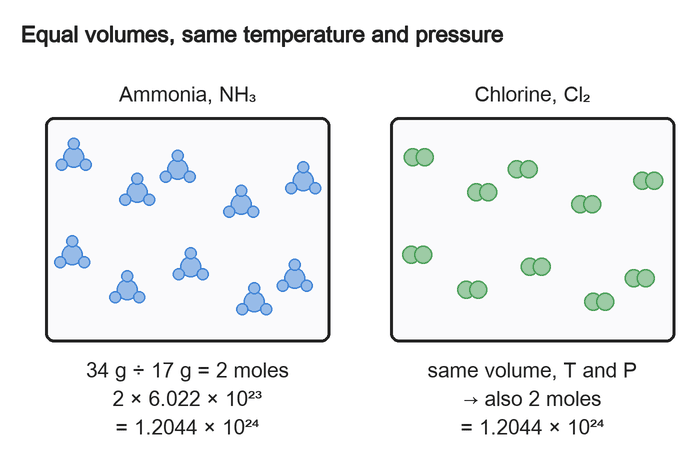
Watch out: The masses of the two gases are different, but the NUMBERS of molecules are equal; do not use the mass of chlorine at all.
Therefore, the chlorine gas contains 1.2044 × 10²⁴ molecules (about 1.2 × 10²⁴).
