Solution:
Concept: To find an empirical formula (the simplest whole-number ratio of atoms): divide each element's percentage (or mass) by its atomic mass to get the relative number of gram atoms, divide every value by the smallest one, and, if needed, multiply by a small whole number to clear fractions. The molecular formula is n × (empirical formula), where n = molecular mass ÷ empirical formula mass, and molecular mass = 2 × vapour density.
Step 1 — Find the percentage of oxygen.
The compound contains only carbon, hydrogen and oxygen, so oxygen makes up the rest of the 100 %.
% of O=100−(47.4+10.5)=42.1%
Step 2 — Find the empirical formula.
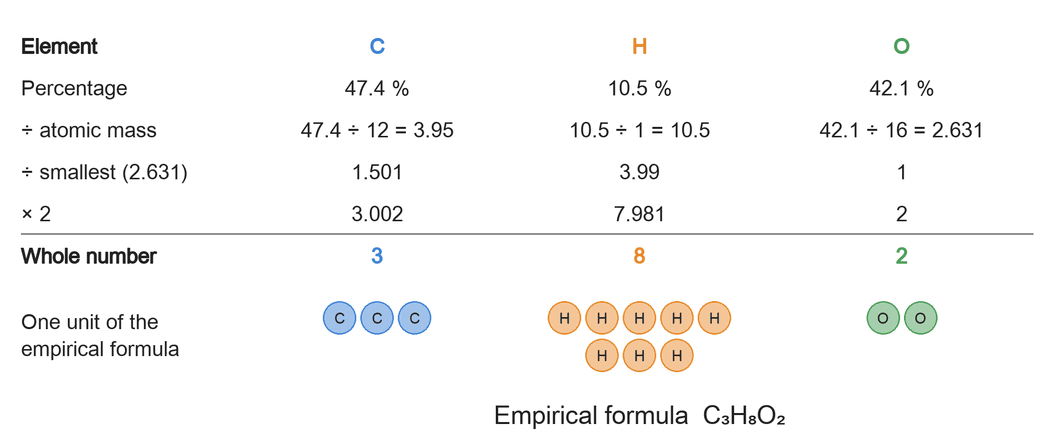
We divide each percentage by the atomic mass and then by the smallest value (2.631, for oxygen). Carbon comes out as 1.5, not a whole number, so we multiply every value by 2.
| Element | % | Atomic mass | Gram atoms (÷ atomic mass) | ÷ smallest | × 2 |
|---|
| C | 47.4 | 12 | 47.4 ÷ 12 = 3.95 | 1.5 | 3 |
| H | 10.5 | 1 | 10.5 | 3.99 | 8 |
| O | 42.1 | 16 | 42.1 ÷ 16 = 2.631 | 1 | 2 |
So C : H : O is 3 : 8 : 2, and the empirical formula is C₃H₈O₂.
Step 3 — Find the empirical formula mass.
We add the atomic masses of the atoms in C₃H₈O₂.
E.F. mass=3×12+8×1+2×16=76
Step 4 — Find n and the molecular formula.
We divide the relative molecular mass by the empirical formula mass.
n=7676=1
Since n = 1, the molecular formula is the same as the empirical formula.
Watch out: A ratio of 1.5 : 4 : 1 is not yet a formula; multiply every value by 2 to make all of them whole.
Therefore, the empirical formula of X is C3H8O2 and its molecular formula is also C3H8O2.
