(i) A gas of mass 32 gms has a volume of 20 litres at S.T.P.
Question 25 marksAsked 2016Medium
(i) A gas of mass 32 gms has a volume of 20 litres at S.T.P. Calculate the gram molecular weight of the gas.
(ii) How much Calcium oxide is formed when 82 g of calcium nitrate is heated? Also find the volume of nitrogen dioxide evolved:
2Ca(NO3)2⟶2CaO+4NO2+O2
[Ca = 40, N = 14, O = 16]
Solution:
Concept:The mole concept: one mole of any substance contains the Avogadro number, NA=6.022×10²³, of particles (atoms, molecules or formula units), and its mass in grams equals its atomic or molecular mass (the gram atomic / gram molecular mass). So moles=molar massmass and particles=moles×NA. Molar volume: one mole of any gas occupies 22.4 litres (22400 cm³) at S.T.P. (273 K and 760 mm of Hg, that is 1 atm). Stoichiometry: the coefficients of a balanced equation give the ratio of moles in which substances react and form. So we change the given quantity to moles (mass ÷ molar mass, or volume at S.T.P. ÷ 22.4 L), use the mole ratio, and change back to mass (moles × molar mass) or volume (moles × 22.4 L at S.T.P.).
(i) Gram molecular weight of the gas
Step 1 — Write what is given.
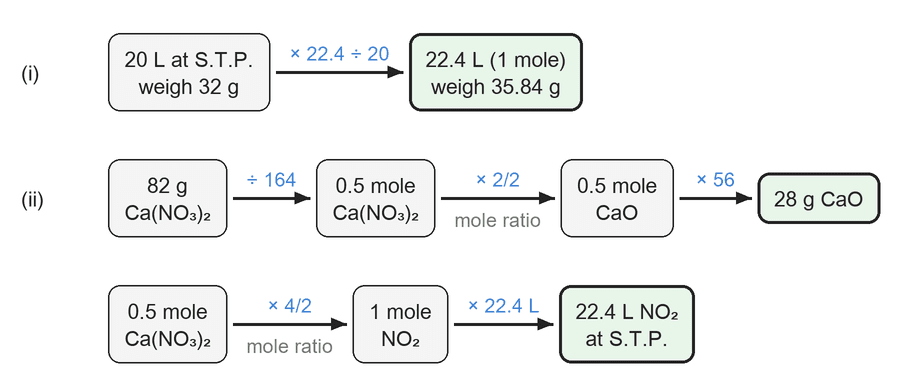
We know that 20 L of the gas at S.T.P. weighs 32 g. The gram molecular weight is the mass of one mole, that is, of 22.4 L at S.T.P.
Step 2 — Scale the mass up to 22.4 L.
The mass is proportional to the volume, so we multiply the mass of 1 L (32 ÷ 20 g) by 22.4.
gram molecular weight=2032×22.4 g=35.84 g
So one mole of the gas weighs 35.84 g, and its relative molecular mass is 35.84.
(ii) Calcium oxide formed and nitrogen dioxide evolved
Step 3 — Write the balanced equation and the molar masses.
The equation shows the mole ratio in which the substances react and form.
2Ca(NO3)2Δ2CaO+4NO2+O2
Using Ca = 40, N = 14 and O = 16, we work out the two molar masses we need.
Ca(NO3)2=40+2×(14+3×16)=164 gCaO=40+16=56 g
Step 4 — Change 82 g of calcium nitrate to moles.
We divide the mass by the molar mass.
moles of Ca(NO3)2=16482=0.5 mol
Step 5 — Find the mass of calcium oxide.
The equation shows that 2 moles of Ca(NO₃)₂ give 2 moles of CaO, a 1 : 1 ratio, so 0.5 mol of calcium nitrate gives 0.5 mol of calcium oxide. We then multiply by its molar mass.
mass of CaO=0.5×56 g=28 g
Step 6 — Find the volume of nitrogen dioxide.
The equation shows that 2 moles of Ca(NO₃)₂ give 4 moles of NO₂, a 1 : 2 ratio, so 0.5 mol gives 1 mol of NO₂. One mole of a gas occupies 22.4 L at S.T.P.
moles of NO2=0.5×24=1 molvolume of NO2=1×22.4 L=22.4 L
Watch out: The coefficients give MOLES, not grams: change 82 g to moles first, use the mole ratio, and only then change back to grams or litres.
Note: As the question expects, nitrogen dioxide is treated as a gas at S.T.P. (Real NO₂ condenses, mostly as N₂O₄, below about 21 °C, so this is the ideal-gas volume the mole method gives.)
Therefore, (i) the gram molecular weight of the gas is 35.84 g; (ii) 28 g of calcium oxide is formed and 22.4 litres of nitrogen dioxide (at S.T.P.) is evolved.