
Question 642 marksEasy
A hydride of nitrogen contains 87.5 per cent by mass of nitrogen. Determine the empirical formula of this compound.
Confirming your payment
Sign up now and get 250 free tokens.
Mole Concept and Stoichiometry · Question 64 of 159
A hydride of nitrogen contains 87.5 per cent by mass of nitrogen. Determine the empirical formula of this compound.
Solution:
Concept: To find an empirical formula (the simplest whole-number ratio of atoms): divide each element's percentage (or mass) by its atomic mass to get the relative number of gram atoms, divide every value by the smallest one, and, if needed, multiply by a small whole number to clear fractions. The molecular formula is n × (empirical formula), where n = molecular mass ÷ empirical formula mass, and molecular mass = 2 × vapour density.
Step 1 — Find the percentage of hydrogen.
A hydride of nitrogen contains only nitrogen and hydrogen.
Step 2 — Find the simplest ratio.
We divide by the atomic masses (N = 14, H = 1), then by the smallest value, 6.25.
| Element | % | Atomic mass | Gram atoms (÷ atomic mass) | ÷ smallest |
|---|---|---|---|---|
| N | 87.5 | 14 | 87.5 ÷ 14 = 6.25 | 1 |
| H | 12.5 | 1 | 12.5 | 2 |
So N : H = 1 : 2, and the empirical formula is NH₂. (The real compound is hydrazine, N₂H₄.)
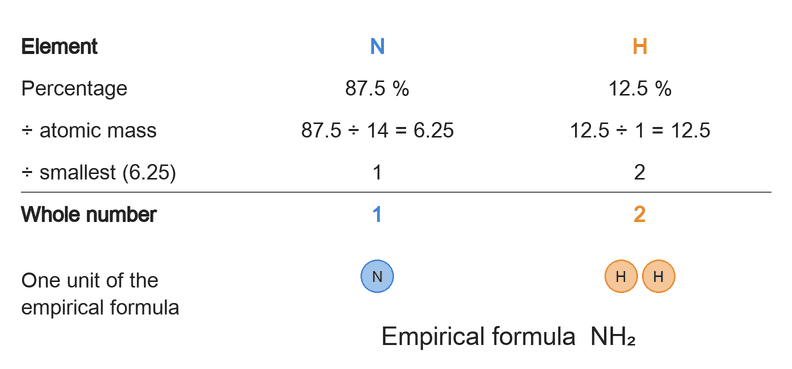
Therefore, the empirical formula of the hydride is NH₂.