Solution:
Concept: Stoichiometry: the coefficients of a balanced equation give the ratio of moles in which substances react and form. So we change the given quantity to moles (mass ÷ molar mass, or volume at S.T.P. ÷ 22.4 L), use the mole ratio, and change back to mass (moles × molar mass) or volume (moles × 22.4 L at S.T.P.).
Step 1 — Read the mole ratio.
From the balanced equation:
P+5HNO3→H3PO4+5NO2+H2O
So P : HNO₃ : H₃PO₄ : H₂O = 1 : 5 : 1 : 1 by moles.
Step 2 — (a) Moles of phosphorus.
The atomic mass of phosphorus is 31.
moles of P=316.2=0.2
Step 3 — (a) Mass of phosphoric acid.
The ratio is 1 : 1, and the molar mass of H₃PO₄ is 3 + 31 + 64 = 98 g.
mass of H3PO4=0.2×98 g=19.6 g
Step 4 — (b) Mass of nitric acid.
Five moles of HNO₃ (63 g each) are used per mole of P.
moles of HNO3=5×0.2=1
mass of HNO3=1×63 g=63 g
Step 5 — (c) Volume of steam at S.T.P.
0.2 mole of steam forms (ratio 1 : 1).
VSTP=0.2×22.4 L=4.48 L
Step 6 — (c) Change to 273 °C.
The pressure is 760 mm (standard), and 273 °C is 546 K. By Charles's law, volume is proportional to kelvin temperature.
V=4.48×273546 L=8.96 L
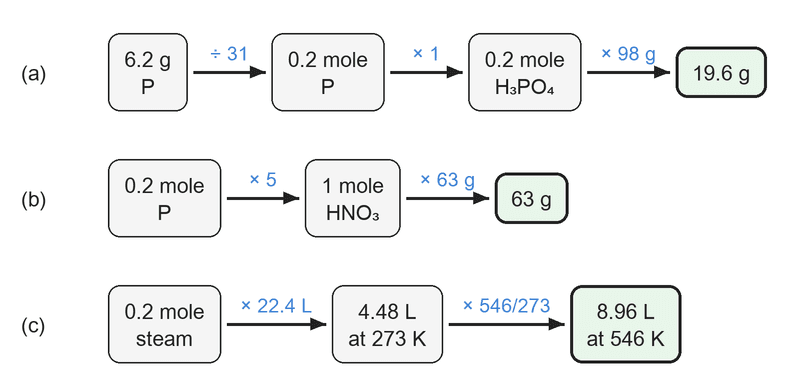
Watch out: 273 °C is 546 K, double 273 K, so the volume doubles.
Therefore, (a) 0.2 mole of phosphorus gives 19.6 g of phosphoric acid; (b) 63 g of nitric acid is consumed; (c) 8.96 litres of steam are produced at 760 mm and 273 °C.
