
Question 324 marksEasy
(a) Calculate the mass of nitrogen supplied to soil by 5 kg of urea [].
[O = 16; N = 14; C = 12; H = 1]
(b) Calculate the volume occupied by 320 g of sulphur dioxide at STP [S = 32; O = 16]
Confirming your payment
Sign up now and get 250 free tokens.
Mole Concept and Stoichiometry · Question 32 of 159
(a) Calculate the mass of nitrogen supplied to soil by 5 kg of urea [].
[O = 16; N = 14; C = 12; H = 1]
(b) Calculate the volume occupied by 320 g of sulphur dioxide at STP [S = 32; O = 16]
Solution:
Concept: The mass of an element in a compound is in the same proportion as in one mole of the compound. Molar volume: one mole of any gas occupies 22.4 litres (22400 cm³) at S.T.P. (273 K and 760 mm of Hg, or 1 atm).
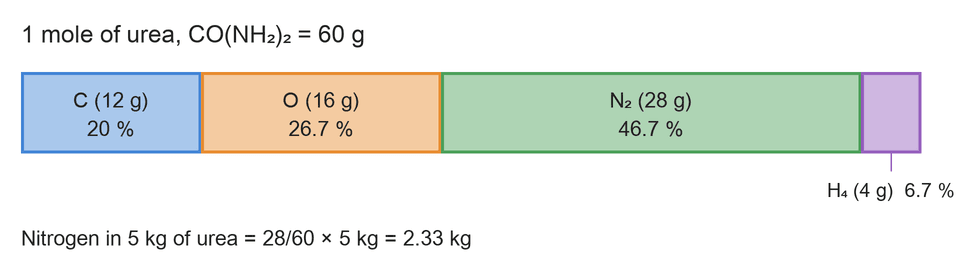
Step 1 — (a) Find the molar mass of urea.
Urea, CO(NH₂)₂, has 1 C, 1 O, 2 N and 4 H.
Of this, nitrogen contributes 2 × 14 = 28.
Step 2 — (a) Find the nitrogen in 5 kg.
Nitrogen is 28/60 of the mass of urea.
Step 3 — (b) Find the moles of SO₂.
The molar mass of SO₂ is 32 + 2 × 16 = 64 g.
Step 4 — (b) Find the volume at S.T.P.
Each mole occupies 22.4 L at S.T.P.
Watch out: Urea has two nitrogen atoms, so use 28, not 14.
Therefore, (a) 5 kg of urea supplies 2.33 kg of nitrogen; (b) 320 g of SO₂ occupies 112 litres at S.T.P.