
Question 544 marksEasy
An organic compound, whose vapour density is 45, has the following percentage composition,
H = 2.22%; O = 71.19%; and remaining carbon.
Calculate :
(a) its empirical formula,
(b) its molecular formula.
Confirming your payment
Sign up now and get 250 free tokens.
Mole Concept and Stoichiometry · Question 54 of 159
An organic compound, whose vapour density is 45, has the following percentage composition,
H = 2.22%; O = 71.19%; and remaining carbon.
Calculate :
(a) its empirical formula,
(b) its molecular formula.
Solution:
Concept: To find an empirical formula (the simplest whole-number ratio of atoms): divide each element's percentage (or mass) by its atomic mass to get the relative number of gram atoms, divide every value by the smallest one, and, if needed, multiply by a small whole number to clear fractions. The molecular formula is n × (empirical formula), where n = molecular mass ÷ empirical formula mass, and molecular mass = 2 × vapour density.
Step 1 — Find the percentage of carbon.
Carbon is the remainder after hydrogen and oxygen.
Step 2 — (a) Find the simplest ratio.
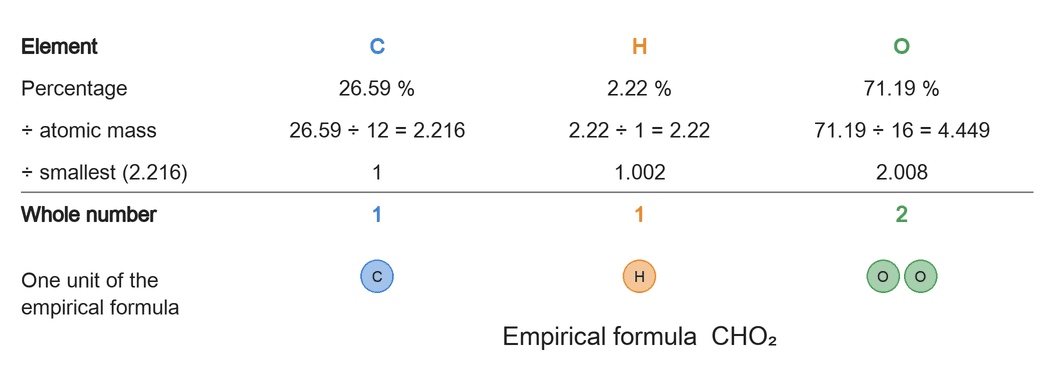
We divide each percentage by the atomic mass, then by the smallest value, 2.216.
| Element | % | Atomic mass | Gram atoms (÷ atomic mass) | ÷ smallest |
|---|---|---|---|---|
| C | 26.59 | 12 | 26.59 ÷ 12 = 2.216 | 1 |
| H | 2.22 | 1 | 2.22 | 1 |
| O | 71.19 | 16 | 71.19 ÷ 16 = 4.449 | 2.01 |
So C : H : O = 1 : 1 : 2, and the empirical formula is CHO₂.
Step 3 — (b) Find n.
The empirical formula mass is 12 + 1 + 32 = 45, and the molecular mass is twice the vapour density.
Step 4 — (b) Write the molecular formula.
We double every subscript of CHO₂, giving C₂H₂O₄ (oxalic acid).
Therefore, (a) the empirical formula is CHO₂; (b) the molecular formula is C₂H₂O₄.