
Question 554 marksEasy
An organic compound contains 4.07% hydrogen, 71.65% chlorine and remaining carbon. Its molar mass is 98.96. Find its,
(a) Empirical formula
(b) Molecular formula
Confirming your payment
Sign up now and get 250 free tokens.
Mole Concept and Stoichiometry · Question 55 of 159
An organic compound contains 4.07% hydrogen, 71.65% chlorine and remaining carbon. Its molar mass is 98.96. Find its,
(a) Empirical formula
(b) Molecular formula
Solution:
Concept: To find an empirical formula (the simplest whole-number ratio of atoms): divide each element's percentage (or mass) by its atomic mass to get the relative number of gram atoms, divide every value by the smallest one, and, if needed, multiply by a small whole number to clear fractions. The molecular formula is n × (empirical formula), where n = molecular mass ÷ empirical formula mass, and molecular mass = 2 × vapour density.
Step 1 — Find the percentage of carbon.
Carbon is the remainder after hydrogen and chlorine.
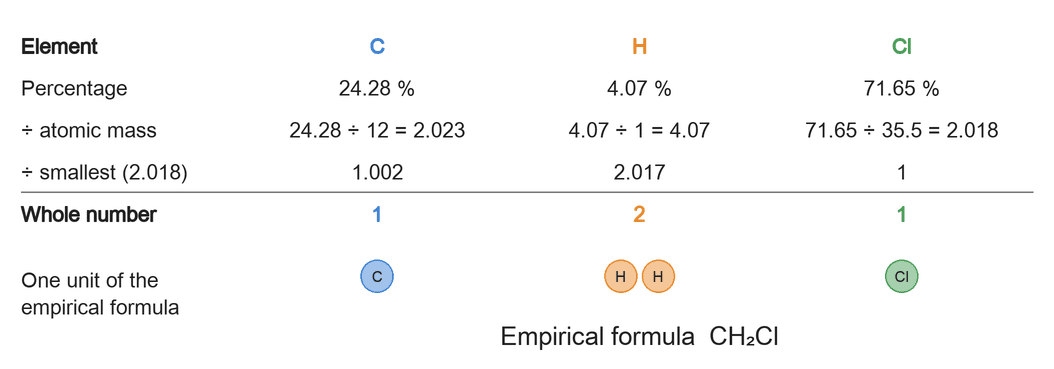
Step 2 — (a) Find the simplest ratio.
We divide each percentage by the atomic mass (C = 12, H = 1, Cl = 35.5), then by the smallest value, 2.018.
| Element | % | Atomic mass | Gram atoms (÷ atomic mass) | ÷ smallest |
|---|---|---|---|---|
| C | 24.28 | 12 | 24.28 ÷ 12 = 2.023 | 1 |
| H | 4.07 | 1 | 4.07 | 2.02 |
| Cl | 71.65 | 35.5 | 71.65 ÷ 35.5 = 2.018 | 1 |
So C : H : Cl = 1 : 2 : 1, and the empirical formula is CH₂Cl.
Step 3 — (b) Find n.
The empirical formula mass is 12 + 2 + 35.5 = 49.5, and the molar mass is given as 98.96.
Step 4 — (b) Write the molecular formula.
We double every subscript of CH₂Cl, giving C₂H₄Cl₂ (molar mass 99, which matches 98.96).
Watch out: N must be a whole number; 1.999 rounds to 2 because the data are rounded.
Therefore, (a) the empirical formula is CH₂Cl; (b) the molecular formula is C₂H₄Cl₂.