Solution:
Concept: Stoichiometry: the coefficients of a balanced equation give the ratio of moles in which substances react and form. So we change the given quantity to moles (mass ÷ molar mass, or volume at S.T.P. ÷ 22.4 L), use the mole ratio, and change back to mass (moles × molar mass) or volume (moles × 22.4 L at S.T.P.).
Step 1 — Read the mole ratio.
From the balanced equation:
Al4C3+12H2O→3CH4+4Al(OH)3
So Al₄C₃ : CH₄ : Al(OH)₃ = 1 : 3 : 4 by moles.
Step 2 — Find the moles of aluminium carbide.
The molar mass of Al₄C₃ is 4 × 27 + 3 × 12 = 144 g.
moles of Al4C3=14412=121
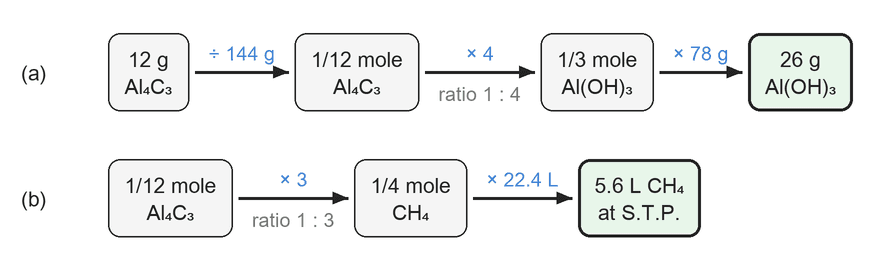
Step 3 — (a) Mass of aluminium hydroxide.
Four moles form per mole of carbide, so 4 × 1/12, that is 1/3 mole, forms. The molar mass of Al(OH)₃ is 27 + 3 × 17 = 78 g.
mass of Al(OH)3=31×78 g=26 g
Step 4 — (b) Volume of methane.
Three moles of CH₄ form per mole of carbide, so 3 × 1/12, that is 1/4 mole, forms.
volume of CH4=41×22.4 L=5.6 L
Watch out: Keep the moles as the fraction 1/12; rounding it to 0.08 early gives 24.96 g instead of 26 g.
Therefore, (a) 26 g of aluminium hydroxide is formed; (b) 5.6 litres of methane (at S.T.P.) are obtained.
