Solution:
Concept: Stoichiometry: the coefficients of a balanced equation give the ratio of moles in which substances react and form. So we change the given quantity to moles (mass ÷ molar mass, or volume at S.T.P. ÷ 22.4 L), use the mole ratio, and change back to mass (moles × molar mass) or volume (moles × 22.4 L at S.T.P.).
Step 1 — Read the mole ratio.
From the balanced equation:
MnO2+4HCl→MnCl2+2H2O+Cl2
So MnO₂ : HCl : MnCl₂ : Cl₂ = 1 : 4 : 1 : 1 by moles.
The molar masses (Mn = 55) are: MnO₂, 55 + 32 = 87; MnCl₂, 55 + 71 = 126; Cl₂, 71; HCl, 36.5.
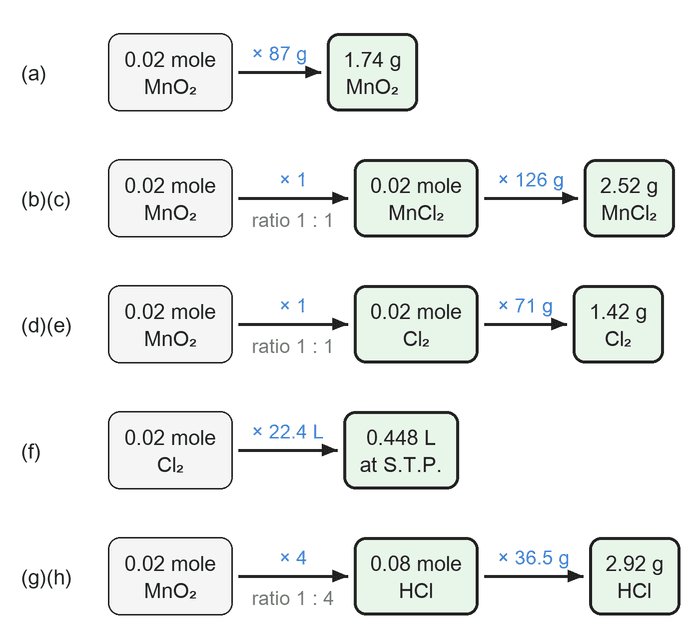
Step 2 — (a) Mass of MnO₂.
We multiply the moles by the molar mass.
mass of MnO2=0.02×87 g=1.74 g
Step 3 — (b) and (c) The salt, MnCl₂.
The ratio is 1 : 1, so 0.02 mole of MnCl₂ forms.
mass of MnCl2=0.02×126 g=2.52 g
Step 4 — (d) and (e) Chlorine.
The ratio is 1 : 1, so 0.02 mole of Cl₂ forms.
mass of Cl2=0.02×71 g=1.42 g
Step 5 — (f) Volume of chlorine at S.T.P.
Each mole of gas occupies 22.4 dm³ at S.T.P.
volume of Cl2=0.02×22.4 dm3=0.448 dm3
Step 6 — (g) and (h) The acid, HCl.
Four moles of HCl are needed per mole of MnO₂.
moles of HCl=4×0.02=0.08
mass of HCl=0.08×36.5 g=2.92 g
Watch out: Only the acid has a ratio other than 1 : 1 here; use 4 × 0.02 mole for HCl.
Therefore, (a) 1.74 g of MnO₂; (b) 0.02 mole and (c) 2.52 g of MnCl₂; (d) 0.02 mole, (e) 1.42 g and (f) 0.448 dm³ of chlorine; (g) 0.08 mole and (h) 2.92 g of HCl.
