Solution:
Concept: Stoichiometry: the coefficients of a balanced equation give the ratio of moles in which substances react and form. So we change the given quantity to moles (mass ÷ molar mass, or volume at S.T.P. ÷ 22.4 L), use the mole ratio, and change back to mass (moles × molar mass) or volume (moles × 22.4 L at S.T.P.). The limiting reactant is the one that is used up first; it decides how much product forms, and the other reactant is left over.
Step 1 — Read the mole ratio.
From the balanced equation:
N2+3H2→2NH3
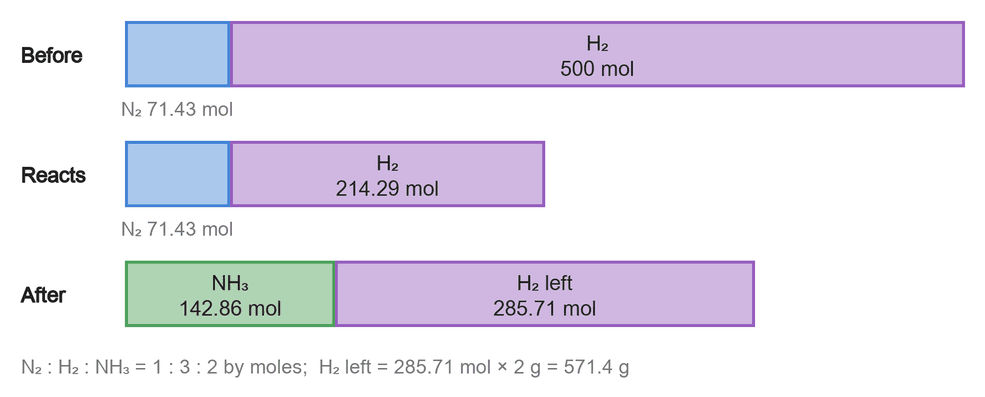
So N₂ : H₂ : NH₃ = 1 : 3 : 2 by moles.
Step 2 — Find the moles of each reactant.
We divide each mass by its molar mass (H₂ = 2, N₂ = 28).
moles of H2=21000=500
moles of N2=282000=71.43
Step 3 — Find the limiting reactant.
All the nitrogen would need three times its moles of hydrogen.
H2 needed=3×71.43=214.29
Since 500 moles of hydrogen are present, nitrogen is used up first (limiting), and hydrogen is in excess.
Step 4 — (a) Hydrogen left over.
We subtract the hydrogen used, then change moles to grams.
moles of H2 left=500−214.29=285.71
mass of H2 left=285.71×2 g=571.4 g
Step 5 — (b) Mass of ammonia.
Ammonia forms in twice the moles of nitrogen, and its molar mass is 17 g.
moles of NH3=2×71.43=142.86
mass of NH3=142.86×17 g=2428.57 g
Check: 2428.57 g + 571.43 g = 3000 g, the total mass taken.
Watch out: Compare moles, not grams: 1000 g of H₂ is far more moles (500) than 2000 g of N₂ (71.43).
Therefore, (a) yes, hydrogen remains unreacted, 571.4 g of it; (b) 2428.57 g of ammonia is formed.
