Solution:
Concept: Stoichiometry: the coefficients of a balanced equation give the ratio of moles in which substances react and form. So we change the given quantity to moles (mass ÷ molar mass, or volume at S.T.P. ÷ 22.4 L), use the mole ratio, and change back to mass (moles × molar mass) or volume (moles × 22.4 L at S.T.P.).
Step 1 — Write the balanced equation.
Ammonia neutralises sulphuric acid to give ammonium sulphate.
2NH3+H2SO4→(NH4)2SO4
So NH₃ : H₂SO₄ : (NH₄)₂SO₄ = 2 : 1 : 1 by moles.
Step 2 — Find the moles of ammonium sulphate.
Its molar mass is 2(14 + 4) + 32 + 4 × 16 = 132 g.
moles=13266=0.5
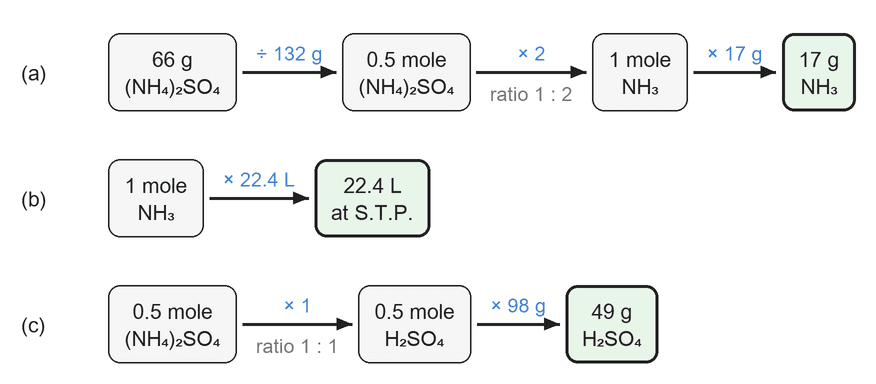
Step 3 — (a) Mass of ammonia.
Twice as many moles of NH₃ are needed, that is 2 × 0.5 = 1 mole, and the molar mass of NH₃ is 17 g.
mass of NH3=1×17 g=17 g
Step 4 — (b) Volume of ammonia at S.T.P.
One mole of gas occupies 22.4 L at S.T.P.
volume=1×22.4 L=22.4 L
Step 5 — (c) Mass of sulphuric acid.
The ratio is 1 : 1, so 0.5 mole of H₂SO₄ (98 g per mole) is needed.
mass of H2SO4=0.5×98 g=49 g
Check: 17 g + 49 g = 66 g, so mass is conserved.
Watch out: Two moles of ammonia are needed for each mole of ammonium sulphate; do not use 0.5 mole of NH₃.
Therefore, the equation is 2NH₃ + H₂SO₄ → (NH₄)₂SO₄; (a) 17 g of ammonia is required; (b) it occupies 22.4 litres at S.T.P.; (c) 49 g of sulphuric acid is required.
