Solution:
Concept: Stoichiometry: the coefficients of a balanced equation give the ratio of moles in which substances react and form. So we change the given quantity to moles (mass ÷ molar mass, or volume at S.T.P. ÷ 22.4 L), use the mole ratio, and change back to mass (moles × molar mass) or volume (moles × 22.4 L at S.T.P.).
Step 1 — Write the equation and mole ratio.
Marble is calcium carbonate.
CaCO3+2HNO3→Ca(NO3)2+H2O+CO2
So 1 mole of CaCO₃ gives 1 mole of Ca(NO₃)₂ and 1 mole of CO₂.
Step 2 — Find the molar masses.
We use Ca = 40, C = 12, N = 14, O = 16.
CaCO3=40+12+3×16=100
Ca(NO3)2=40+2(14+3×16)=164
Step 3 — Find the moles of marble.
We divide the mass by the molar mass.
moles of CaCO3=10015=0.15
Step 4 — (a) Mass of calcium nitrate.
The ratio is 1 : 1, so 0.15 mole of Ca(NO₃)₂ forms.
mass=0.15×164 g=24.6 g
Step 5 — (b) Volume of carbon dioxide.
The ratio is 1 : 1, so 0.15 mole of CO₂ forms, and each mole occupies 22.4 L at S.T.P.
volume=0.15×22.4 L=3.36 L
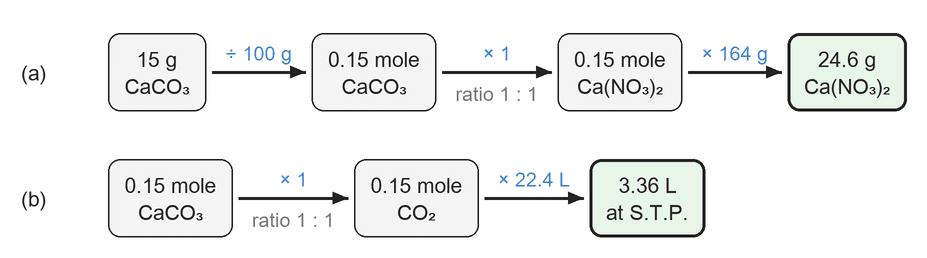
Therefore, (a) 24.6 g of anhydrous calcium nitrate is formed; (b) 3.36 litres of carbon dioxide are evolved at S.T.P.
