Solution:
Concept: Stoichiometry: the coefficients of a balanced equation give the ratio of moles in which substances react and form. So we change the given quantity to moles (mass ÷ molar mass, or volume at S.T.P. ÷ 22.4 L), use the mole ratio, and change back to mass (moles × molar mass) or volume (moles × 22.4 L at S.T.P.). The same ratios hold for kilograms and kilomoles (1 kmol = molar mass in kg).
Step 1 — Read the mole ratios.
Each nitrate gives nitric acid in the ratio 1 : 1.
KNO3+H2SO4→KHSO4+HNO3
NaNO3+H2SO4→NaHSO4+HNO3
Step 2 — Find the molar masses.
We use K = 39, Na = 23, N = 14, O = 16, H = 1.
HNO3=1+14+3×16=63
KNO3=39+14+3×16=101
NaNO3=23+14+3×16=85
Step 3 — Find the kilomoles of nitric acid.
We divide the mass in kg by the molar mass.
kilomoles of HNO3=63126=2
Step 4 — Mass of KNO₃.
The ratio is 1 : 1, so 2 kmol of KNO₃ are needed.
mass of KNO3=2×101 kg=202 kg
Step 5 — Mass of NaNO₃.
The ratio is also 1 : 1, so 2 kmol of NaNO₃ are needed.
mass of NaNO3=2×85 kg=170 kg
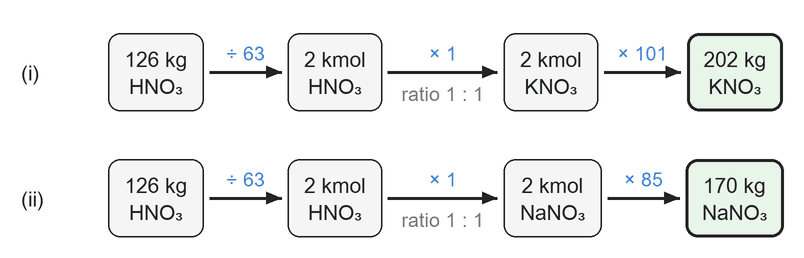
Therefore, 202 kg of KNO₃ is required, and a smaller mass of NaNO₃ (170 kg) is enough, because its molar mass (85) is less than that of KNO₃ (101).
