
Question 225 marksEasy
Calculate the number of :
(a) particles in 0.1 mole of any substance,
(b) hydrogen atoms in 0.1 mole of ,
(c) molecules in one kg of calcium chloride.
Confirming your payment
Sign up now and get 250 free tokens.
Mole Concept and Stoichiometry · Question 22 of 159
Calculate the number of :
(a) particles in 0.1 mole of any substance,
(b) hydrogen atoms in 0.1 mole of ,
(c) molecules in one kg of calcium chloride.
Solution:
Concept: The mole concept: one mole of any substance contains the Avogadro number, , of particles (atoms, molecules or formula units), and its mass in grams equals its atomic or molecular mass (the gram atomic / gram molecular mass). So and .
Step 1 — (a) Particles in 0.1 mole.
One mole of any substance has 6.022 × 10²³ particles, so we multiply by 0.1.
Step 2 — (b) Hydrogen atoms in 0.1 mole of H₂SO₄.
Each H₂SO₄ molecule contains 2 hydrogen atoms, so 0.1 mole of molecules contains 0.2 mole of hydrogen atoms.
Step 3 — (c) Moles in 1 kg of calcium chloride.
The molar mass of CaCl₂ is 40 + 2 × 35.5 = 111 g, and 1 kg = 1000 g.
Step 4 — (c) Number of molecules.
We multiply the moles by the Avogadro number.
Calcium chloride is ionic, so these 'molecules' are really formula units.
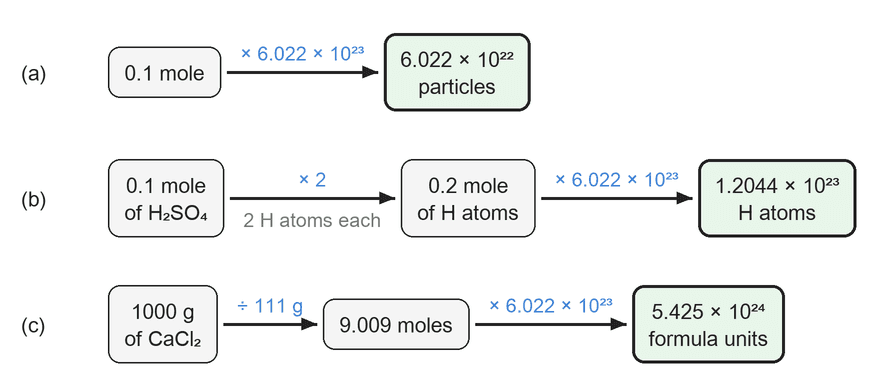
Watch out: In (b) count the atoms per molecule: 0.1 mole of H₂SO₄ has 0.2 mole of hydrogen atoms, not 0.1.
Therefore, (a) 6.022 × 10²² particles; (b) 1.2044 × 10²³ hydrogen atoms; (c) 5.425 × 10²⁴ molecules (formula units).