Solution:
Concept: Stoichiometry: the coefficients of a balanced equation give the ratio of moles in which substances react and form. So we change the given quantity to moles (mass ÷ molar mass, or volume at S.T.P. ÷ 22.4 L), use the mole ratio, and change back to mass (moles × molar mass) or volume (moles × 22.4 L at S.T.P.). For gases reacting with gases, Gay-Lussac's law lets us use volumes directly in the ratio of the coefficients.
Step 1 — (a) Read the mole ratio.
From the balanced equation:
CO2+C→2CO
So 1 mole of carbon gives 2 moles of carbon monoxide.
Step 2 — (a) Find the moles of carbon.
The atomic mass of carbon is 12.
moles of C=123=0.25
Step 3 — (a) Find the volume of CO.
Twice as many moles of CO form, and each mole occupies 22.4 L at S.T.P.
moles of CO=2×0.25=0.5
volume of CO=0.5×22.4 L=11.2 L

Step 4 — (b) Read the volume ratio.
Carbon monoxide burns in oxygen:
2CO+O2→2CO2
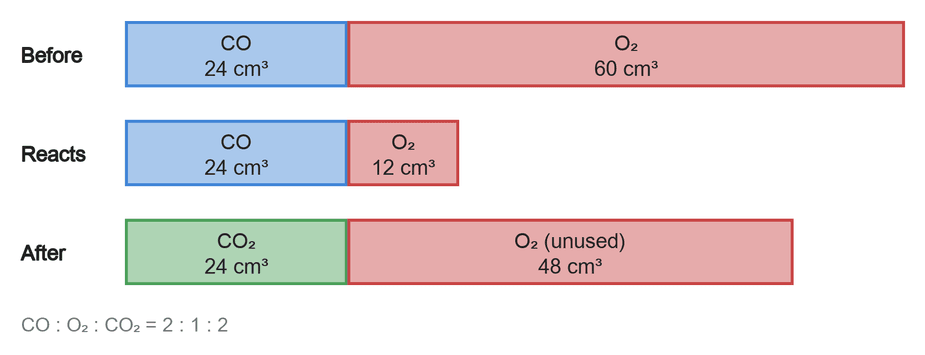
So CO : O₂ : CO₂ = 2 : 1 : 2 by volume.
Step 5 — (b)(i) Oxygen used up.
Each 2 volumes of CO use 1 volume of oxygen.
oxygen used=24×21 cm3=12 cm3
Oxygen is in excess, and 60 − 12 = 48 cm³ of it is left over.
Step 6 — (b)(ii) Carbon dioxide formed.
Each volume of CO gives one volume of CO₂.
CO2 formed=24×22 cm3=24 cm3
Watch out: In (a) the 2 in '2CO' doubles the moles: 0.25 mole of carbon gives 0.5 mole of CO.
Therefore, (a) 11.2 litres of carbon monoxide at S.T.P. can be obtained; (b)(i) 12 cm³ of oxygen is used up and (ii) 24 cm³ of carbon dioxide is formed.
